The four ukulele strings in standard tuning are G, C, E and A, from the string nearest your face to the one nearest the floor. With octave numbers that is G4, C4, E4 and A4, often remembered with the jingle “My dog has fleas” (Ukulele tuning). The surprise for beginners: the G string is not the lowest note. It is tuned higher than C and E, which gives the ukulele its bright sound. It is the usual tuning on soprano, concert and tenor ukuleles. Baritone ukuleles use D G B E.
Ukulele string notes chart
| String | Note | Frequency |
|---|---|---|
| 4 (nearest your face) | G4 (high G) | 392.00 Hz |
| 3 | C4 (middle C) | 261.63 Hz |
| 2 | E4 | 329.63 Hz |
| 1 (nearest the floor) | A4 | 440.00 Hz |
The frequencies are for A4 = 440 Hz, the ISO 16 standard tuning pitch, in equal temperament. The table of piano key frequencies lists G4 as 391.9954 Hz, C4 as 261.6256 Hz and E4 as 329.6276 Hz. The A string is the same note as the standard tuning pitch: exactly 440 Hz.
Ukulele string order: why G is high
On most instruments the strings go from low to high. The ukulele does not. Its tuning is re-entrant: the 4th string jumps back up. Wikipedia describes the G string as an octave above where you would expect, which suits close-harmony chords. In pitch order, from lowest to highest, the strings are C, E, G, A.
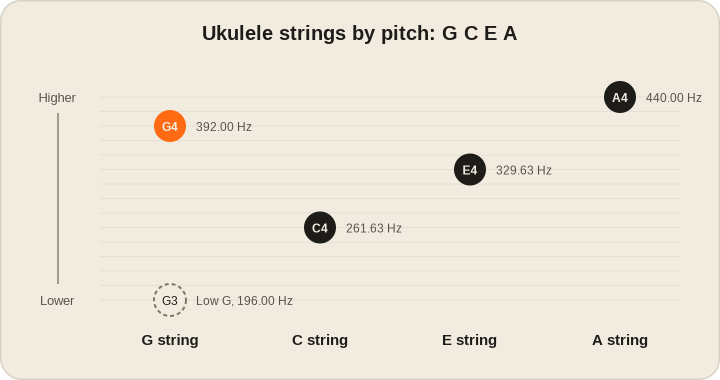
The string numbers can confuse you too, because lessons do not all count the same way. Some count from the floor, as in the table above: the 1st string is A and the 4th is G, so the lowest note is on the 3rd string. Ukulele Underground’s first lesson counts from the top instead, so its 3rd string is E. When a lesson says “3rd string”, look at the note name it gives to know which way it counts.
High G or low G
Low G (G3, 196.00 Hz) tunes the 4th string an octave down. Then the strings go in pitch order: G, C, E, A, from low to high. Wikipedia says low G is rare on soprano ukuleles and more common on larger ones, especially tenors. It also notes that low G tuning matches the top four strings of a guitar with a capo at the 5th fret.
Most ukuleles come with high G. If you are not sure which you have, the ukulele tuner page explains how to tell from the thickness of the 4th string. The ukulele tuner has a setting for each.
Notes on every fret
Each fret raises a string by one semitone, and the 12th fret is the open note one octave up (Fret). The chart shows standard G C E A tuning. For low G the note names are the same, only one octave lower on the 4th string.
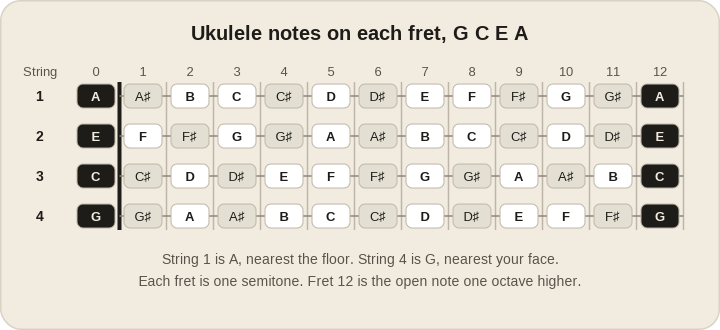
A first look at how the chart is used: the C major chord is one finger on the 3rd fret of the A string. The chart shows that note is C, so with the open G, C and E strings you play the notes G, C, E and C: the notes of a C major chord. The ukulele chords chart shows the fingers for every chord and plays it.
How to tune a ukulele for beginners
Use a tuner until you can hear the notes yourself. Ukulele Underground gives the same advice to beginners (Ukulele Underground).
- Open the ukulele tuner and allow the microphone.
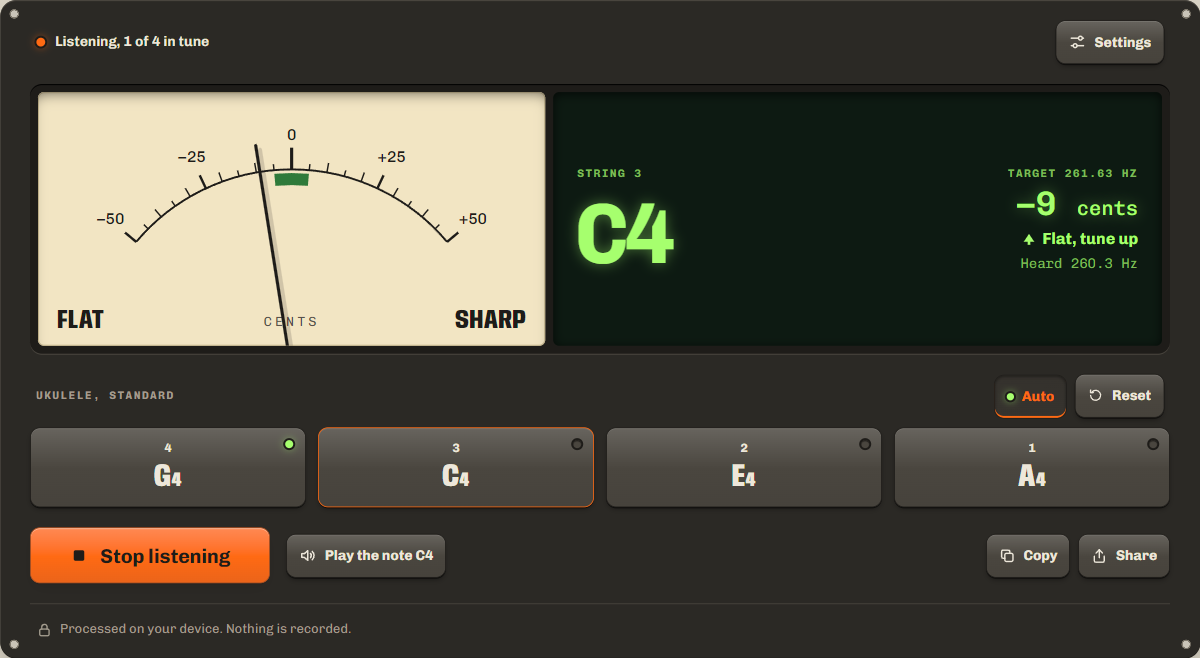
- Pluck the G string and let it ring. The tuner shows the note and a needle.
- If the tuner says the string is flat (too low), tighten it. If it says sharp (too high), loosen it a little below the note, then come back up to it.
- Tune C, E and A the same way.
- Check all four again.
Two things are normal on a new ukulele. Ukulele Underground notes that a new ukulele often comes “slacked down”, tuned low for shipping, so the first tuning takes a lot of turns. New strings also take time to settle, so check the tuning often in the first days.
To tune by ear without a tuner, tune one string to a reference and match the others to it with frets. The tuner page lists the frets for tuning the strings to each other.
Other ukulele tunings
- Baritone: D3 G3 B3 E4, the same as the four thinnest strings of a guitar.
- D tuning: A4 D4 F♯4 B4, one whole step above standard. Wikipedia says it was standard in early 20th century Hawaiian music.
- Low G: G3 C4 E4 A4, as above.
If you also play guitar, see guitar string notes: the ukulele’s C E A strings match the guitar’s G B E strings with a capo at the 5th fret.