Violin Tuner: Tune Your Violin Online
A free online violin tuner for practice and lessons. Tap Start, allow the microphone, then bow or pluck one string.
Ready
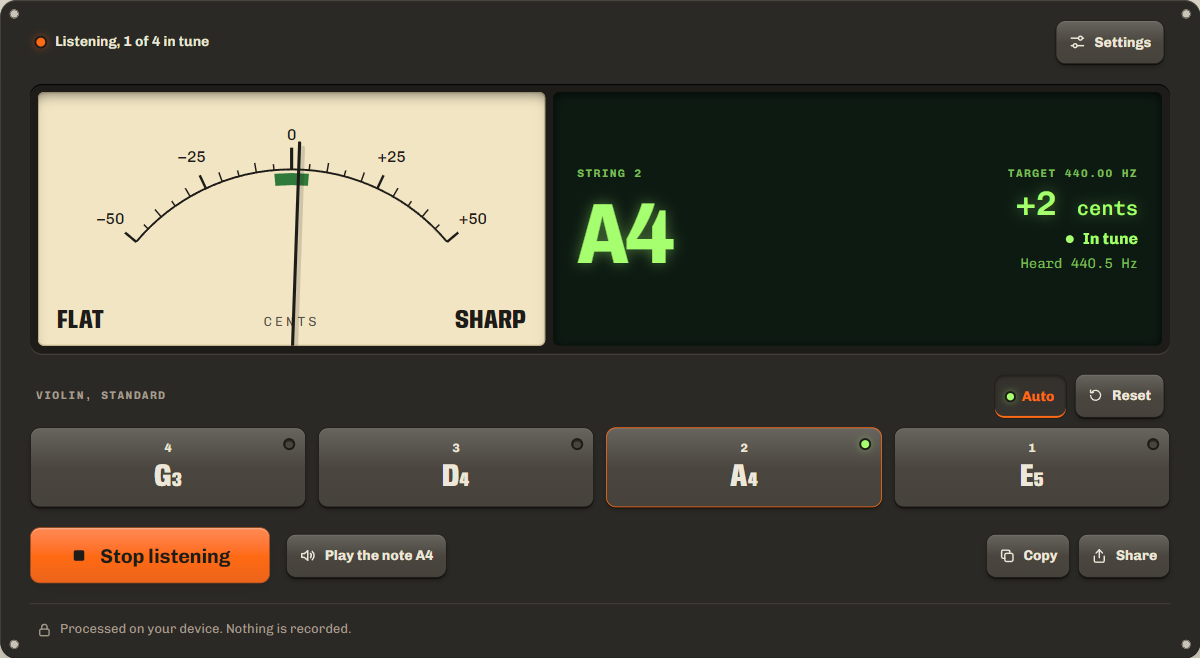
Tap Start, then bow or pluck a string.
Settings
Processed on your device. Nothing is recorded.
How to tune a violin with the tuner
- Step 1Tap Start listeningYour browser asks to use the microphone. Choose Allow. If your orchestra tunes to 442, set A4 reference under Settings.
- Step 2Bow one open stringUse a long, even stroke, or pluck it. Auto finds the string, or tap G, D, A or E to lock the tuner to it.
- Step 3Turn the fine tuner until the needle is greenLeft of center is flat: turn the fine tuner clockwise. Right of center is sharp: turn it back. When all four lamps are lit, the violin is in tune.
Violin strings: G D A E
A violin is tuned in fifths: G3, D4, A4 and E5, from the thickest string to the thinnest. Players number them from the top: E is string 1 and G is string 4. The table gives the frequency of each open string at A = 440 Hz and at 442 Hz.
| String | Note | A = 440 | A = 442 |
|---|---|---|---|
| 1 | E5 | 659.26 Hz | 662.25 Hz |
| 2 | A4 | 440.00 Hz | 442.00 Hz |
| 3 | D4 | 293.66 Hz | 295.00 Hz |
| 4 | G3 | 196.00 Hz | 196.89 Hz |
Tune the A first, then the others
Violinists tune the A string first, because the other strings are tuned to it. Then tune D, G and E. Tap the A key to lock the tuner to it, or leave it on Auto.
Teachers also tune by ear: bow two strings together and turn until the fifth sounds smooth, with no beat. A pure fifth is about 2 cents wider than the tuner's note. From the A, that puts D and E about 2 cents off and G about 4, which is still inside the green zone. To hear the A by ear, tap Play the note, or play a steady A 440 on the tone generator.
Fine tuners or pegs
Use the fine tuners for small changes and the pegs only for big ones. Fine tuners are the small screws on the tailpiece. Many violins have one on the E string only, and student violins often have four. Turn clockwise to go up, counterclockwise to go down.
If a string is more than about a quarter tone off, the needle sits at the end of the scale and the readout says what it hears. Then use the peg: push it in gently as you turn so it holds, and finish with the fine tuner. If a fine tuner is screwed all the way in, turn it back to the middle and retune with the peg.
Why violin strings go out of tune
Strings go out of tune because the wood, the pegs and the strings move with temperature and humidity. A violin taken from a cold car into a warm room changes pitch within minutes. Pegs can slip, and the string then drops in pitch. New strings stretch for a few days. Tune at the start of every practice, and again after the violin has warmed up.
A = 440 or 442 Hz
A = 440 Hz is the standard, and the tuner starts there. Many orchestras tune a little higher, often to 442 Hz, for a brighter sound. If yours does, open Settings and choose 442 under A4 reference. All four strings move with it, and the tuner keeps the setting in this browser.
Is my audio recorded?
No. Your browser analyzes the sound on your device and then discards it. Nothing is recorded, uploaded or stored, and the microphone turns off when you tap Stop or leave the page. Only your A4 reference and tuning are saved, in this browser. If the tuner hears nothing, check that the browser may use the microphone. The privacy policy has the details.
FAQ
What are the violin strings, in order?
G D A E, from the lowest (string 4, the thickest) to the highest (string 1, the thinnest): G3, D4, A4, E5. Each string is a fifth above the one before.
Can I tune my violin with my phone?
Yes. Open this page, tap Start listening and put the phone on the music stand or a table near you. Bow one open string at a time. It works in Safari and Chrome on iPhone and Android, and on a computer with a microphone.
Does it work for viola or cello?
The tuner has no viola or cello setting. Both are tuned C G D A: the viola from C3, the cello from C2. Use the pitch detector, which names any note and shows how many cents off it is.
Should I tune to 440 or 442?
Use 440 Hz unless your orchestra or teacher says otherwise. Many orchestras tune a little higher, often to 442. Set it under Settings, A4 reference, and every string follows.
How close is in tune?
The needle turns green within 5 cents of the note. A string counts as tuned when it stays green for about a second, and its lamp lights.
Related tools
All audio toolsCheck any note you play, or tune a viola or cello.
Tune a guitar in standard, Drop D or an open tuning.
Play a steady A 440 to tune by ear.
Maintained by NabeelUpdated Oct 20, 2026.