Online Decibel Meter
Measure how loud it is around you in dB, using your phone or computer microphone.
Ready
Tap Start to measure the sound level around you.
- Min
- No reading yet
- Average (Leq)
- No reading yet
- Max
- No reading yet
- Time
- No reading yet
Settings
Readings are estimates until you calibrate. Put the microphone next to a sound level meter, play a steady sound, type what the meter shows, then tap Match.
History
Measurements you save appear here: average, max and time. They stay on this device.
Processed on your device. Nothing is recorded.
How to measure decibels with your phone or computer
- Step 1Tap Start listeningYour browser asks to use the microphone. Choose Allow. The meter hears sound only while it is on.
- Step 2Point the microphone at the soundHold the phone at arm's length or set it down. Keep your hand off the microphone.
- Step 3Read the levelThe big number is the level now. The thin marker on the bar holds the highest level of the last 3 seconds. Min, average (Leq) and max cover the time since Start or Reset.
- Step 4Check the safe timeFrom 70 dB(A), the meter turns your average into the NIOSH time limit per day. Copy, share or save the result when you are done.
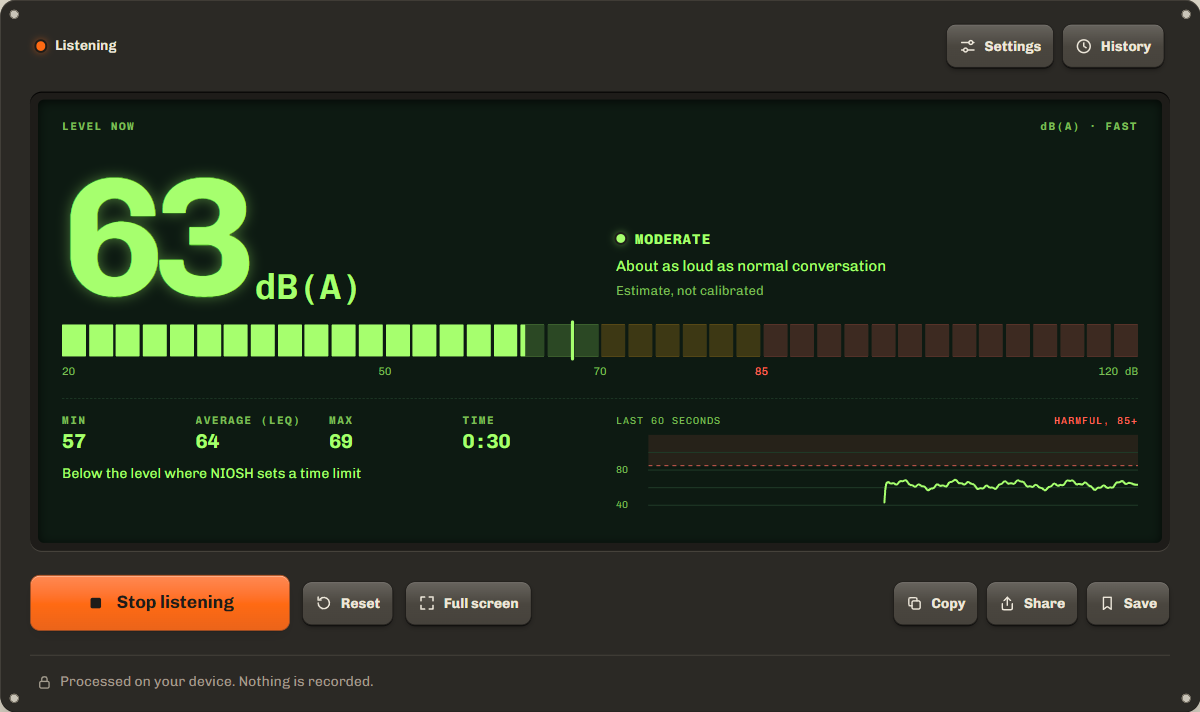
It shows dB(A), the unit that hearing limits use. Under the number, the meter compares the level with a common sound from the chart below. Weighting, response, calibration and Keep screen on are in Settings. For a long measurement, leave Keep screen on switched on, so the phone does not lock and stop the meter. Nothing is recorded, as the privacy policy explains.
How accurate is an online decibel meter?
It gives a good estimate, not a certified reading. The browser gets the microphone's signal but not its sensitivity, so the meter starts from a value for a typical phone. Two devices in the same room can read several decibels apart.
The meter turns off the browser's voice processing (echo cancellation, noise suppression and automatic gain control), because it changes the level. Some phones still process the sound, and deep bass or very loud sound can read too low.
To get closer, calibrate once. Put your phone next to a sound level meter and play a steady sound, such as a fan or pink noise from the speaker test. Open Settings, type the meter's reading into Match a known level and tap Match. Without a meter, a rough check is normal conversation, whichWHO puts at about 60 dB.
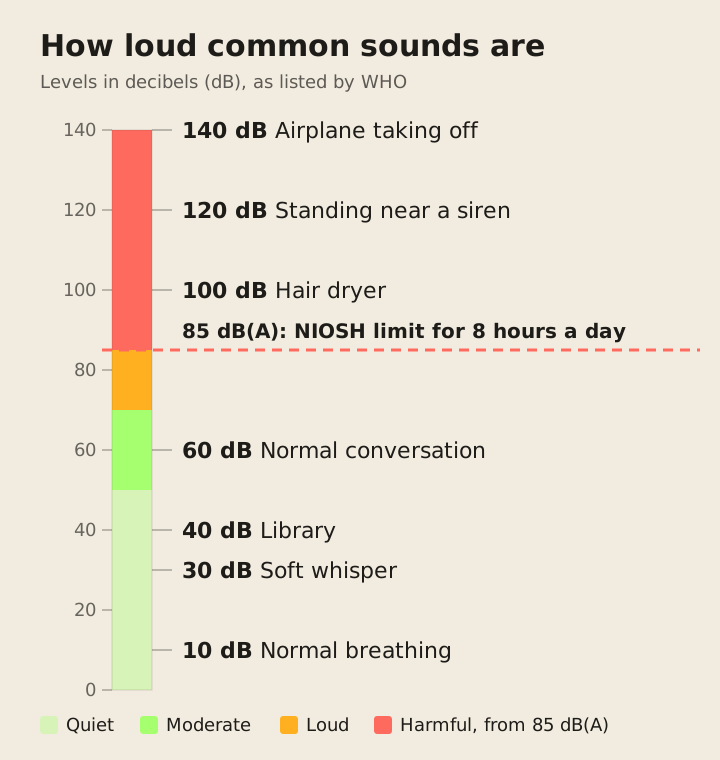
Decibel chart: how loud common sounds are
Decibels are logarithmic: a sound 10 dB louder is ten times more intense. These levels come from the WHO guide to safe listening.
| Sound | Level | On this meter |
|---|---|---|
| Normal breathing | 10 dB | Quiet |
| Soft whisper | 30 dB | Quiet |
| Library | 40 dB | Quiet |
| Normal conversation | 60 dB | Moderate |
| Doorbell | 80 dB | Loud |
| Heavy traffic, inside a car | 85 dB | Harmful |
| Shouted conversation | 90 dB | Harmful |
| Motorcycle | 95 dB | Harmful |
| Hair dryer | 100 dB | Harmful |
| Standing near a siren | 120 dB | Harmful |
| Jackhammer | 130 dB | Harmful |
| Airplane taking off | 140 dB | Harmful |
Embed this chart on your site
Copy this code. The chart links back here, so your readers can try the tool.
How loud is too loud?
NIOSH recommends a limit of 85 dBA, averaged over an 8-hour workday. For each 3 dB more, the safe time halves.
| Level | Safe time per day |
|---|---|
| 85 dBA | 8 hours |
| 88 dBA | 4 hours |
| 91 dBA | 2 hours |
| 94 dBA | 1 hour |
| 97 dBA | 30 minutes |
| 100 dBA | 15 minutes |
NIOSH also gives a test without a meter: at 85 dBA you often have to raise your voice to be heard by someone 3 feet (1 m) away, and at 95 dBA you likely have to shout. For music,WHO says 80 dB is safe for up to 40 hours a week, but 90 dB for only four hours a week.
From an average of 70 dB(A), the meter uses this rule to show the NIOSH limit for your average (Leq), for example "about 2 h 30 min a day" at 90 dB(A). Like every reading, it is an estimate until you calibrate. The red Harmful zone starts at 85 dB(A). If you see it often, take breaks or wear hearing protection.
dB vs dBA vs dBC
dB is the unit. The letter is the frequency weighting: how much low, middle and high sounds count. The IEC 61672 standard sets the curves.
- dB(A)Follows how the ear hears moderate sounds, so it cuts deep bass: about 19 dB at 100 Hz. Hearing limits use it.
- dB(C)Almost flat: less than 1 dB at 100 Hz. It counts the bass that A-weighting leaves out, so it suits music and engines.
- dB(Z)Flat from 10 Hz to 20 kHz: every frequency counts the same.
With a lot of bass, dB(C) and dB(Z) read higher than dB(A). On this meter the A and C curves follow IEC 61672 to within 0.1 dB from 10 Hz to 4 kHz.
Online meter vs phone app vs a real sound level meter
All three measure sound level. They differ in how sure you can be of the number.
| Feature | Online meter | Phone app | Sound level meter |
|---|---|---|---|
| Setup | None: it opens in your browser | An app download | A separate device |
| Accuracy | An estimate until you calibrate | NIOSH iPhone app: within 2 dBA | Class 1 or 2 under IEC 61672 |
| Best for | Quick checks | Regular checks on one phone | Workplace noise |
The NIOSH Sound Level Meter app is free but runs only on iOS. With a calibrated external microphone it meets IEC 61672 type 2. For workplace noise, use a sound level meter.
FAQ
Is 70 dB loud?
It is louder than normal conversation (about 60 dB) and quieter than heavy traffic inside a car (about 85 dB). WHO says sound levels below 80 dB are unlikely to cause hearing damage.
Can my phone measure decibels accurately?
It gives a useful estimate. Without calibration a phone can be several decibels off, because microphones differ. NIOSH says its own iPhone app is accurate to within 2 dBA. For the best result, calibrate this meter against a sound level meter.
Why are my readings low?
A hand or a case may cover the microphone. A Bluetooth headset microphone, or a phone that still processes the sound, can also read low. To fix it, calibrate the meter or raise the offset.
Is my audio recorded?
No. Your browser analyzes the sound on your device and then discards it. Nothing is recorded or uploaded. Only your calibration offset, and the measurements you choose to save, are kept in this browser.
What does Leq mean?
Leq is the energy average since Start or Reset: the steady level with the same sound energy. Loud moments count more than quiet ones. The NIOSH limit of 85 dBA over 8 hours is this kind of average.
Related tools
All audio toolsTest left, right and bass on your speakers.
Play a steady tone at any frequency.
Find the note you sing or play.
Maintained by NabeelUpdated Oct 20, 2026.