Bracket Maker
Make a tournament bracket from a list of names, then run it: tap the winners, enter scores, print it or share a link.
Enter at least 2 players
2 to 64 names. In seeded mode, put the best first: line 1 is seed 1.
Seed 1 plays the lowest seed (1 v 16, 8 v 9), so the top two can only meet in the final.
0 games
Add at least 2 names
Saved brackets
Brackets you save appear here. They stay on this device.
Made on your device. Brackets you save stay in this browser; a share link carries the whole bracket.
How to make a bracket
Paste or type the players or teams, one per line, and press Make bracket. The bracket draws at once, with byes in place for any count that is not a power of two. On a phone, swipe the bracket sideways to see the later rounds.
- Step 1Paste the namesOne player or team per line. For seeded brackets, put the strongest first: line 1 is seed 1.
- Step 2Pick a formatSingle elimination, double elimination or round robin, then the seeding: as entered, random or seeded.
- Step 3Tap the winnersTap a name to send it to the next round, or type the score. Undo takes back the last change.
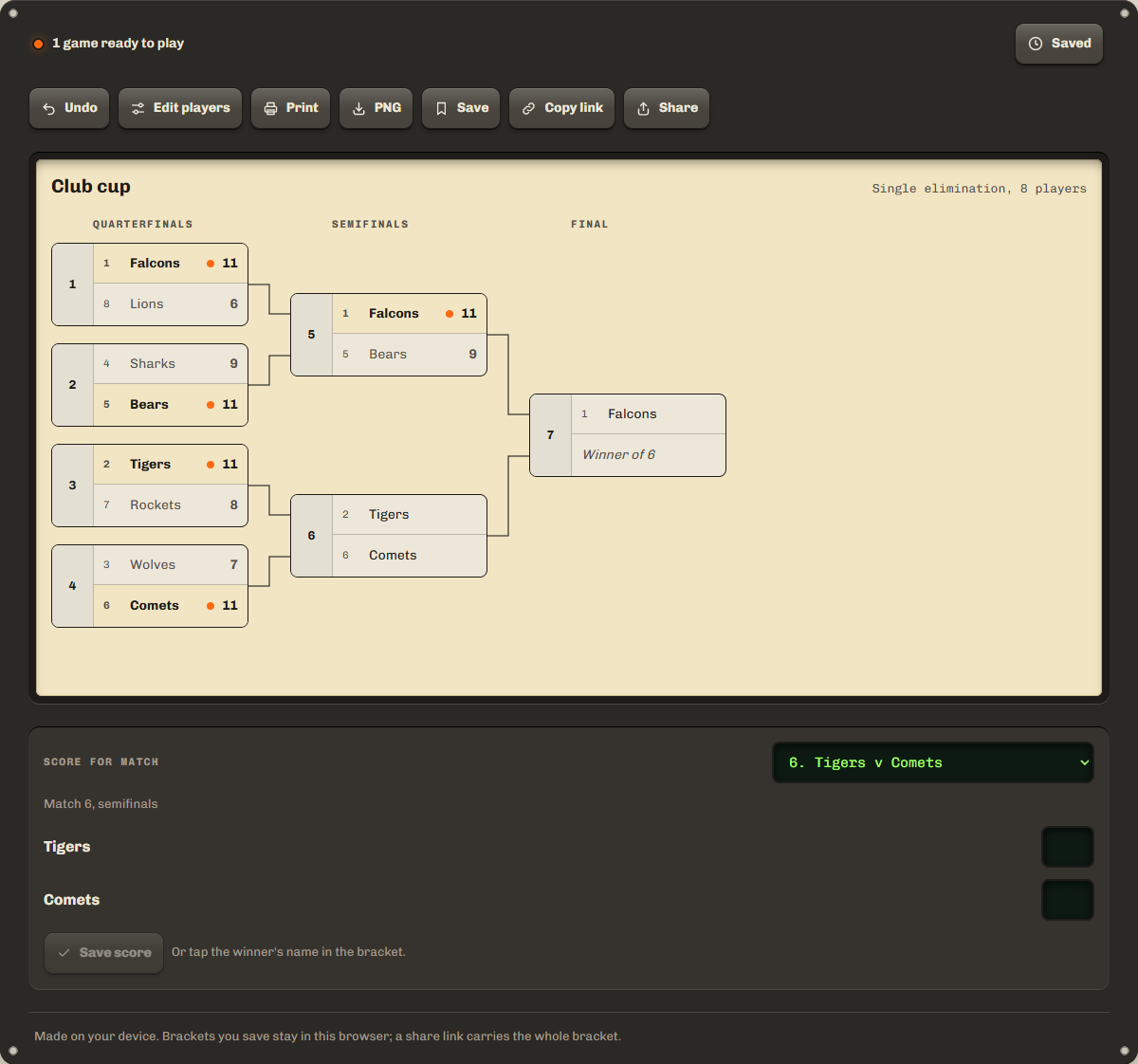
Each match has a number on its left. Tap that number to enter the score for that match, or use the score box under the bracket, which always offers the next game to play. The winner moves on by itself, and in double elimination the loser drops into the losers bracket. Print prints the bracket only, fitted to a landscape page, and PNG saves it as an image.
Single vs double elimination vs round robin
- Single elimination. Lose once and you are out. The quickest format: the fewest games and the fewest rounds, so it suits one evening or a big field. One bad game ends a strong player's day.
- Double elimination. Lose once and you drop into the losers bracket; lose twice and you are out. The losers bracket champion meets the winners bracket champion in the grand final. It takes about twice as many games, and it is fairer to a strong player who has one bad game.
- Round robin. Everyone plays everyone once and a table ranks them by wins, then by point differential. It is the fairest format and gives everyone the same number of games, but the games add up fast as the field grows.
| Players | Single elimination | Double elimination | Round robin |
|---|---|---|---|
| 4 | 3 | 6 or 7 | 6 |
| 6 | 5 | 10 or 11 | 15 |
| 8 | 7 | 14 or 15 | 28 |
| 12 | 11 | 22 or 23 | 66 |
| 16 | 15 | 30 or 31 | 120 |
| 24 | 23 | 46 or 47 | 276 |
| 32 | 31 | 62 or 63 | 496 |
The double elimination count is higher by one when the bracket reset final is played. For doubles with changing partners, such as a pickleball social, use the pickleball round robin generator instead.
How byes and seeding work
A knockout bracket halves the field every round, so it needs 2, 4, 8, 16, 32 or 64 places. When the count is in between, the empty places are byes: the player drawn against a bye goes straight to round 2. The bracket maker gives the byes to the top seeds, the usual rule, and hides those empty games so the bracket stays clean.
| Players | Bracket size | Byes | Who gets them | Play in round 1 |
|---|---|---|---|---|
| 5 | 8 | 3 | seeds 1 to 3 | 2 |
| 6 | 8 | 2 | seeds 1 and 2 | 4 |
| 10 | 16 | 6 | seeds 1 to 6 | 4 |
| 12 | 16 | 4 | seeds 1 to 4 | 8 |
| 20 | 32 | 12 | seeds 1 to 12 | 8 |
Seeding decides who plays whom. Seeded places the list the standard way: in a 16 bracket, 1 plays 16, 8 plays 9, 4 plays 13 and so on, so seeds 1 and 2 are in different halves and can only meet in the final. As entered keeps your order (line 1 against line 2, line 3 against line 4), which is right when you have already drawn the games. Random shuffles the list once and then works like as entered.
In double elimination, players who lose in the winners bracket drop into the losers bracket in reversed order every other round, so they do not meet the player they just played again straight away.
FAQ
How many games are in a tournament?
Single elimination has one game fewer than the number of players, because every game knocks out one player and all but the champion go out. Double elimination has twice the players minus 2, plus one more if the bracket reset final is played. A round robin has n times (n minus 1) divided by 2 games: 28 for 8 players, 120 for 16.
Who gets a bye?
The top seeds. A bracket needs a power of two (4, 8, 16, 32, 64), so with 6 players the bracket has 8 places and 2 byes. With seeded or as entered order, the first names on your list get them, and the byes are spread over the bracket so two bye players never meet in round 2 unless the count forces it.
What is a bracket reset?
In double elimination, the winners bracket champion has not lost yet, and the losers bracket champion has lost once. If the losers bracket champion wins the grand final, both have one loss, so a second final decides it. That second game is the bracket reset. Turn it off in the settings if your event plays one final only.
Can I change a result?
Yes. Tap the other name in a played match, or pick the match in the score box and save a new score. If the winner changes, the later games that depended on it are cleared, because they may now have other players. Undo takes back the last change, up to 50 steps.
How do I share or save the bracket?
Share or Copy link makes a link that holds the whole bracket, names and results, compressed in the part after the # sign. Nothing is uploaded: whoever opens the link gets their own copy. Save keeps the bracket in this browser, and the last bracket opens again on your next visit.
How many players can a bracket have?
Up to 64 for single and double elimination, and up to 32 for a round robin, which already means 496 games.
Related tools
All game toolsDoubles rounds with rotating partners, courts and sit-outs.
Plan pixel circles, ovals and spheres block by block.
Find the best moves for your three blocks.
Maintained by NabeelUpdated Nov 22, 2026.