Vocal Range Test
Sing your lowest note, then your highest. See your range in notes and octaves, and the voice type it is closest to.
Ready
- 1. Lowest note
- 2. Highest note
- 3. Your range
--
Tap Start the test and allow the microphone. Then sing your lowest comfortable note on an open "ah".
Settings
Raise it if quiet low notes do not count. Lower it in a noisy room.
Processed on your device. Nothing is recorded.
How to test your vocal range
- Step 1Warm up, then tap StartHum or sing gently for a minute first. Tap Start the test and allow the microphone. Use a quiet room.
- Step 2Sing your lowest noteSing an open "ah" and slide down to the lowest note you can sing clearly. Hold it. Tap That is my lowest.
- Step 3Sing your highest noteSlide up slowly to the highest note that still feels comfortable, and hold it. Tap That is my highest.
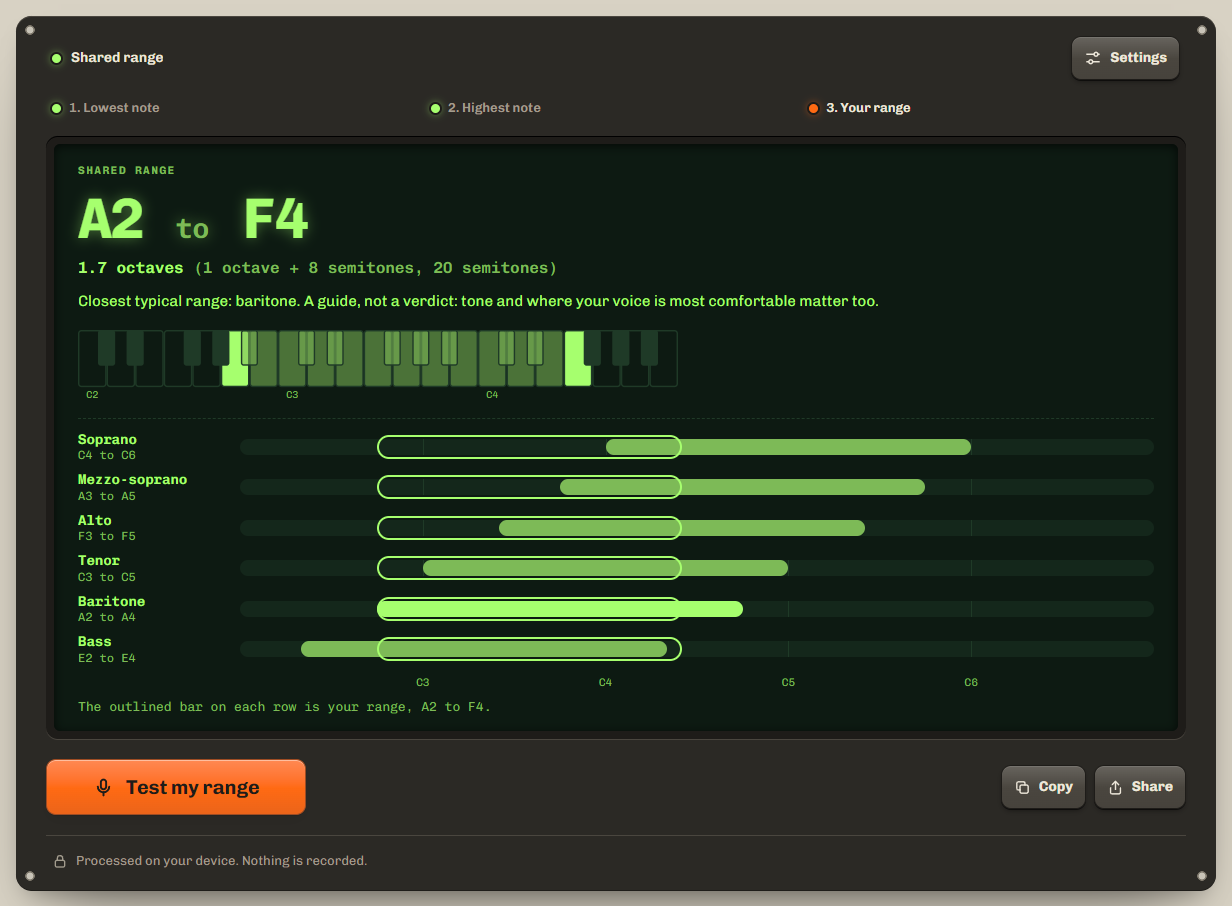
- Step 4Read your rangeSee your range in notes and octaves, and the typical voice type it is closest to. Copy or share it.
A note counts only after you hold it clearly for about a third of a second, so a crack, a breath or a noise does not stretch your range. Do not push or strain: the test is about the notes you can sing well, not the ones you can just reach. To check a single note instead, use the pitch detector.
Vocal range test online, free
This vocal range test is free, with no sign-up and nothing to install. It runs in your browser on a phone, tablet or computer, and uses the same pitch engine as our pitch detector. It counts notes from C2 to C7: lower than that is mostly mains hum, higher mostly whistles and squeaks.
For the best reading, sit close to the microphone in a quiet room, turn off music and fans, and sing one note at a time. Headphones are not needed, because the test plays no sound.
Female and male vocal ranges
Classical singing names three typical female voice types and three typical male ones. The ranges below are the typical ranges listed in the Wikipedia article on voice type, two octaves each. They are approximate conventions, not limits: many singers go past them, and many do not reach both ends.
Typical ranges of the six voice types, C2 to C7
- SopranoC4 to C6
- Mezzo-sopranoA3 to A5
- AltoF3 to F5
- TenorC3 to C5
- BaritoneA2 to A4
- BassE2 to E4
| Voice type | Typical range |
|---|---|
| Soprano | C4 to C6 |
| Mezzo-soprano | A3 to A5 |
| Alto | F3 to F5 |
| Voice type | Typical range |
|---|---|
| Tenor | C3 to C5 |
| Baritone | A2 to A4 |
| Bass | E2 to E4 |
Middle C is C4. The typical soprano range starts on middle C and the typical tenor range ends one octave above it. Female and male here follow the classical names; your voice type is about your voice, not your gender.
What's my voice type?
After the test, the tool shows the typical range that matches yours best. If your range is E2 to G4, for example, it is closest to the bass range, and it also overlaps the baritone range a lot. Treat it as a first guide. Teachers classify a voice by its range, its tessitura (where it is most comfortable for most of a song), its tone and the notes where it changes register. Two singers with the same range can be different voice types.
A range under one octave fits almost any voice type, so the tool shows a voice type only from one octave up. If the result surprises you, warm up and test again. A voice teacher or choir director can tell you more in a few minutes of listening.
Vocal range test app vs online test
A vocal range test app and an online test do the same job: they read the pitch you sing through the microphone. An online test needs nothing installed and no account, and works the same on a phone and a computer. An app can add lessons, exercises and progress tracking, often for a fee.
For a quick, free check, the online test is enough. The reading depends more on the microphone and the room than on the app: a quiet room and a phone held about a hand's width from your mouth give a clean result.
How to extend your vocal range
Range grows slowly, with steady practice, and never by forcing. Warm up first with humming, lip trills and gentle slides (sirens) from low to high and back. Practise a few notes past the edges of your comfortable range, softly, and stop as soon as your throat feels tight.
Drink water, rest your voice after long sessions and do not sing through pain or hoarseness. Test your range again every few weeks to see progress. A singing teacher can show you safe exercises for your voice; if hoarseness lasts more than a couple of weeks, see a doctor.
FAQ
What is a good vocal range?
There is no good or bad range. The typical ranges of the classical voice types are about two octaves each, and many singers have less. Training can widen a range, but tone and control matter more than size.
Why does my range change from day to day?
Your voice changes with warm up, rest, time of day, a cold and how much you sang the day before. Low notes are often lower in the morning. Test a few times and use the range you get when your voice is warm and rested.
Should I count falsetto and whistle notes?
Count the notes you can sing clearly and use in a song. The test counts any clear note you hold, falsetto included, so you decide. For a voice type, the comfortable range matters most.
Is my voice recorded?
No. Your browser reads the pitch from the microphone and discards the sound at once. Nothing is recorded, uploaded or stored. The microphone turns off when you stop or leave the page.
Related tools
All audio toolsSing or play one note and see what note it is and how in tune you are.
Play a reference note to warm up or to sing along with.
Check that your microphone works before you start.
Maintained by NabeelUpdated Oct 22, 2026.