Subwoofer Test
Play low bass tones from 20 to 120 Hz, sweep through them to find rattles, and set your subwoofer's phase from your seat.
Turn the volume down, then tap Play
Deep bass. Where a subwoofer does its main work. It should sound clean, with no buzz or rattle.
Plays on all your speakers, so with a subwoofer set up the bass goes to it. Start with the volume low: deep bass can be much louder than it sounds on a phone. Nothing is recorded.
How to test a subwoofer
The test plays pure sine tones through your normal audio output. On a stereo amplifier or receiver with a subwoofer, the bass is sent to it the way it is for music and films. With a receiver set to use a subwoofer, the lowest notes go to the subwoofer, so these tones test it directly.
- Step 1Turn the volume downSet the volume slider and your amplifier low. Deep bass can be much louder in the room than you expect.
- Step 2Tap PlayStart with 40 Hz, then step lower and higher. Each tone plays until you tap Stop.
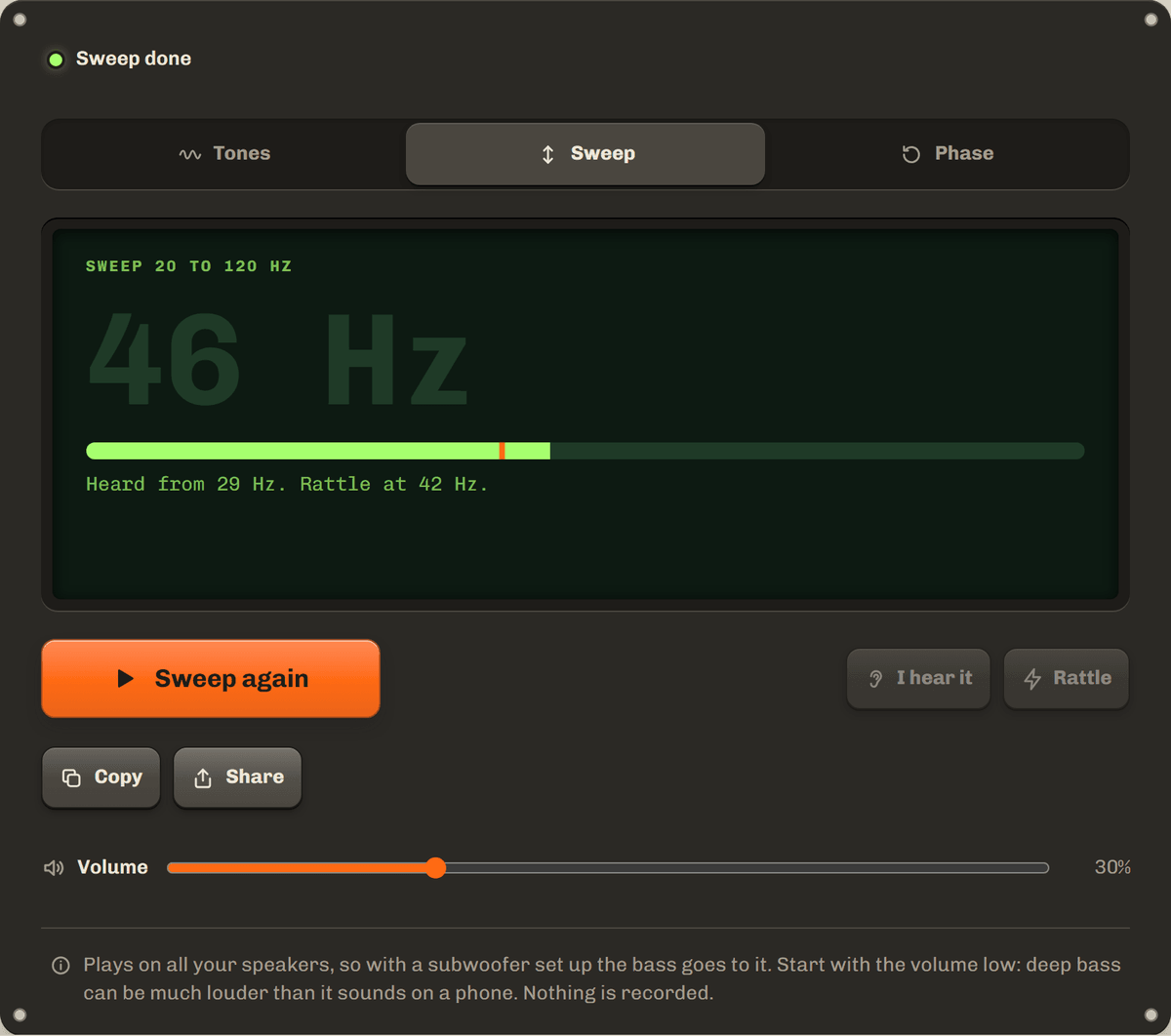
- Step 3Run the sweepPick Sweep. It rises from 20 to 120 Hz in 30 seconds. Tap I hear it when the bass starts, and Rattle when something buzzes.
- Step 4Check the phasePick Phase, play the tone at your crossover and flip the subwoofer's phase switch. Keep the louder setting.
Sit where you usually listen. Bass changes a lot from one place in a room to another, so a tone that booms in one seat can be faint a metre away. That is the room, not the subwoofer.
What each tone shows
| Range | Name | What to listen for |
|---|---|---|
| 20 to 30 Hz | Lowest bass | The bottom of hearing. Many subwoofers fade here, and you may feel it more than hear it. |
| 30 to 60 Hz | Deep bass | Where a subwoofer does its main work. It should sound clean, with no buzz or rattle. |
| 60 to 90 Hz | Mid bass | Around the usual crossover. The subwoofer and the main speakers share this part. |
| 90 to 120 Hz | Upper bass | Most main speakers play this too, so the subwoofer is only part of what you hear. |
Step down one tone at a time. At some point the tone gets much quieter or turns into a faint hum: that is where your system stops playing deep bass at this volume. A tone that sounds louder than its neighbours points at a room resonance, which is common in small rooms and not a fault.
Finding rattles and buzzing
Deep bass makes loose things vibrate: a picture frame, a shelf, a window, a cable against the cabinet, or a part inside the subwoofer. Each one buzzes at its own frequency, so a slow sweep finds them. Start the sweep, tap Rattle when you hear a buzz, then go to Tones and hold that frequency while you walk around the room to find it.
If the buzz stays when you hold the subwoofer's cabinet still and nothing nearby moves, turn the volume down and try again. A buzz that remains at a low volume, from the driver itself, is a reason to contact the maker.
Subwoofer phase and polarity
Around the crossover, the subwoofer and the main speakers play the same notes. If they move out of step, they partly cancel each other and the bass gets thinner at your seat. The phase switch (0 or 180) or phase knob on the subwoofer moves it back in step.
Harman's advice on setting subwoofer phase: sit in your main listening position, have someone switch the phase between 0 and 180 degrees, and use the setting that sounds louder at your seat. Harman notes that phase is usually left at 0, and that if you hear no difference, the placement has no problem. Phase mode plays a steady tone at the crossover you pick, which makes the difference easier to hear than music.
The In phase and Out of phase keys check the two main speakers, not the subwoofer: Out of phase flips the right channel. The bass should get weaker. If it gets stronger, one speaker's wires are reversed at the speaker or the amplifier. The speaker test has the same check with a midrange tone.
Crossover and placement
The crossover is the frequency below which the subwoofer plays. KEF's subwoofer setup tips note that the THX film standard is 80 Hz and that it often works for music as well, and suggest moving it up or down while you play the same familiar song each time. If a receiver runs the crossover, set it in the receiver and follow its manual for the crossover knob on the subwoofer itself.
For placement, KEF describes the subwoofer crawl: put the subwoofer on your seat for a moment, play music with steady bass, and walk around the room. Where the bass sounds best is where the subwoofer goes. A held tone from this test works too, at a low volume.
Testing a 5.1 or 7.1 system? The surround sound test plays each speaker on its own, and the tone generator plays any single frequency.
FAQ
How do I know if my subwoofer is working?
Play a 40 or 50 Hz tone at a low volume and put your hand on the subwoofer cabinet or stand next to it. A working subwoofer plays the tone and you feel a little movement. If you hear it only from the main speakers, check that the subwoofer is on, that its cable goes to the SUB or LFE output, and that the receiver is set to use a subwoofer.
What is the lowest frequency a subwoofer should play?
It depends on the subwoofer and the room, and makers list it in the specifications. Run the sweep at a low volume and tap I hear it where the bass starts. That is the lowest note your setup plays at that volume, in that seat.
Should the subwoofer phase be 0 or 180?
Use the one that sounds louder at your seat with a tone at the crossover. Harman says phase is usually left at 0 degrees, and that if you hear no difference, the speaker and subwoofer placement has no problem.
What crossover should I set?
KEF notes that the THX film standard is 80 Hz and that it often works for music too. Start there, then move it up or down while you listen to the same song each time.
Why can I not hear the lowest tones on my phone or laptop?
Small speakers cannot move enough air for deep bass, so the lowest tones are faint or silent. That is normal. The test is for a subwoofer or for speakers and headphones that can play low notes.
Can a subwoofer test damage my speakers?
Not at a normal volume. Start low, turn up slowly, and stop if you hear distortion or a hard knocking sound. Low tones at high volume are the hardest work a speaker does.
Related tools
All audio toolsCheck left and right, the full 20 Hz to 20 kHz sweep and stereo phase.
Play each speaker of a 5.1 or 7.1 system, subwoofer included.
Hold any frequency, from 1 Hz up, in four waveforms.
Maintained by NabeelUpdated Nov 19, 2026.