Tango Solver
A free sun and moon puzzle solver. Tap in the grid and the signs, then take one explained hint at a time, check your cells or see the answer.
Ready to solve
Tap a cell to cycle sun, moon, empty. Copy only the symbols the puzzle starts with.
6 symbols and 7 signs on the board.
Board
Solved on your device. Nothing is sent anywhere. Not affiliated with or endorsed by LinkedIn.
How to enter the Tango grid
Copy the grid from the game into the tool, then take as much help as you want. The tool opens with an example made for this site. It works for the daily LinkedIn puzzle and for any 6 by 6 sun and moon grid with = and × signs.
- Step 1Copy the symbolsChoose Puzzle and tap each cell that starts filled: one tap for a sun, two for a moon, three to clear it.
- Step 2Add the signsChoose Signs and tap the line between two cells: one tap for =, two for ×, three to remove it.
- Step 3Add your own cellsAlready part way? Choose My cells and copy the suns and moons you placed, so Check can test them.
- Step 4Hint, Check or SolveHint fills one cell, or a few, and names the rule. Check marks wrong cells. Solve fills the grid.
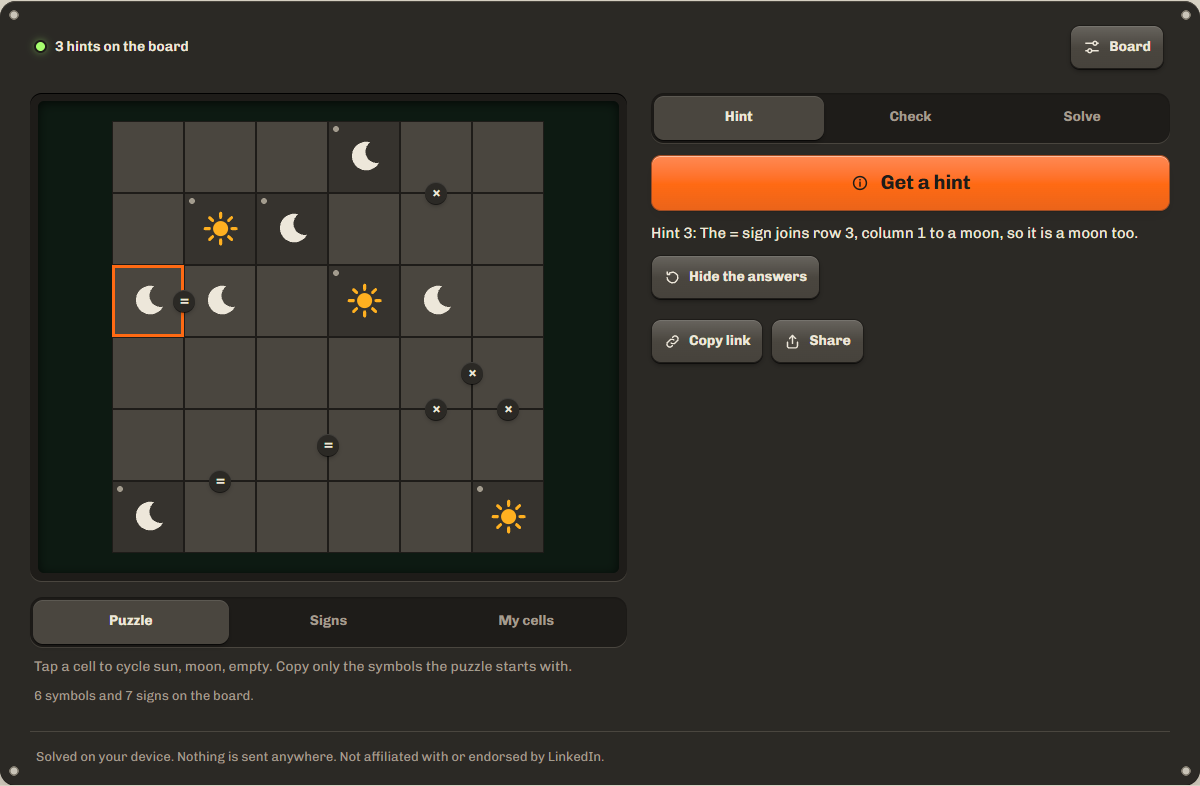
Symbols from the puzzle get a darker cell and a small dot, so you can tell them from the cells you or the hints fill. The grid goes into the address bar as you edit it, so Copy link opens the same grid on another device.
Tango rules
- Fill every cell of the 6 by 6 grid with a sun or a moon.
- Each row and each column has 3 suns and 3 moons.
- No more than 2 suns or 2 moons may sit next to each other, across or down.
- Two cells joined by = hold the same symbol. Two cells joined by × hold opposite symbols.
Each puzzle has one answer, and you can always reach it by reasoning: you never have to guess.
How to solve Tango: the rules that fill cells
Five patterns fill almost every cell. Look for them in this order, in every row and column, and come back to them after each new symbol. These are the same rules the solver names in its hints.
Follow the signs
When one side of a sign is known, the other side follows at once: = means the same symbol, × means the other one. Two empty cells joined by × also tell you something: they hold one sun and one moon between them, which counts toward the 3 of each in their row.
The pair rule
Two of the same symbol side by side means the cells on both ends hold the other symbol, or there would be three in a row. This is the most common move in the game, across and down.
The sandwich rule
Two of the same symbol with one empty cell between them: the middle cell is the other symbol. It is easy to miss, so scan each line for a symbol, a gap and the same symbol again.
Count to three
A row or column can hold only 3 of each. Once it has 3 suns, every empty cell in it is a moon, and the other way round. Count after every move, because a full count often appears in a line you were not looking at.
Think about the whole line
When the simple rules stop, take one row and ask how it could be finished. Here the row has two suns, and the × pair at the end must hold one more, so the row's third sun is spoken for: the empty cell in column 3 is a moon. There are only 14 ways to fill a line with 3 of each and no three in a row, so checking them all is quick for the solver, and a cell that is the same in every way that fits is certain.
If a sun goes here, what breaks?
In the hardest grids, pick an empty cell, imagine a sun there and follow the simple rules for a few moves. If they lead to four moons in a line or three in a row, the cell is a moon. The solver calls this a trial step and tells you which rule broke.
How the hints work
Each tap of Get a hint fills the next cell, or a few cells at once when one rule fills them together, outlined in orange. The sentence under the key names the rule and the cells, such as "Two moons sit side by side in column 4. A third would make three in a row, so the cells on both ends are suns." Hints always use the simplest rule that works.
If the grid has no answer, the tool follows the rules from your board until one breaks and tells you which, so you can find the symbol or sign that was copied wrong. If it has more than one answer, it says so.
Gizmetto is not affiliated with or endorsed by LinkedIn. Queens, Tango and Zip are names of LinkedIn's games. This page solves grids you enter yourself and is not a copy of the game.
FAQ
Does it give the same answer as the game?
Yes, when you copy every symbol and sign. A Tango grid is made to have one answer, and the solver finds every grid that follows the rules. If it finds more than one, it says so, which means a symbol or a sign is missing.
What does it mean when it finds a contradiction?
The board you entered cannot be filled without breaking a rule. The tool follows the rules from your board and tells you the first one that breaks, such as four moons in a column or a × between two suns. Usually one symbol or sign was copied wrong.
Do rows have to be different from each other?
No. Some binary puzzles (Takuzu, Binairo) also ask for every row to be unique. Tango does not, and neither does this solver: only the count, the no-three rule and the signs.
Is the Tango solver free, and does it work on a phone?
Yes to both. There is no sign-up and nothing to install. The solver runs in your browser, and the grid stays on your device.
Related tools
All puzzle solversPlace one queen per row, column and region, step by step.
Find the one path through every cell and every number.
Get a hint or the full answer for a Pips domino board.
Find the spangram and theme words in a Strands grid.
Maintained by NabeelUpdated Nov 22, 2026.