BPM to ms calculator
Type a tempo or tap it, and get the delay time in ms and Hz for every note value, straight, dotted and triplet.
120 BPM
500.0ms
- 1/8
- 250.0 ms
- Dotted 1/8
- 375.0 ms
- Rate
- 2.00 Hz
Any tempo from 20 to 300 BPM, decimals too.
| Note | Straight | Dotted | Triplet |
|---|---|---|---|
| 1/1 (whole) | |||
| 1/2 (half) | |||
| 1/4 | |||
| 1/8 | |||
| 1/16 | |||
| 1/32 |
Milliseconds, with the rate in Hz under each. Tap a cell to copy it.
How to convert BPM to ms
This BPM to ms calculator turns a tempo into note lengths in milliseconds, and the ms to BPM mode does the reverse. The formula is short: one beat lasts 60,000 ÷ BPM milliseconds, because a minute has 60,000 ms. At 120 BPM, one beat is 60,000 ÷ 120 = 500.0 ms.
The beat is counted as a quarter note, as in most pop, rock and dance music. From there, every other note is a simple step:
- Shorter notes halve each time: at 120 BPM a 1/8 note is 250.0 ms, a 1/16 is 125.0 ms and a 1/32 is 62.5 ms.
- Longer notes double: a 1/2 note is 1000.0 ms and a whole note 2000.0 ms.
- A dotted note is 1.5 times as long: a dotted 1/8 at 120 BPM is 375.0 ms.
- A triplet note is 2/3 as long, because three of them fill the time of two: a 1/8 triplet is 166.7 ms.
- For a rate in hertz, such as an LFO or tremolo speed, divide 1000 by the ms: a 500.0 ms beat is 2 Hz.
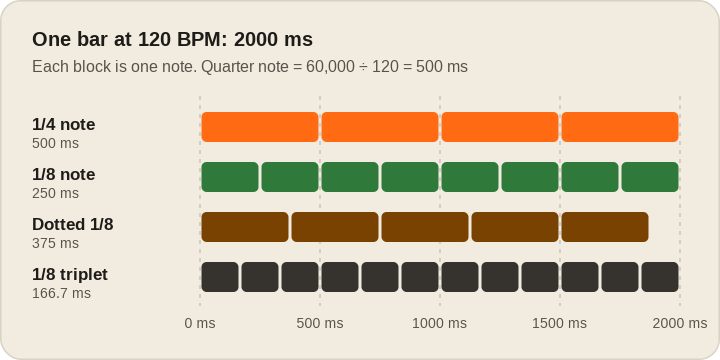
BPM to ms chart
Delay times for 60 to 200 BPM in steps of 10. For any tempo in between, such as 128 or 174 BPM, type it in the calculator above.
| BPM | 1/2 | 1/4 | 1/8 | 1/16 | Dotted 1/4 | Dotted 1/8 | 1/4 triplet | 1/8 triplet |
|---|---|---|---|---|---|---|---|---|
| 60 | 2000.0 | 1000.0 | 500.0 | 250.0 | 1500.0 | 750.0 | 666.7 | 333.3 |
| 70 | 1714.3 | 857.1 | 428.6 | 214.3 | 1285.7 | 642.9 | 571.4 | 285.7 |
| 80 | 1500.0 | 750.0 | 375.0 | 187.5 | 1125.0 | 562.5 | 500.0 | 250.0 |
| 90 | 1333.3 | 666.7 | 333.3 | 166.7 | 1000.0 | 500.0 | 444.4 | 222.2 |
| 100 | 1200.0 | 600.0 | 300.0 | 150.0 | 900.0 | 450.0 | 400.0 | 200.0 |
| 110 | 1090.9 | 545.5 | 272.7 | 136.4 | 818.2 | 409.1 | 363.6 | 181.8 |
| 120 | 1000.0 | 500.0 | 250.0 | 125.0 | 750.0 | 375.0 | 333.3 | 166.7 |
| 130 | 923.1 | 461.5 | 230.8 | 115.4 | 692.3 | 346.2 | 307.7 | 153.8 |
| 140 | 857.1 | 428.6 | 214.3 | 107.1 | 642.9 | 321.4 | 285.7 | 142.9 |
| 150 | 800.0 | 400.0 | 200.0 | 100.0 | 600.0 | 300.0 | 266.7 | 133.3 |
| 160 | 750.0 | 375.0 | 187.5 | 93.8 | 562.5 | 281.3 | 250.0 | 125.0 |
| 170 | 705.9 | 352.9 | 176.5 | 88.2 | 529.4 | 264.7 | 235.3 | 117.6 |
| 180 | 666.7 | 333.3 | 166.7 | 83.3 | 500.0 | 250.0 | 222.2 | 111.1 |
| 190 | 631.6 | 315.8 | 157.9 | 78.9 | 473.7 | 236.8 | 210.5 | 105.3 |
| 200 | 600.0 | 300.0 | 150.0 | 75.0 | 450.0 | 225.0 | 200.0 | 100.0 |
All values in milliseconds, rounded to one decimal.
Convert ms to BPM
To go from a length back to a tempo, divide 60,000 by the length of one beat: a 500 ms beat is 60,000 ÷ 500 = 120 BPM. If the length is a different note, count how many beats it holds first. An eighth note holds half a beat, so a 250 ms eighth is 60,000 × 0.5 ÷ 250 = 120 BPM.
Switch the calculator to ms to BPM, type the length, and pick the note value and feel. This helps when a delay pedal or plug-in shows a time in ms and you want to know which tempo it fits, or when you set a delay by ear and want to match the song to it. To find the tempo of a song itself, tap the tempo along with it, or let the BPM finder detect it from the file.
Setting delay and reverb to tempo
A delay set to a note length repeats in time with the song, so the echoes add rhythm instead of blurring it. A 1/4 delay repeats on every beat. A 1/8 repeats twice a beat. A dotted 1/8 lands between the beats, and a triplet gives a swung feel.
Many plug-ins can sync to the host tempo by themselves, but hardware pedals and some older units take a time in ms. Type the song's tempo, copy the cell you want from the table, and paste or dial it in. For a tremolo, auto-pan or LFO that takes a rate, use the Hz figure under each cell.
The same note lengths give a starting point for reverb. For example, set the pre-delay to a short note value such as a 1/32, and the decay so the tail fades before the next beat or bar. This is a starting point, not a rule: listen, and adjust until the mix sounds clear. If you also need the key of the song for tuning effects or samples, the song key finder estimates it.
FAQ
How many ms is 120 BPM?
One beat (a quarter note) at 120 BPM lasts 60,000 ÷ 120 = 500.0 ms. An eighth note is 250.0 ms, a sixteenth 125.0 ms and a whole note 2000.0 ms.
What is a dotted 1/8 delay?
A delay time 1.5 times as long as an eighth note, which is three sixteenths. At 120 BPM it is 375.0 ms. The echoes fall between the beats, which gives the rolling, galloping repeat heard on many guitar parts.
How do I convert ms to BPM?
Divide 60,000 by the length of one beat in ms: 60,000 ÷ 500 = 120 BPM. If the length is an eighth note, divide 30,000 by it instead, because an eighth is half a beat. The ms to BPM mode of the calculator does this for any note value.
What is the formula for BPM to ms?
Quarter note in ms = 60,000 ÷ BPM. Halve it for each shorter note value (1/8, 1/16, 1/32) and double it for longer ones (1/2, whole). Multiply by 1.5 for a dotted note and by 2/3 for a triplet. For a rate in hertz, divide 1000 by the ms.
How many ms is 170 BPM?
One beat at 170 BPM is 60,000 ÷ 170 = 352.9 ms. An eighth note is 176.5 ms and a dotted eighth 264.7 ms.
Related tools
All audio toolsTap tempo along with a song, with a metronome to play it back.
Detect the tempo of an audio file on your device.
Find the key of a song from a file or the microphone.
Maintained by NabeelUpdated Nov 9, 2026.