Ukulele Chords Chart
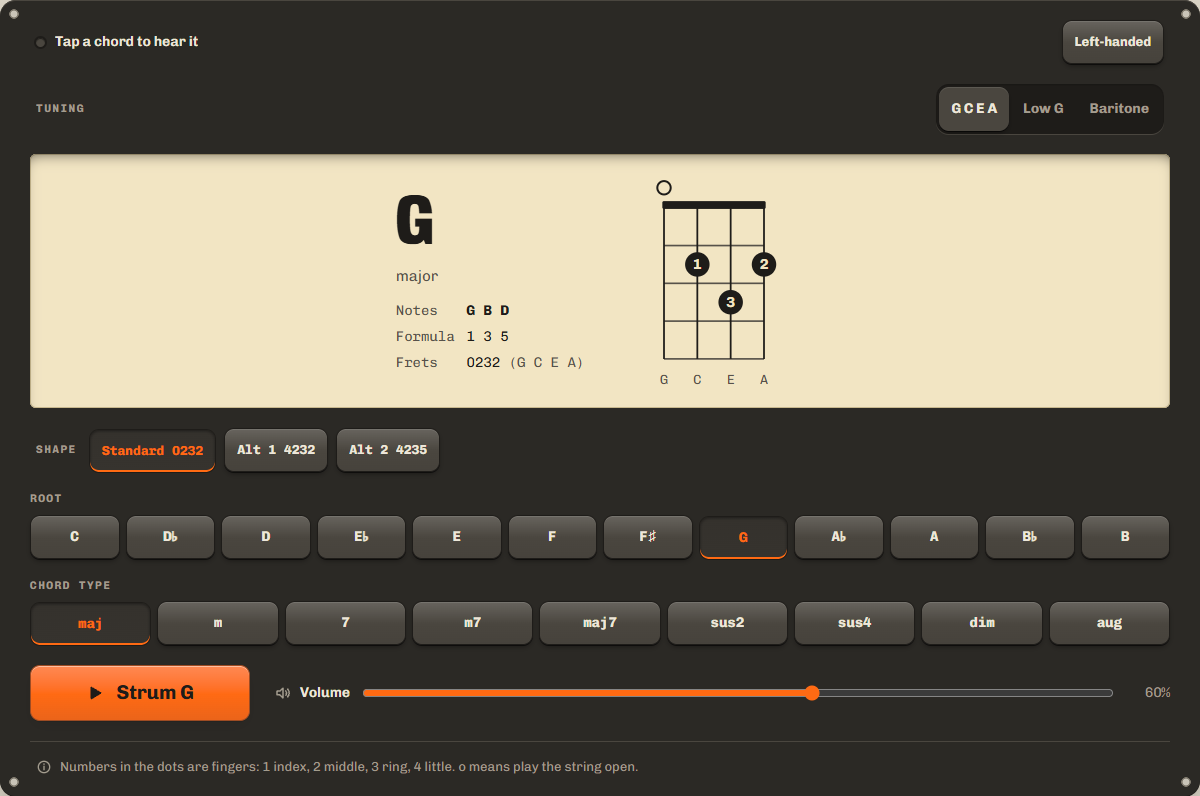
Every ukulele chord in all 12 keys, with finger numbers and alternate shapes. Tap a chord to hear it strummed and see its notes.
Tap a chord to hear it
major
- Notes
- C E G
- Formula
- 1 3 5
- Frets
- 0003 (G C E A)
Numbers in the dots are fingers: 1 index, 2 middle, 3 ring, 4 little. o means play the string open.
How to read the ukulele chord chart
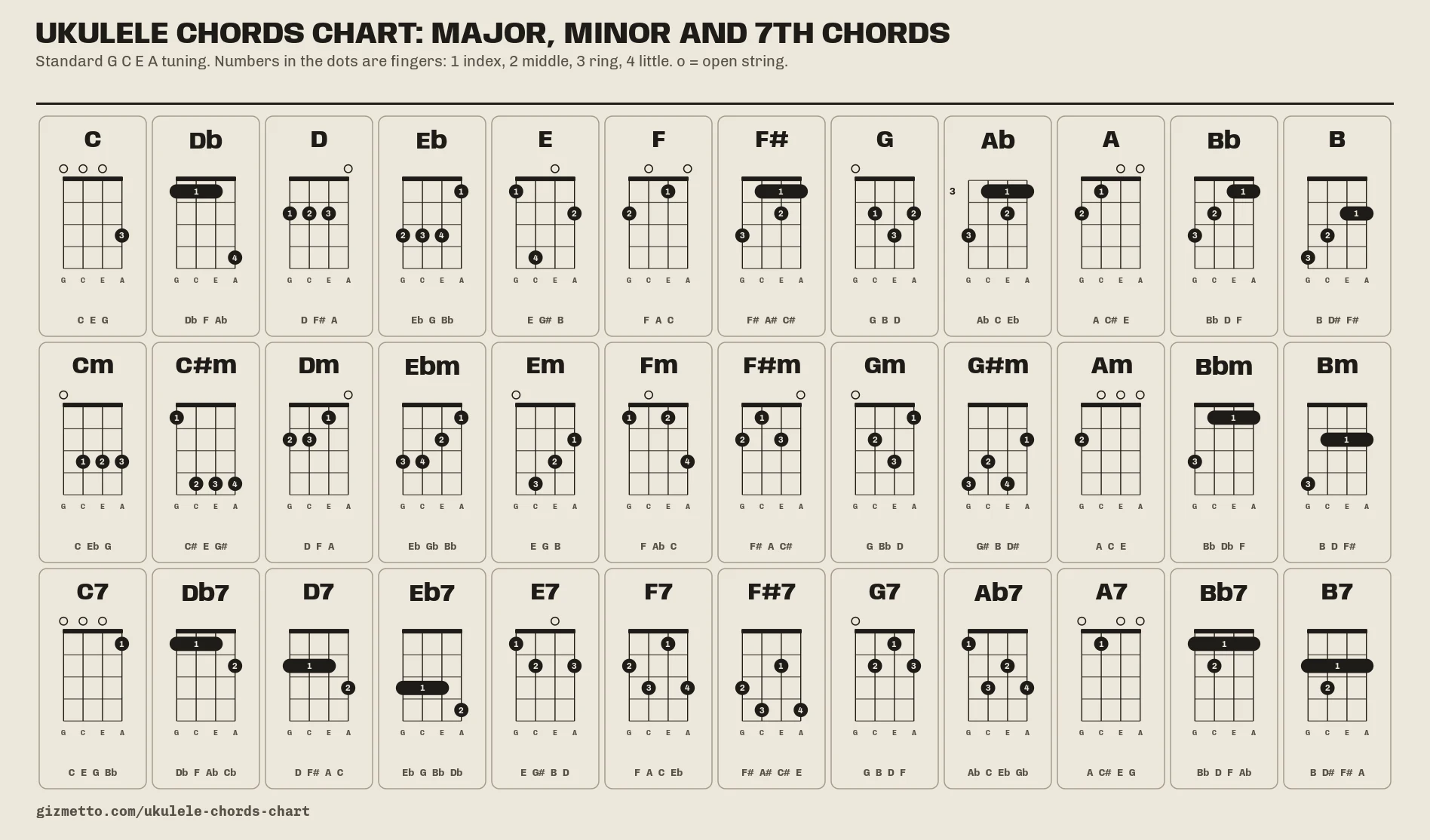
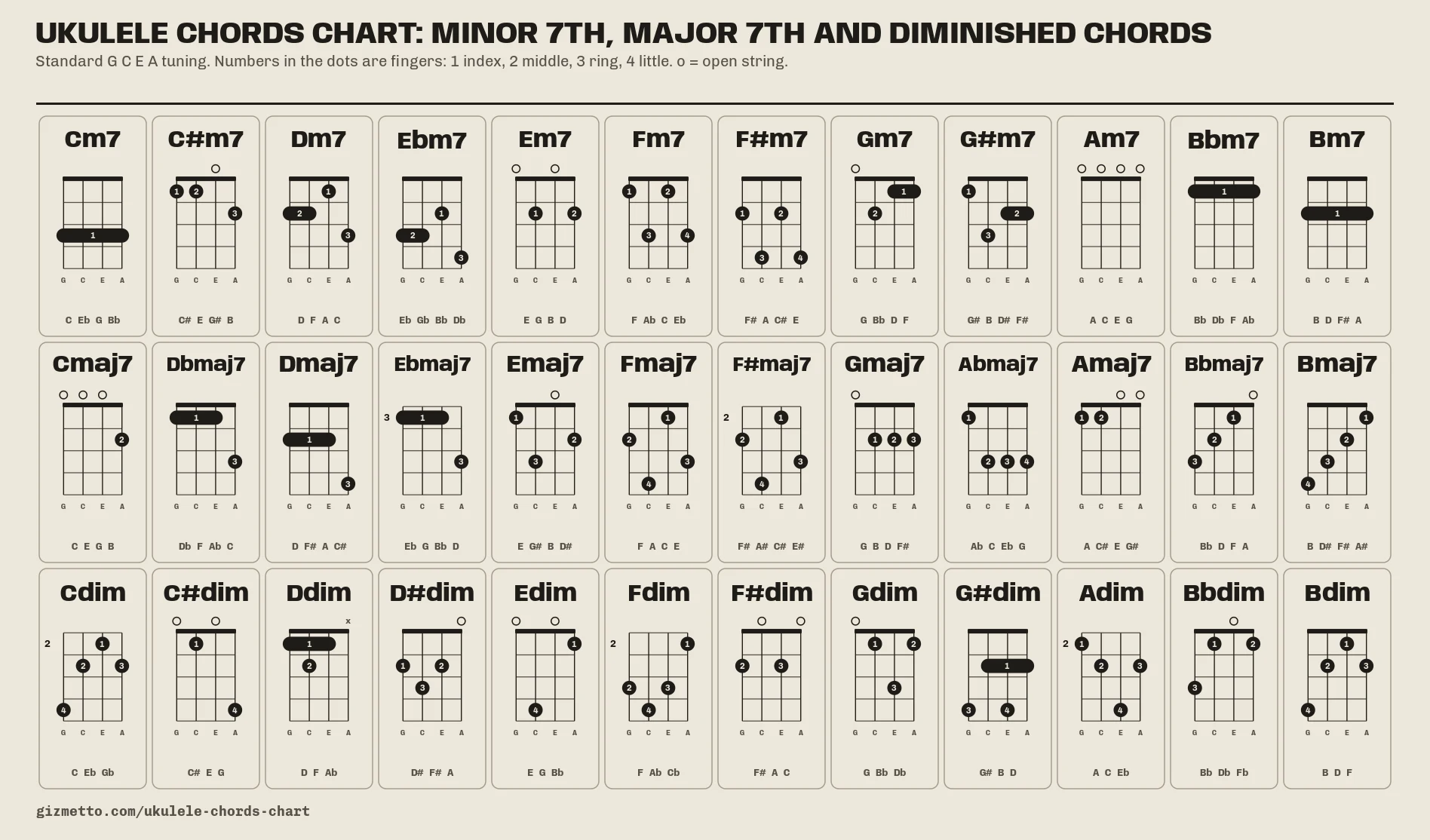
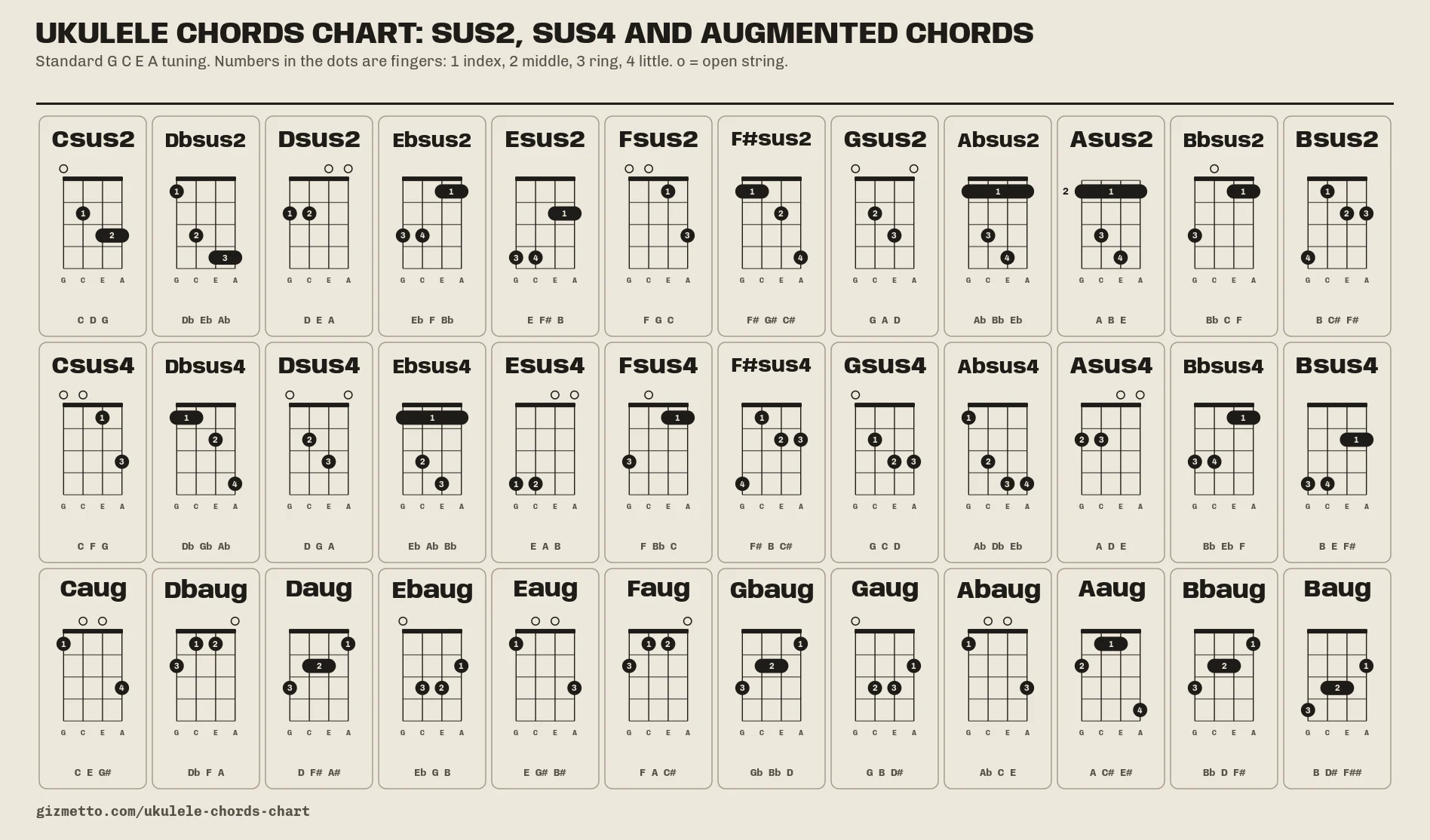
A chord box is the ukulele neck seen from the front, standing up. The four vertical lines are the strings, G C E A from left to right, and the horizontal lines are the frets. The thick bar on top is the nut. A dot is where a finger presses, and the number in it is the finger: 1 index, 2 middle, 3 ring, 4 little. An o above the nut means play the string open; an × means leave it out.
When the shape sits higher on the neck, the box has no nut and a number on the left says which fret the top row is. A long bar across several strings is a barre: one finger flat across those strings. The fret numbers in the table, such as 0003 for C, read the same way: one digit per string, G to A.
Tap a root and a chord type in the chart to hear the chord strummed from the G string down. Shape switches between the standard voicing and its alternates, Tuning switches to low G or baritone, and Left-handed mirrors the box.
Chord types and formulas
A formula lists the notes of a chord as steps of the major scale on its root. 1 3 5 on C is C E G; a ♭ lowers a step by one semitone, so 1 ♭3 5 is C E♭ G, C minor. Every chord on this page is spelled from its formula.
| Type | Symbol | Formula | On C | C on ukulele |
|---|---|---|---|---|
| major | C | 1 3 5 | C E G | 0003 |
| minor | Cm | 1 ♭3 5 | C E♭ G | 0333 |
| seventh | C7 | 1 3 5 ♭7 | C E G B♭ | 0001 |
| minor seventh | Cm7 | 1 ♭3 5 ♭7 | C E♭ G B♭ | 3333 |
| major seventh | Cmaj7 | 1 3 5 7 | C E G B | 0002 |
| suspended second | Csus2 | 1 2 5 | C D G | 0233 |
| suspended fourth | Csus4 | 1 4 5 | C F G | 0013 |
| diminished | Cdim | 1 ♭3 ♭5 | C E♭ G♭ | 5323 |
| augmented | Caug | 1 3 ♯5 | C E G♯ | 1003 |
- major: Major triad: bright and stable.
- minor: Minor triad: the third is one semitone lower, so it sounds darker.
- seventh: Dominant seventh: a major triad plus a minor seventh. It pulls toward the chord a fifth below.
- minor seventh: Minor triad plus a minor seventh: soft and mellow.
- major seventh: Major triad plus a major seventh: dreamy, used a lot in jazz and soul.
- suspended second: The third is replaced by the second: open, neither major nor minor.
- suspended fourth: The third is replaced by the fourth: it wants to resolve to the major chord.
- diminished: Two minor thirds stacked: tense, used as a passing chord.
- augmented: Two major thirds stacked: the fifth is raised, so it sounds unresolved.
Beginner ukulele chords to learn first
Start with C, Am, F and G: they need one to three fingers and together play the most common progression in pop. Then add G7, D, Em and A7, which open the keys of G and D.
- C0003
- Am2000
- F2010
- G0232
- G70212
- D2220
- Em0432
- A70100
Common ukulele chord progressions
Roman numerals name chords by their place in the key: I is the chord on the first note of the scale, V on the fifth. Capitals are major chords, small letters minor. The same numerals work in any key, so learn the pattern once and move it to suit your voice. The frets of each chord are in brackets.
I V vi IV: The pop progression
- Key of C: C (0003), G (0232), Am (2000), F (2010)
- Key of G: G (0232), D (2220), Em (0432), C (0003)
- Key of F: F (2010), C (0003), Dm (2210), B♭ (3211)
- Key of A: A (2100), E (1402), F♯m (2120), D (2220)
I IV V: Three chord rock, folk and blues
- Key of C: C (0003), F (2010), G (0232)
- Key of G: G (0232), C (0003), D (2220)
- Key of F: F (2010), B♭ (3211), C (0003)
- Key of A: A (2100), D (2220), E (1402)
I vi IV V: The 50s progression
- Key of C: C (0003), Am (2000), F (2010), G (0232)
- Key of G: G (0232), Em (0432), C (0003), D (2220)
- Key of F: F (2010), Dm (2210), B♭ (3211), C (0003)
- Key of A: A (2100), F♯m (2120), D (2220), E (1402)
ii V7 I: The jazz turnaround
- Key of C: Dm (2210), G7 (0212), C (0003)
- Key of G: Am (2000), D7 (2223), G (0232)
- Key of F: Gm (0231), C7 (0001), F (2010)
- Key of A: Bm (4222), E7 (1202), A (2100)
All ukulele chords with fret numbers
All 108 chords in standard G C E A tuning. Frets read from the G string to the A string; alternates follow the standard shape. Frets above 9 are separated by dots.
| Chord | Notes | Standard | Alternates |
|---|---|---|---|
| C | C E G | C: 0003 | 5433, 5787 |
| Cm | C E♭ G | Cm: 0333 | 5333, 5786 |
| C7 | C E G B♭ | C7: 0001 | 3433, 5767 |
| Cm7 | C E♭ G B♭ | Cm7: 3333 | 5766, 8.10.8.10 |
| Cmaj7 | C E G B | Cmaj7: 0002 | 4433, 5432 |
| Csus2 | C D G | Csus2: 0233 | 5785, 7.7.8.10 |
| Csus4 | C F G | Csus4: 0013 | 5533, 5788 |
| Cdim | C E♭ G♭ | Cdim: 5323 | 5686, 8686 |
| Caug | C E G♯ | Caug: 1003 | 5443, 5447 |
| D♭ | D♭ F A♭ | D♭: 1114 | 6544, 6898 |
| C♯m | C♯ E G♯ | C♯m: 1444 | 6444, 6447 |
| D♭7 | D♭ F A♭ C♭ | D♭7: 1112 | 4544, 6878 |
| C♯m7 | C♯ E G♯ B | C♯m7: 1102 | 4444, 6877 |
| D♭maj7 | D♭ F A♭ C | D♭maj7: 1113 | 5544, 6543 |
| D♭sus2 | D♭ E♭ A♭ | D♭sus2: 1344 | 6896, 8.8.9.11 |
| D♭sus4 | D♭ G♭ A♭ | D♭sus4: 1124 | 6644, 6899 |
| C♯dim | C♯ E G | C♯dim: 0104 | 6434, 6797 |
| D♭aug | D♭ F A | D♭aug: 2110 | 2114, 2554 |
| D | D F♯ A | D: 2220 | 2225, 7655 |
| Dm | D F A | Dm: 2210 | 2555, 7555 |
| D7 | D F♯ A C | D7: 2223 | 5655, 7989 |
| Dm7 | D F A C | Dm7: 2213 | 5555, 7988 |
| Dmaj7 | D F♯ A C♯ | Dmaj7: 2224 | 6655, 7654 |
| Dsus2 | D E A | Dsus2: 2200 | 2455, 7.9.10.7 |
| Dsus4 | D G A | Dsus4: 0230 | 2235, 7755 |
| Ddim | D F A♭ | Ddim: 121x | 7545, 7.8.10.8 |
| Daug | D F♯ A♯ | Daug: 3221 | 3225, 3665 |
| E♭ | E♭ G B♭ | E♭: 3331 | 3336, 8766 |
| E♭m | E♭ G♭ B♭ | E♭m: 3321 | 3666, 8666 |
| E♭7 | E♭ G B♭ D♭ | E♭7: 3334 | 6766, 8.10.9.10 |
| E♭m7 | E♭ G♭ B♭ D♭ | E♭m7: 3324 | 6666, 8.10.9.9 |
| E♭maj7 | E♭ G B♭ D | E♭maj7: 3335 | 7766, 8765 |
| E♭sus2 | E♭ F B♭ | E♭sus2: 3311 | 3566, 8.10.11.8 |
| E♭sus4 | E♭ A♭ B♭ | E♭sus4: 1341 | 3346, 8866 |
| D♯dim | D♯ F♯ A | D♯dim: 2320 | 8656, 8.9.11.9 |
| E♭aug | E♭ G B | E♭aug: 0332 | 4332, 4336 |
| E | E G♯ B | E: 1402 | 4442, 4447 |
| Em | E G B | Em: 0432 | 4432, 4777 |
| E7 | E G♯ B D | E7: 1202 | 4445, 7877 |
| Em7 | E G B D | Em7: 0202 | 4435, 7777 |
| Emaj7 | E G♯ B D♯ | Emaj7: 1302 | 4446, 9876 |
| Esus2 | E F♯ B | Esus2: 4422 | 4677, 9.11.12.9 |
| Esus4 | E A B | Esus4: 4400 | 2452, 4452 |
| Edim | E G B♭ | Edim: 0401 | 3431, 9767 |
| Eaug | E G♯ B♯ | Eaug: 1003 | 1443, 5443 |
| F | F A C | F: 2010 | 2013, 5558 |
| Fm | F A♭ C | Fm: 1013 | 5543, 5888 |
| F7 | F A C E♭ | F7: 2313 | 5556, 8988 |
| Fm7 | F A♭ C E♭ | Fm7: 1313 | 5546, 8888 |
| Fmaj7 | F A C E | Fmaj7: 2413 | 5557, 10.9.8.7 |
| Fsus2 | F G C | Fsus2: 0013 | 5533, 5788 |
| Fsus4 | F B♭ C | Fsus4: 3011 | 3013, 3563 |
| Fdim | F A♭ C♭ | Fdim: 4542 | 10.8.7.8 |
| Faug | F A C♯ | Faug: 2110 | 2114, 6558 |
| F♯ | F♯ A♯ C♯ | F♯: 3121 | 3124, 6669 |
| F♯m | F♯ A C♯ | F♯m: 2120 | 2124, 6654 |
| F♯7 | F♯ A♯ C♯ E | F♯7: 3424 | 6667, 9.10.9.9 |
| F♯m7 | F♯ A C♯ E | F♯m7: 2424 | 6657, 9999 |
| F♯maj7 | F♯ A♯ C♯ E♯ | F♯maj7: 3524 | 6668, 10.10.9.9 |
| F♯sus2 | F♯ G♯ C♯ | F♯sus2: 1124 | 6644, 6899 |
| F♯sus4 | F♯ B C♯ | F♯sus4: 4122 | 4674, 4124 |
| F♯dim | F♯ A C | F♯dim: 2020 | 5653, 11.9.8.9 |
| G♭aug | G♭ B♭ D | G♭aug: 3221 | 3225, 3665 |
| G | G B D | G: 0232 | 4232, 4235 |
| Gm | G B♭ D | Gm: 0231 | 3231, 3235 |
| G7 | G B D F | G7: 0212 | 4535, 7778 |
| Gm7 | G B♭ D F | Gm7: 0211 | 3535, 7768 |
| Gmaj7 | G B D F♯ | Gmaj7: 0222 | 4635, 7779 |
| Gsus2 | G A D | Gsus2: 0230 | 2235, 7755 |
| Gsus4 | G C D | Gsus4: 0233 | 5233, 5785 |
| Gdim | G B♭ D♭ | Gdim: 0131 | 3131, 6764 |
| Gaug | G B D♯ | Gaug: 0332 | 4332, 4336 |
| A♭ | A♭ C E♭ | A♭: 5343 | 1343, 5346 |
| G♯m | G♯ B D♯ | G♯m: 4342 | 1342, 4346 |
| A♭7 | A♭ C E♭ G♭ | A♭7: 1323 | 5646, 8889 |
| G♯m7 | G♯ B D♯ F♯ | G♯m7: 1322 | 4646, 8879 |
| A♭maj7 | A♭ C E♭ G | A♭maj7: 1333 | 5746, 8.8.8.10 |
| A♭sus2 | A♭ B♭ E♭ | A♭sus2: 1341 | 3346, 8866 |
| A♭sus4 | A♭ D♭ E♭ | A♭sus4: 1344 | 6344, 6896 |
| G♯dim | G♯ B D | G♯dim: 4242 | 1242, 7875 |
| A♭aug | A♭ C E | A♭aug: 1003 | 5443, 5447 |
| A | A C♯ E | A: 2100 | 2454, 6454 |
| Am | A C E | Am: 2000 | 2453, 5453 |
| A7 | A C♯ E G | A7: 0100 | 2434, 6757 |
| Am7 | A C E G | Am7: 0000 | 2433, 5757 |
| Amaj7 | A C♯ E G♯ | Amaj7: 1100 | 2444, 6857 |
| Asus2 | A B E | Asus2: 2452 | 4457, 9977 |
| Asus4 | A D E | Asus4: 2200 | 2455, 7455 |
| Adim | A C E♭ | Adim: 2353 | 5353, 8986 |
| Aaug | A C♯ E♯ | Aaug: 2114 | 2110, 2554 |
| B♭ | B♭ D F | B♭: 3211 | 3565, 7565 |
| B♭m | B♭ D♭ F | B♭m: 3111 | 3114, 3564 |
| B♭7 | B♭ D F A♭ | B♭7: 1211 | 7868, 10.10.10.11 |
| B♭m7 | B♭ D♭ F A♭ | B♭m7: 1111 | 3544, 6868 |
| B♭maj7 | B♭ D F A | B♭maj7: 3210 | 2211, 3555 |
| B♭sus2 | B♭ C F | B♭sus2: 3011 | 3563, 5568 |
| B♭sus4 | B♭ E♭ F | B♭sus4: 3311 | 3566, 8566 |
| B♭dim | B♭ D♭ F♭ | B♭dim: 3101 | 3464, 6464 |
| B♭aug | B♭ D F♯ | B♭aug: 3221 | 3225, 3665 |
| B | B D♯ F♯ | B: 4322 | 4676, 8676 |
| Bm | B D F♯ | Bm: 4222 | 4675, 7675 |
| B7 | B D♯ F♯ A | B7: 2322 | 4656, 8979 |
| Bm7 | B D F♯ A | Bm7: 2222 | 4655, 7979 |
| Bmaj7 | B D♯ F♯ A♯ | Bmaj7: 4321 | 3322, 4666 |
| Bsus2 | B C♯ F♯ | Bsus2: 4122 | 4674, 6679 |
| Bsus4 | B E F♯ | Bsus4: 4422 | 4677, 9677 |
| Bdim | B D F | Bdim: 4212 | 4575, 7575 |
| Baug | B D♯ F𝄪 | Baug: 4332 | 4336, 4776 |
Printable ukulele chords chart
Three sheets, one chord box for every root of each type, with fingers. Print them (only the charts print, one per page) or download the images.
FAQ
What are the first ukulele chords to learn?
C (0003), Am (2000), F (2010) and G (0232). With these four you can play the I V vi IV progression in C and hundreds of songs. Add G7 (0212), D (2220), Em (0432) and A7 (0100) next.
How do I read ukulele chord numbers like 0003?
Each digit is one string, from the G string (closest to your chin when you hold the ukulele) to the A string: the fret to press, or 0 for an open string. 0003 means G, C and E open and the A string at fret 3. An x means do not play that string.
Do these chord shapes work on low G and baritone ukuleles?
Low G uses the same shapes as standard tuning; only the G string sounds an octave lower. A baritone is tuned D G B E, a fourth lower, so each shape plays a different chord: the C shape plays G. Choose Baritone in the chart and it shows the right shape for each chord name.
What is the difference between dim and dim7?
This chart shows the diminished triad (1 ♭3 ♭5), such as C E♭ G♭ for Cdim. A dim7 chord adds a double flat seventh (C E♭ G♭ B𝄫). Some ukulele charts label the dim7 shape as dim, so check the notes when a song sheet says dim.
Which hand do the finger numbers mean?
The fretting hand: 1 index, 2 middle, 3 ring, 4 little finger. A bar across several strings is a barre: one finger presses all of those strings at that fret. Turn on Left-handed to mirror the diagrams if you play with the ukulele the other way round.
Sources
Every shape was checked against these two references on 22 November 2026, and a test works out the notes of each shape from the tuning and the frets and checks that they make the named chord.
- chords-db, ukulele chords (tombatossals, on GitHub) Open chord database used by many chord sites, here as served by muted.io. Frets, fingers and barres for every root and type; the fingers on this page come from it.
- Ukulele Chords (ukulele-chords.com), soprano, standard GCEA A chord page per chord with three positions. Its first position is our standard voicing wherever chords-db has the same shape, which is true for most chords. It lists a few three-string shapes (such as Cdim x323) where we show a four-string shape.
Related tools
All music chartsTune G C E A first, or chords sound wrong even with the right shape.
Find the chords of a song from a file or the microphone.
The same chords on the keyboard, with inversions.
Pluck one string and see which note it plays.