Song Key Finder
Find the key of a song from an audio file, the microphone or its chords, with the relative key and the scale notes.
Ready
Choose a song (MP3, WAV or M4A) or drop it here. It is analysed on this device and never uploaded.
Your file is analysed on your device. Nothing is uploaded.
How to find the key of a song
- Step 1Pick a sourceChoose File and pick an MP3, WAV or M4A, or drop it on the screen. Or choose Mic and play the song nearby, or Chords and type the chords you know.
- Step 2Wait a few secondsYour browser measures how much of each of the 12 notes the song holds, on your device. A three minute song takes a few seconds.
- Step 3Read the keyThe big reading is the key, with its relative major or minor beside it, the seven scale notes and the three main chords. Play along to check it by ear.
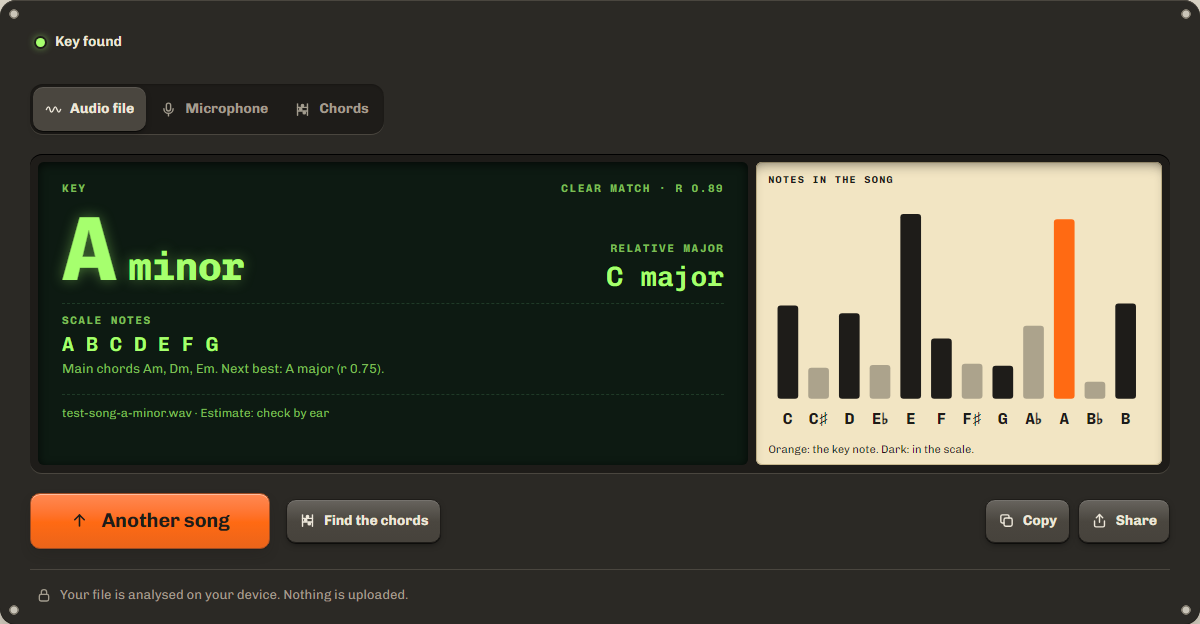
This song key finder works online in any modern browser, on a phone or a computer. The browser decodes the file with the Web Audio API (decodeAudioData), so the formats that work are the ones your browser can play. To see the chords as well, open the same file in the chord finder.
How it finds the key
First it measures the song's chroma: how much of each of the 12 note names (C, C♯, D and so on, in any octave) sounds across the whole song. This is the same analysis the chord finder uses.
Then it compares that profile with a profile for each of the 24 major and minor keys and picks the best match. The key profiles come from experiments by Carol Krumhansl and Edward Kessler, in which listeners rated how well each note fits a key. Krumhansl describes them in her book Cognitive Foundations of Musical Pitch, and the values are listed in this article on key finding. The tonic scores highest, then the fifth and the third, and notes outside the scale score lowest.
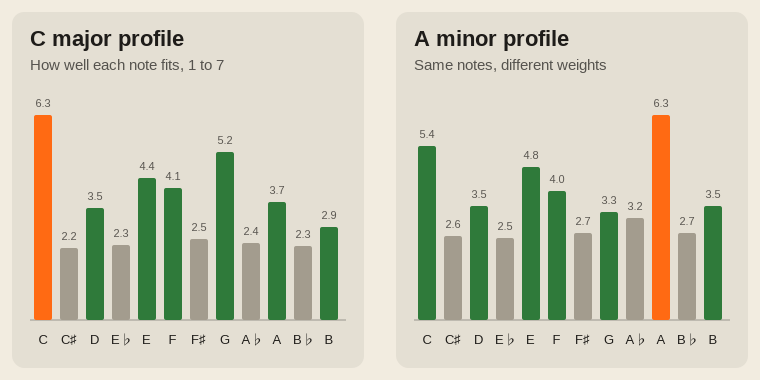
A real note also sounds a fifth above its octave, so a song in C holds some extra G and D. Without a correction, a song would often read as the key a fifth up. The tool adds the same harmonics to each key profile that the chord finder adds to its chord templates, so a song in C reads as C.
The match is a correlation, r, from −1 to 1, shown on the screen. Clear match means r is 0.75 or more and the next key that is not the relative key scores at least 0.1 lower. Unclear means the top keys are close, so check by ear.
Relative major and minor
Every major key has a relative minor three semitones below it, with the same notes: C major and A minor, G major and E minor, F major and D minor. The difference is which note feels like home. That is why the tool always shows the relative key next to the result.
To choose between them, listen to the last chord and the chorus. If they rest on the major chord and the song sounds bright, take the major key. If they rest on the minor chord, take the minor key. The three main chords on the screen (I, IV and V, or i, iv and v in minor) help: play them along with the song and hear which one sounds like home.
Key finder by chords
If you already know the chords, choose Chords and type them in order, such as C G Am F or Am, Dm, E. Spaces, commas and bars all work, and a word the tool cannot read is listed so you can fix it. It reads major, minor, 7, maj7 and m7 chords, with ♯ or ♭ written as # or b.
Each chord adds its notes, and the first and last chords count one and a half times, since songs often start and end on the home chord. A short list with no clear home chord, such as F G alone, can fit two keys about equally well.
How accurate is it?
Treat the key as a good first guess. A key profile method works well on most pop, rock and folk songs, and it has limits that no amount of tuning removes:
- Works wellSongs that stay in one major or minor key, with clear chords from guitar, piano or a band.
- Often confusedThe relative key (C major and A minor), and the keys a fifth apart, such as C and G, in songs that lean on the V chord.
- Not detectedKey changes, and modes such as Dorian or Mixolydian: a song in D Dorian shows as the nearest major or minor key.
- TuningIt expects A4 = 440 Hz. A song tuned a quarter tone off can read as the key one semitone away.
- Little to go onDrums alone, rap over a beat with few notes, or heavy distortion. The tool then says Unclear.
The microphone mode also hears the room, so it needs at least 6 seconds of music and works best close to the speaker or the instrument.
Why your file stays on your device
The analysis runs in your browser, in a background worker so the page stays responsive. The song is never uploaded, so there is no upload limit and no copy of your music anywhere else. In microphone mode, nothing is recorded. When you close the page, the result is gone.
FAQ
How do I find the key of a song?
Upload the song here and read the key, or type its chords under Chords. By ear: hum the note that feels like home at the end of the song, then check whether the song sounds major (bright) or minor (dark) on that note.
Why does it say A minor when the song is in C major?
C major and A minor use the same seven notes, so they look alike to any key finder. The tool shows the relative key next to the result for this reason. If the song ends on C and sounds bright, take C major.
Can I find the key from chords only?
Yes. Choose Chords and type them in order, such as G D Em C. The first and last chords count a little more, because songs often start and end on the home chord. Major, minor and seventh chords work.
Does it work with YouTube or Spotify links?
No. It reads an audio file on your device, or sound through the microphone. A file gives a cleaner result than the microphone.
Is the song key finder free?
Yes. There is no sign-up, no limit on songs and nothing to install. Your file is never uploaded.
Does it find key changes?
No. It gives one key for the whole file. If a song moves up a step for the last chorus, the result leans to the key that plays longest. To check one part, use a file of that part only.
Related tools
All audio toolsSee every chord of the same song on a timeline.
Detect the tempo of the same file.
Find single notes of a melody.
Maintained by NabeelUpdated Oct 23, 2026.