The six guitar strings in standard tuning are E, A, D, G, B and E, from the thickest string to the thinnest. With octave numbers that is E2, A2, D3, G3, B3 and E4 (standard tuning). The thickest string is low E at 82.41 Hz, and the thinnest is high E at 329.63 Hz, two octaves higher. The strings are numbered from the thinnest: string 1 is high E and string 6 is low E. Below are the exact frequencies, a chart of the note on every fret, and how to use them to tune.
Guitar string notes chart
| String | Note | Frequency |
|---|---|---|
| 6 (thickest) | E2, low E | 82.41 Hz |
| 5 | A2 | 110.00 Hz |
| 4 | D3 | 146.83 Hz |
| 3 | G3 | 196.00 Hz |
| 2 | B3 | 246.94 Hz |
| 1 (thinnest) | E4, high E | 329.63 Hz |
The frequencies are for A4 = 440 Hz, the standard tuning pitch in ISO 16. They come from the equal temperament formula: each note is 440 Hz times 2 to the power of (n − 49) / 12, where n is the key number on an 88-key piano. The table of piano key frequencies gives E2 as 82.40689 Hz, D3 as 146.8324 Hz, G3 as 195.9977 Hz, B3 as 246.9417 Hz and E4 as 329.6276 Hz. A2 is exactly 110 Hz, a quarter of 440.
One thing that confuses people who read music: guitar music is written an octave higher than it sounds. The low E on a guitar sounds at E2, but the score shows it an octave up, so it fits on the treble staff.
Guitar string order, and how to remember it
Two ways to count, and both are in use:
- By number, from the thinnest: 1 E, 2 B, 3 G, 4 D, 5 A, 6 E. Lessons and tabs use these numbers. “Play the 3rd string” means G.
- By pitch, from the lowest: E A D G B E. This is how tunings are written.
Fender suggests “Easter Bunnies Get Dizzy At Easter” for E A D G B E (Fender). Any sentence works, as long as the first letters are E A D G B E.
Also note what “top” and “bottom” mean. When you hold the guitar, the low E string is at the top, closest to your face, but it is the lowest note. Many players call it the bottom string because of its pitch. Use the numbers to avoid mistakes.
Notes on every fret
Each fret raises a string by one semitone (Fret). The 12th fret divides the string into two equal halves, so it plays the open note one octave higher. After fret 12 the pattern starts again.
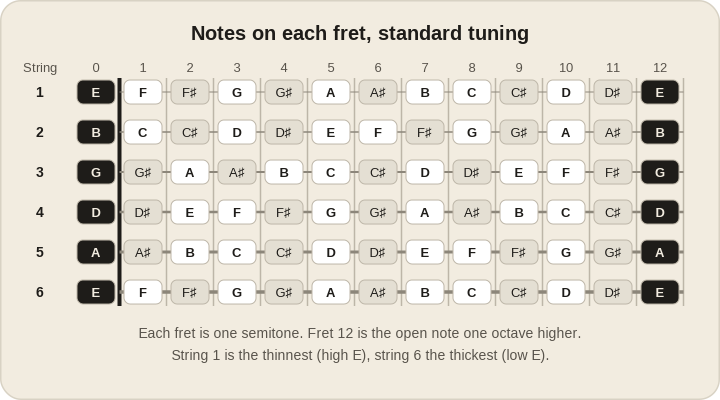
The notes go up in this order: C, C♯, D, D♯, E, F, F♯, G, G♯, A, A♯, B, then C again. There is no sharp between B and C or between E and F. A sharp has a second name: C♯ is also D♭, D♯ is E♭, and so on.
To find any note without the chart, start from the open string and count one semitone per fret. On the A string, for example: A at fret 0, A♯ at 1, B at 2, C at 3, C♯ at 4 and D at 5. The interactive guitar notes chart shows every note up to fret 12 and plays it when you tap it.
How to tune guitar strings for beginners
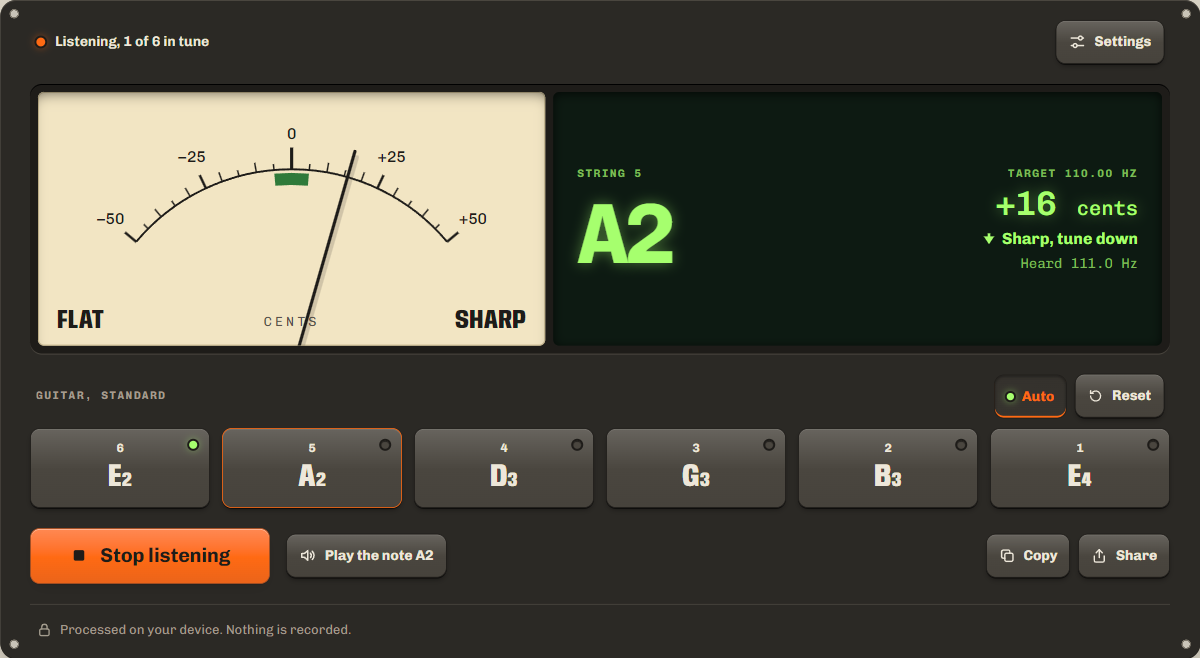
The easiest way is a tuner. Open the guitar tuner, play one string at a time and turn its peg until the needle is in the middle.
- Start with string 6, the low E. Play it open and let it ring.
- Watch the tuner. If the note is flat (too low), tighten the string. If it is sharp (too high), loosen it.
- Finish by tuning up to the note. If you go past it, go a little below and come up again (the tuner page explains why to tune up to the note).
- Do strings 5, 4, 3, 2 and 1 the same way.
- Check all six again before you play.
If a string is very far off, the tuner may show another note. That is normal: tune toward the note on the chart above, a little at a time.
Tune by ear: the fifth fret method
If you have one string in tune, you can tune the others from it. This uses the intervals between the strings: in standard tuning each pair of strings is a fourth apart (5 semitones), except G to B, which is a major third (4 semitones) (guitar tunings).
- Fret the low E string at fret 5. That is A. Tune the open A string to match it.
- A string, fret 5, is D. Tune the open D string.
- D string, fret 5, is G. Tune the open G string.
- G string, fret 4, is B. Tune the open B string. This is the one exception.
- B string, fret 5, is E. Tune the open high E string.
The method keeps the strings in tune with each other, but not with other instruments. If you play with others or with a recording, tune at least one string to a reference first, or use a tuner for all six.
Standard tuning and other tunings
E A D G B E is standard tuning. Other tunings change one or more strings. The guitar tuner has the common ones built in, such as Drop D (the low E string tuned down to D) and DADGAD.
If you play bass or ukulele too, the notes are related. A four-string bass uses E A D G, an octave lower than the four thickest guitar strings. For the ukulele, see ukulele string notes.