Piano Notes Chart
Every key on an 88 key piano with its name, octave and frequency. Tap a key to hear it and see it on the treble or bass staff.
Tap a key to hear it
Scientific pitch: middle C is C4. Frequencies at A4 = 440 Hz, equal temperament.
How to read a piano notes chart
The piano uses seven note names, A B C D E F G, on the white keys, and then starts again. The black keys sit in groups of two and three. C is always the white key just left of a group of two black keys, and F is just left of a group of three. Find one C and you can name every key from there.
The number after each name is the octave, in scientific pitch notation. It goes up by one at every C, so the note after B3 is C4. A standard piano has 88 keys, from A0 to C8. Middle C is C4, key 40, and the A above it, A4, is the 440 Hz tuning note.
- Step 1Tap a keyThe keyboard starts at middle C. Swipe or scroll it sideways to reach all 88 keys.
- Step 2Read the screenIt shows the note with its octave number, its frequency, its key number and where it sits on the staff.
- Step 3Choose sharps or flatsSwitch the black key names between sharps (C♯) and flats (D♭). The staff follows.
Piano notes on the staff: treble and bass clef
Piano music is written on the grand staff: a treble staff for the right hand on top and a bass staff for the left hand below. The treble clef curls around the second line, which is G4, and the two dots of the bass clef sit on either side of the fourth line, F3. Lines and spaces count from the bottom.
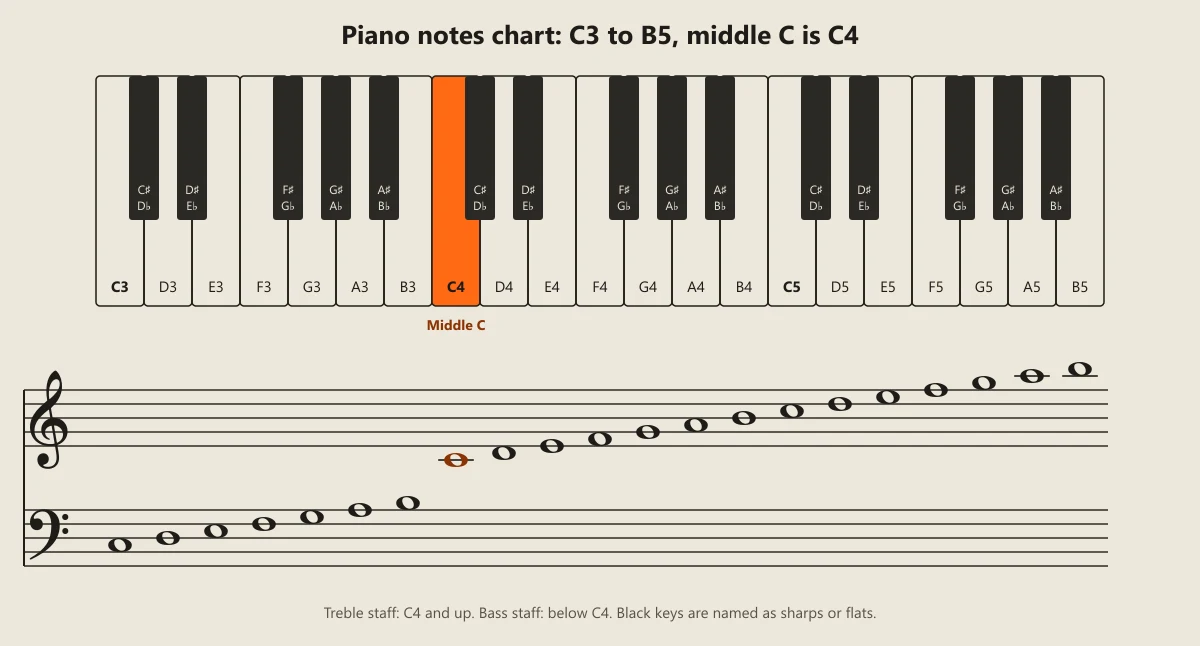
Middle C sits between the two staves, on a short ledger line: one line below the treble staff or one line above the bass staff. It is the same key either way. Notes above and below the staves get more ledger lines, and in the tool at the top of the page, the highest keys are written under 8va or 15ma (play one or two octaves higher than written) and the lowest under 8vb (one octave lower).
Tricks to remember the notes
- Treble lines, E G B D F: Every Good Boy Does Fine.
- Treble spaces, F A C E: they spell FACE.
- Bass lines, G B D F A: Good Boys Do Fine Always.
- Bass spaces, A C E G: All Cows Eat Grass.
- On the keys: C is left of the two black keys, F is left of the three.
Then learn a few landmark notes and read from them: middle C, the G on the treble clef's line, the F on the bass clef's line, and the Cs an octave above and below middle C (C5 on the third treble space, C3 on the second bass space).
All 88 piano keys with frequencies
Every key from the lowest to the highest, with its number, its names and its frequency in hertz at A4 = 440 Hz. The ISO 16 standard sets A4 to 440 Hz, and each frequency is 440 × 2^((key − 49) ÷ 12) (piano key frequencies).
| Key | Note | Frequency | Staff |
|---|---|---|---|
| 1 | A0 (lowest key) | 27.50 Hz | Bass |
| 2 | A♯0 / B♭0 | 29.14 Hz | Bass |
| 3 | B0 | 30.87 Hz | Bass |
| 4 | C1 | 32.70 Hz | Bass |
| 5 | C♯1 / D♭1 | 34.65 Hz | Bass |
| 6 | D1 | 36.71 Hz | Bass |
| 7 | D♯1 / E♭1 | 38.89 Hz | Bass |
| 8 | E1 | 41.20 Hz | Bass |
| 9 | F1 | 43.65 Hz | Bass |
| 10 | F♯1 / G♭1 | 46.25 Hz | Bass |
| 11 | G1 | 49.00 Hz | Bass |
| 12 | G♯1 / A♭1 | 51.91 Hz | Bass |
| 13 | A1 | 55.00 Hz | Bass |
| 14 | A♯1 / B♭1 | 58.27 Hz | Bass |
| 15 | B1 | 61.74 Hz | Bass |
| 16 | C2 | 65.41 Hz | Bass |
| 17 | C♯2 / D♭2 | 69.30 Hz | Bass |
| 18 | D2 | 73.42 Hz | Bass |
| 19 | D♯2 / E♭2 | 77.78 Hz | Bass |
| 20 | E2 | 82.41 Hz | Bass |
| 21 | F2 | 87.31 Hz | Bass |
| 22 | F♯2 / G♭2 | 92.50 Hz | Bass |
| 23 | G2 | 98.00 Hz | Bass |
| 24 | G♯2 / A♭2 | 103.83 Hz | Bass |
| 25 | A2 | 110.00 Hz | Bass |
| 26 | A♯2 / B♭2 | 116.54 Hz | Bass |
| 27 | B2 | 123.47 Hz | Bass |
| 28 | C3 | 130.81 Hz | Bass |
| 29 | C♯3 / D♭3 | 138.59 Hz | Bass |
| 30 | D3 | 146.83 Hz | Bass |
| 31 | D♯3 / E♭3 | 155.56 Hz | Bass |
| 32 | E3 | 164.81 Hz | Bass |
| 33 | F3 | 174.61 Hz | Bass |
| 34 | F♯3 / G♭3 | 185.00 Hz | Bass |
| 35 | G3 | 196.00 Hz | Bass |
| 36 | G♯3 / A♭3 | 207.65 Hz | Bass |
| 37 | A3 | 220.00 Hz | Bass |
| 38 | A♯3 / B♭3 | 233.08 Hz | Bass |
| 39 | B3 | 246.94 Hz | Bass |
| 40 | C4 (middle c) | 261.63 Hz | Treble |
| 41 | C♯4 / D♭4 | 277.18 Hz | Treble |
| 42 | D4 | 293.66 Hz | Treble |
| 43 | D♯4 / E♭4 | 311.13 Hz | Treble |
| 44 | E4 | 329.63 Hz | Treble |
| 45 | F4 | 349.23 Hz | Treble |
| 46 | F♯4 / G♭4 | 369.99 Hz | Treble |
| 47 | G4 | 392.00 Hz | Treble |
| 48 | G♯4 / A♭4 | 415.30 Hz | Treble |
| 49 | A4 (tuning a, 440 hz) | 440.00 Hz | Treble |
| 50 | A♯4 / B♭4 | 466.16 Hz | Treble |
| 51 | B4 | 493.88 Hz | Treble |
| 52 | C5 | 523.25 Hz | Treble |
| 53 | C♯5 / D♭5 | 554.37 Hz | Treble |
| 54 | D5 | 587.33 Hz | Treble |
| 55 | D♯5 / E♭5 | 622.25 Hz | Treble |
| 56 | E5 | 659.26 Hz | Treble |
| 57 | F5 | 698.46 Hz | Treble |
| 58 | F♯5 / G♭5 | 739.99 Hz | Treble |
| 59 | G5 | 783.99 Hz | Treble |
| 60 | G♯5 / A♭5 | 830.61 Hz | Treble |
| 61 | A5 | 880.00 Hz | Treble |
| 62 | A♯5 / B♭5 | 932.33 Hz | Treble |
| 63 | B5 | 987.77 Hz | Treble |
| 64 | C6 | 1046.50 Hz | Treble |
| 65 | C♯6 / D♭6 | 1108.73 Hz | Treble |
| 66 | D6 | 1174.66 Hz | Treble |
| 67 | D♯6 / E♭6 | 1244.51 Hz | Treble |
| 68 | E6 | 1318.51 Hz | Treble |
| 69 | F6 | 1396.91 Hz | Treble |
| 70 | F♯6 / G♭6 | 1479.98 Hz | Treble |
| 71 | G6 | 1567.98 Hz | Treble |
| 72 | G♯6 / A♭6 | 1661.22 Hz | Treble |
| 73 | A6 | 1760.00 Hz | Treble |
| 74 | A♯6 / B♭6 | 1864.66 Hz | Treble |
| 75 | B6 | 1975.53 Hz | Treble |
| 76 | C7 | 2093.00 Hz | Treble |
| 77 | C♯7 / D♭7 | 2217.46 Hz | Treble |
| 78 | D7 | 2349.32 Hz | Treble |
| 79 | D♯7 / E♭7 | 2489.02 Hz | Treble |
| 80 | E7 | 2637.02 Hz | Treble |
| 81 | F7 | 2793.83 Hz | Treble |
| 82 | F♯7 / G♭7 | 2959.96 Hz | Treble |
| 83 | G7 | 3135.96 Hz | Treble |
| 84 | G♯7 / A♭7 | 3322.44 Hz | Treble |
| 85 | A7 | 3520.00 Hz | Treble |
| 86 | A♯7 / B♭7 | 3729.31 Hz | Treble |
| 87 | B7 | 3951.07 Hz | Treble |
| 88 | C8 (highest key) | 4186.01 Hz | Treble |
Printable piano notes chart
This chart shows the three octaves around middle C, from C3 to B5. Each white key is drawn on the staff right below it, so you can match a written note to its key. Save it or print it and keep it on the music stand.
FAQ
Which key is middle C on the piano?
Middle C is C4, key 40 of 88, the fourth C from the left. Its frequency is 261.63 Hz. On the grand staff it sits on one ledger line between the treble and bass staves.
How many keys and notes does a piano have?
A standard piano has 88 keys: 52 white and 36 black. They run from A0, the lowest, to C8, the highest. The 12 notes of each octave repeat across the keyboard: 7 white keys and 5 black keys.
Why does each black key have two names?
A black key sits between two white keys, so it is a sharp of the key below or a flat of the key above. C♯ and D♭ are the same key. Music in sharp keys uses the sharp names, and music in flat keys the flat names.
What do the numbers after the note names mean?
They are octave numbers, in scientific pitch notation. The number goes up by one at every C, so the note after B3 is C4. A0 is the lowest key and C8 the highest.
What frequency is A4?
A4, the A above middle C, is 440 Hz, the standard tuning pitch. Each octave up doubles the frequency, so A5 is 880 Hz, and each key is about 6% higher than the key below it. The highest C, C8, is 4186.01 Hz.
Related tools
All music chartsPlay or sing a note and see its name and how far off it is.
Play a steady tone at any note or frequency.
Find your lowest and highest notes on the keyboard.
Find every note on the guitar fretboard, frets 0 to 12.
Every chord in all 12 keys with the keys lit. Tap to hear it.
Maintained by NabeelUpdated Nov 13, 2026.