Piano Chords Chart
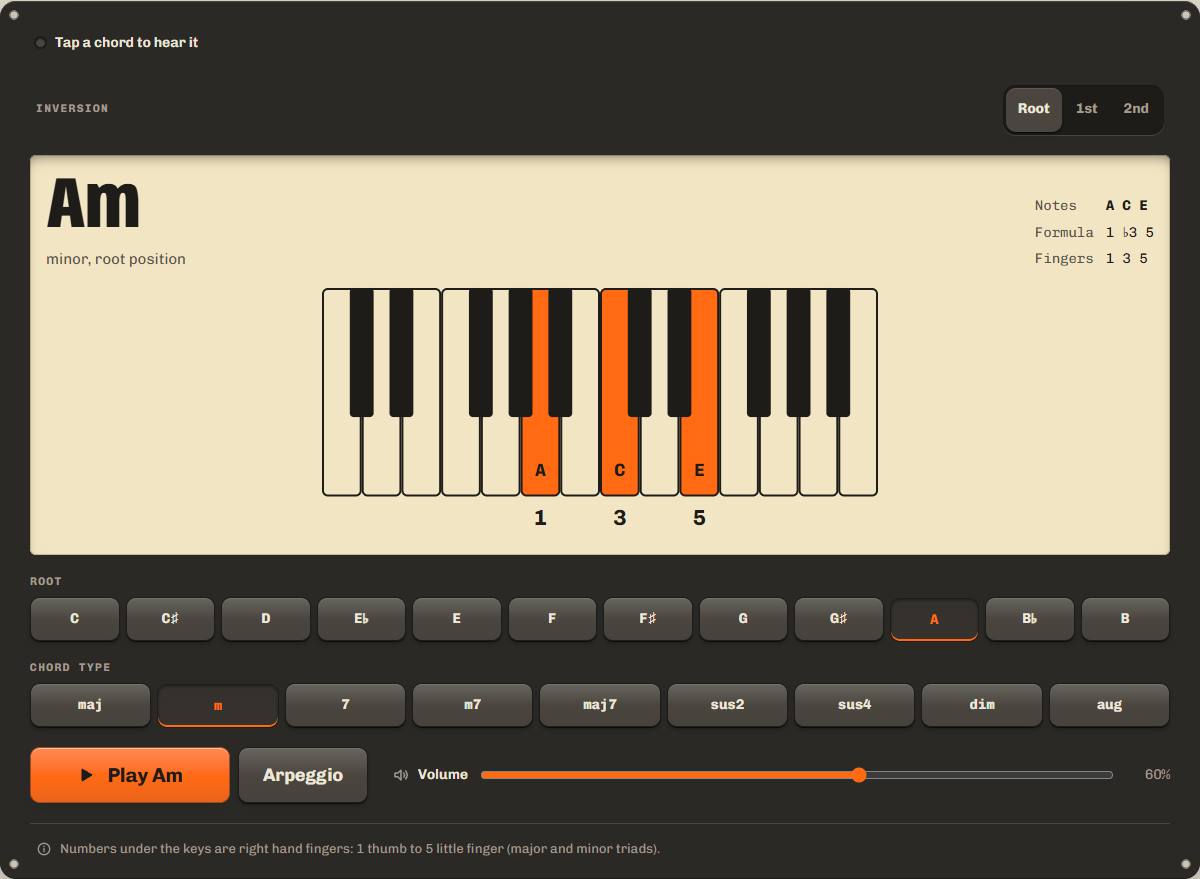
Every piano chord in all 12 keys, with its keys lit, its notes spelled correctly and its inversions. Tap a chord to hear it as a chord or an arpeggio.
Tap a chord to hear it
major, root position
- Notes
- C E G
- Formula
- 1 3 5
- Fingers
- 1 3 5
Numbers under the keys are right hand fingers: 1 thumb to 5 little finger (major and minor triads).
How to read the piano chord chart
The keyboard shows two octaves from middle C. The orange keys are the notes of the chord, with each note's name on its key. Play them together for a chord, or one at a time from the bottom for an arpeggio. Under the keys, the numbers are right hand fingers: 1 is the thumb and 5 the little finger.
Choose a root and a chord type, then an inversion. Root position has the root at the bottom; first inversion puts the third at the bottom and second inversion the fifth. The notes do not change, only their order.
Chord types and formulas
A formula lists a chord's notes as steps of the major scale on its root. 1 3 5 on C is C E G. A ♭ lowers a step by one semitone and a ♯ raises it, so 1 ♭3 5 is C E♭ G, C minor, and 1 3 ♯5 is C E G♯, C augmented.
| Type | Symbol | Formula | Semitones | On C |
|---|---|---|---|---|
| major | C | 1 3 5 | 0 4 7 | C E G |
| minor | Cm | 1 ♭3 5 | 0 3 7 | C E♭ G |
| seventh | C7 | 1 3 5 ♭7 | 0 4 7 10 | C E G B♭ |
| minor seventh | Cm7 | 1 ♭3 5 ♭7 | 0 3 7 10 | C E♭ G B♭ |
| major seventh | Cmaj7 | 1 3 5 7 | 0 4 7 11 | C E G B |
| suspended second | Csus2 | 1 2 5 | 0 2 7 | C D G |
| suspended fourth | Csus4 | 1 4 5 | 0 5 7 | C F G |
| diminished | Cdim | 1 ♭3 ♭5 | 0 3 6 | C E♭ G♭ |
| augmented | Caug | 1 3 ♯5 | 0 4 8 | C E G♯ |
- major: Major triad: bright and stable.
- minor: Minor triad: the third is one semitone lower, so it sounds darker.
- seventh: Dominant seventh: a major triad plus a minor seventh. It pulls toward the chord a fifth below.
- minor seventh: Minor triad plus a minor seventh: soft and mellow.
- major seventh: Major triad plus a major seventh: dreamy, used a lot in jazz and soul.
- suspended second: The third is replaced by the second: open, neither major nor minor.
- suspended fourth: The third is replaced by the fourth: it wants to resolve to the major chord.
- diminished: Two minor thirds stacked: tense, used as a passing chord.
- augmented: Two major thirds stacked: the fifth is raised, so it sounds unresolved.
Sharps and flats follow the letters. A triad uses every other letter from its root, so D♭ major is D♭ F A♭, not C♯ F G♯. Major chords on black keys take their flat names (D♭, E♭, A♭, B♭) and F♯; minor chords take C♯, F♯ and G♯, as their key signatures do. Where one name would need a double flat, the chart uses the other: D♯ diminished instead of E♭ diminished.
Beginner piano chords to learn first
These six chords use only white keys, and the same 1 3 5 hand shape plays all of them. C, G, F and A minor alone cover the most common progression in pop.
- CC E G
- GG B D
- FF A C
- AmA C E
- DmD F A
- EmE G B
Common piano chord progressions
Roman numerals name chords by their place in the key: I is the chord on the first note of the scale, V on the fifth. Capitals are major chords, small letters minor. Learn a pattern once and play it in any key.
I V vi IV: The pop progression
- Key of C: C, G, Am, F
- Key of G: G, D, Em, C
- Key of F: F, C, Dm, B♭
- Key of D: D, A, Bm, G
I IV V: Three chord rock, folk and blues
- Key of C: C, F, G
- Key of G: G, C, D
- Key of F: F, B♭, C
- Key of D: D, G, A
I vi IV V: The 50s progression
- Key of C: C, Am, F, G
- Key of G: G, Em, C, D
- Key of F: F, Dm, B♭, C
- Key of D: D, Bm, G, A
ii V7 I: The jazz turnaround
- Key of C: Dm, G7, C
- Key of G: Am, D7, G
- Key of F: Gm, C7, F
- Key of D: Em, A7, D
Tip: play the chords in the inversion that is closest to the chord before. In C, I V vi IV can be C (C E G), G in first inversion (B D G), A minor in first inversion (C E A) and F in second inversion (C F A): the thumb stays near C.
All piano chords with notes and formulas
All 108 chords, spelled from their root, with the formula and the notes of each inversion.
| Chord | Formula | Notes | 1st inversion | 2nd inversion |
|---|---|---|---|---|
| C | 1 3 5 | C E G | E G C | G C E |
| Cm | 1 ♭3 5 | C E♭ G | E♭ G C | G C E♭ |
| C7 | 1 3 5 ♭7 | C E G B♭ | E G B♭ C | G B♭ C E |
| Cm7 | 1 ♭3 5 ♭7 | C E♭ G B♭ | E♭ G B♭ C | G B♭ C E♭ |
| Cmaj7 | 1 3 5 7 | C E G B | E G B C | G B C E |
| Csus2 | 1 2 5 | C D G | D G C | G C D |
| Csus4 | 1 4 5 | C F G | F G C | G C F |
| Cdim | 1 ♭3 ♭5 | C E♭ G♭ | E♭ G♭ C | G♭ C E♭ |
| Caug | 1 3 ♯5 | C E G♯ | E G♯ C | G♯ C E |
| D♭ | 1 3 5 | D♭ F A♭ | F A♭ D♭ | A♭ D♭ F |
| C♯m | 1 ♭3 5 | C♯ E G♯ | E G♯ C♯ | G♯ C♯ E |
| D♭7 | 1 3 5 ♭7 | D♭ F A♭ C♭ | F A♭ C♭ D♭ | A♭ C♭ D♭ F |
| C♯m7 | 1 ♭3 5 ♭7 | C♯ E G♯ B | E G♯ B C♯ | G♯ B C♯ E |
| D♭maj7 | 1 3 5 7 | D♭ F A♭ C | F A♭ C D♭ | A♭ C D♭ F |
| D♭sus2 | 1 2 5 | D♭ E♭ A♭ | E♭ A♭ D♭ | A♭ D♭ E♭ |
| D♭sus4 | 1 4 5 | D♭ G♭ A♭ | G♭ A♭ D♭ | A♭ D♭ G♭ |
| C♯dim | 1 ♭3 ♭5 | C♯ E G | E G C♯ | G C♯ E |
| D♭aug | 1 3 ♯5 | D♭ F A | F A D♭ | A D♭ F |
| D | 1 3 5 | D F♯ A | F♯ A D | A D F♯ |
| Dm | 1 ♭3 5 | D F A | F A D | A D F |
| D7 | 1 3 5 ♭7 | D F♯ A C | F♯ A C D | A C D F♯ |
| Dm7 | 1 ♭3 5 ♭7 | D F A C | F A C D | A C D F |
| Dmaj7 | 1 3 5 7 | D F♯ A C♯ | F♯ A C♯ D | A C♯ D F♯ |
| Dsus2 | 1 2 5 | D E A | E A D | A D E |
| Dsus4 | 1 4 5 | D G A | G A D | A D G |
| Ddim | 1 ♭3 ♭5 | D F A♭ | F A♭ D | A♭ D F |
| Daug | 1 3 ♯5 | D F♯ A♯ | F♯ A♯ D | A♯ D F♯ |
| E♭ | 1 3 5 | E♭ G B♭ | G B♭ E♭ | B♭ E♭ G |
| E♭m | 1 ♭3 5 | E♭ G♭ B♭ | G♭ B♭ E♭ | B♭ E♭ G♭ |
| E♭7 | 1 3 5 ♭7 | E♭ G B♭ D♭ | G B♭ D♭ E♭ | B♭ D♭ E♭ G |
| E♭m7 | 1 ♭3 5 ♭7 | E♭ G♭ B♭ D♭ | G♭ B♭ D♭ E♭ | B♭ D♭ E♭ G♭ |
| E♭maj7 | 1 3 5 7 | E♭ G B♭ D | G B♭ D E♭ | B♭ D E♭ G |
| E♭sus2 | 1 2 5 | E♭ F B♭ | F B♭ E♭ | B♭ E♭ F |
| E♭sus4 | 1 4 5 | E♭ A♭ B♭ | A♭ B♭ E♭ | B♭ E♭ A♭ |
| D♯dim | 1 ♭3 ♭5 | D♯ F♯ A | F♯ A D♯ | A D♯ F♯ |
| E♭aug | 1 3 ♯5 | E♭ G B | G B E♭ | B E♭ G |
| E | 1 3 5 | E G♯ B | G♯ B E | B E G♯ |
| Em | 1 ♭3 5 | E G B | G B E | B E G |
| E7 | 1 3 5 ♭7 | E G♯ B D | G♯ B D E | B D E G♯ |
| Em7 | 1 ♭3 5 ♭7 | E G B D | G B D E | B D E G |
| Emaj7 | 1 3 5 7 | E G♯ B D♯ | G♯ B D♯ E | B D♯ E G♯ |
| Esus2 | 1 2 5 | E F♯ B | F♯ B E | B E F♯ |
| Esus4 | 1 4 5 | E A B | A B E | B E A |
| Edim | 1 ♭3 ♭5 | E G B♭ | G B♭ E | B♭ E G |
| Eaug | 1 3 ♯5 | E G♯ B♯ | G♯ B♯ E | B♯ E G♯ |
| F | 1 3 5 | F A C | A C F | C F A |
| Fm | 1 ♭3 5 | F A♭ C | A♭ C F | C F A♭ |
| F7 | 1 3 5 ♭7 | F A C E♭ | A C E♭ F | C E♭ F A |
| Fm7 | 1 ♭3 5 ♭7 | F A♭ C E♭ | A♭ C E♭ F | C E♭ F A♭ |
| Fmaj7 | 1 3 5 7 | F A C E | A C E F | C E F A |
| Fsus2 | 1 2 5 | F G C | G C F | C F G |
| Fsus4 | 1 4 5 | F B♭ C | B♭ C F | C F B♭ |
| Fdim | 1 ♭3 ♭5 | F A♭ C♭ | A♭ C♭ F | C♭ F A♭ |
| Faug | 1 3 ♯5 | F A C♯ | A C♯ F | C♯ F A |
| F♯ | 1 3 5 | F♯ A♯ C♯ | A♯ C♯ F♯ | C♯ F♯ A♯ |
| F♯m | 1 ♭3 5 | F♯ A C♯ | A C♯ F♯ | C♯ F♯ A |
| F♯7 | 1 3 5 ♭7 | F♯ A♯ C♯ E | A♯ C♯ E F♯ | C♯ E F♯ A♯ |
| F♯m7 | 1 ♭3 5 ♭7 | F♯ A C♯ E | A C♯ E F♯ | C♯ E F♯ A |
| F♯maj7 | 1 3 5 7 | F♯ A♯ C♯ E♯ | A♯ C♯ E♯ F♯ | C♯ E♯ F♯ A♯ |
| F♯sus2 | 1 2 5 | F♯ G♯ C♯ | G♯ C♯ F♯ | C♯ F♯ G♯ |
| F♯sus4 | 1 4 5 | F♯ B C♯ | B C♯ F♯ | C♯ F♯ B |
| F♯dim | 1 ♭3 ♭5 | F♯ A C | A C F♯ | C F♯ A |
| G♭aug | 1 3 ♯5 | G♭ B♭ D | B♭ D G♭ | D G♭ B♭ |
| G | 1 3 5 | G B D | B D G | D G B |
| Gm | 1 ♭3 5 | G B♭ D | B♭ D G | D G B♭ |
| G7 | 1 3 5 ♭7 | G B D F | B D F G | D F G B |
| Gm7 | 1 ♭3 5 ♭7 | G B♭ D F | B♭ D F G | D F G B♭ |
| Gmaj7 | 1 3 5 7 | G B D F♯ | B D F♯ G | D F♯ G B |
| Gsus2 | 1 2 5 | G A D | A D G | D G A |
| Gsus4 | 1 4 5 | G C D | C D G | D G C |
| Gdim | 1 ♭3 ♭5 | G B♭ D♭ | B♭ D♭ G | D♭ G B♭ |
| Gaug | 1 3 ♯5 | G B D♯ | B D♯ G | D♯ G B |
| A♭ | 1 3 5 | A♭ C E♭ | C E♭ A♭ | E♭ A♭ C |
| G♯m | 1 ♭3 5 | G♯ B D♯ | B D♯ G♯ | D♯ G♯ B |
| A♭7 | 1 3 5 ♭7 | A♭ C E♭ G♭ | C E♭ G♭ A♭ | E♭ G♭ A♭ C |
| G♯m7 | 1 ♭3 5 ♭7 | G♯ B D♯ F♯ | B D♯ F♯ G♯ | D♯ F♯ G♯ B |
| A♭maj7 | 1 3 5 7 | A♭ C E♭ G | C E♭ G A♭ | E♭ G A♭ C |
| A♭sus2 | 1 2 5 | A♭ B♭ E♭ | B♭ E♭ A♭ | E♭ A♭ B♭ |
| A♭sus4 | 1 4 5 | A♭ D♭ E♭ | D♭ E♭ A♭ | E♭ A♭ D♭ |
| G♯dim | 1 ♭3 ♭5 | G♯ B D | B D G♯ | D G♯ B |
| A♭aug | 1 3 ♯5 | A♭ C E | C E A♭ | E A♭ C |
| A | 1 3 5 | A C♯ E | C♯ E A | E A C♯ |
| Am | 1 ♭3 5 | A C E | C E A | E A C |
| A7 | 1 3 5 ♭7 | A C♯ E G | C♯ E G A | E G A C♯ |
| Am7 | 1 ♭3 5 ♭7 | A C E G | C E G A | E G A C |
| Amaj7 | 1 3 5 7 | A C♯ E G♯ | C♯ E G♯ A | E G♯ A C♯ |
| Asus2 | 1 2 5 | A B E | B E A | E A B |
| Asus4 | 1 4 5 | A D E | D E A | E A D |
| Adim | 1 ♭3 ♭5 | A C E♭ | C E♭ A | E♭ A C |
| Aaug | 1 3 ♯5 | A C♯ E♯ | C♯ E♯ A | E♯ A C♯ |
| B♭ | 1 3 5 | B♭ D F | D F B♭ | F B♭ D |
| B♭m | 1 ♭3 5 | B♭ D♭ F | D♭ F B♭ | F B♭ D♭ |
| B♭7 | 1 3 5 ♭7 | B♭ D F A♭ | D F A♭ B♭ | F A♭ B♭ D |
| B♭m7 | 1 ♭3 5 ♭7 | B♭ D♭ F A♭ | D♭ F A♭ B♭ | F A♭ B♭ D♭ |
| B♭maj7 | 1 3 5 7 | B♭ D F A | D F A B♭ | F A B♭ D |
| B♭sus2 | 1 2 5 | B♭ C F | C F B♭ | F B♭ C |
| B♭sus4 | 1 4 5 | B♭ E♭ F | E♭ F B♭ | F B♭ E♭ |
| B♭dim | 1 ♭3 ♭5 | B♭ D♭ F♭ | D♭ F♭ B♭ | F♭ B♭ D♭ |
| B♭aug | 1 3 ♯5 | B♭ D F♯ | D F♯ B♭ | F♯ B♭ D |
| B | 1 3 5 | B D♯ F♯ | D♯ F♯ B | F♯ B D♯ |
| Bm | 1 ♭3 5 | B D F♯ | D F♯ B | F♯ B D |
| B7 | 1 3 5 ♭7 | B D♯ F♯ A | D♯ F♯ A B | F♯ A B D♯ |
| Bm7 | 1 ♭3 5 ♭7 | B D F♯ A | D F♯ A B | F♯ A B D |
| Bmaj7 | 1 3 5 7 | B D♯ F♯ A♯ | D♯ F♯ A♯ B | F♯ A♯ B D♯ |
| Bsus2 | 1 2 5 | B C♯ F♯ | C♯ F♯ B | F♯ B C♯ |
| Bsus4 | 1 4 5 | B E F♯ | E F♯ B | F♯ B E |
| Bdim | 1 ♭3 ♭5 | B D F | D F B | F B D |
| Baug | 1 3 ♯5 | B D♯ F𝄪 | D♯ F𝄪 B | F𝄪 B D♯ |
Printable piano chords chart
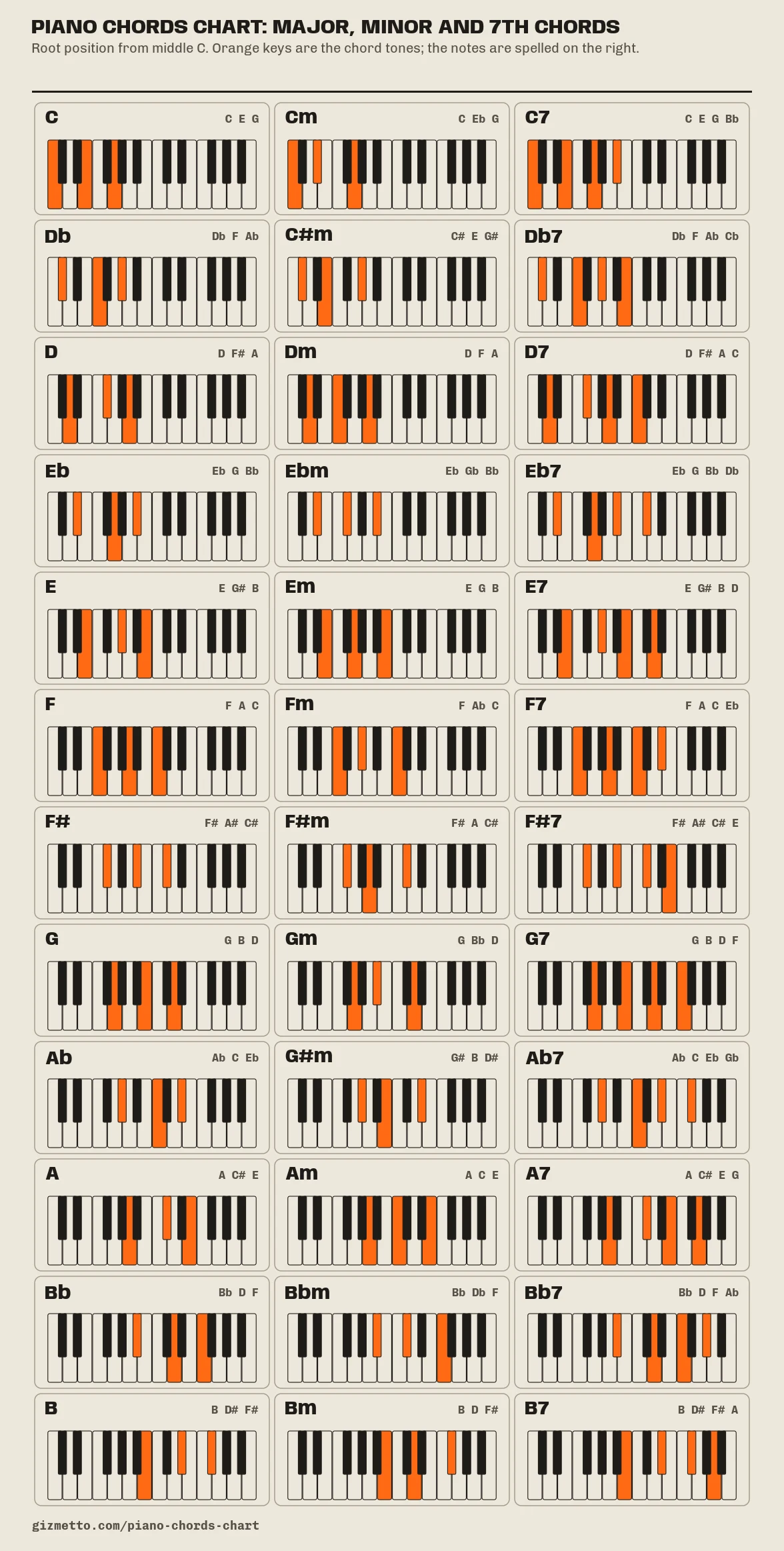
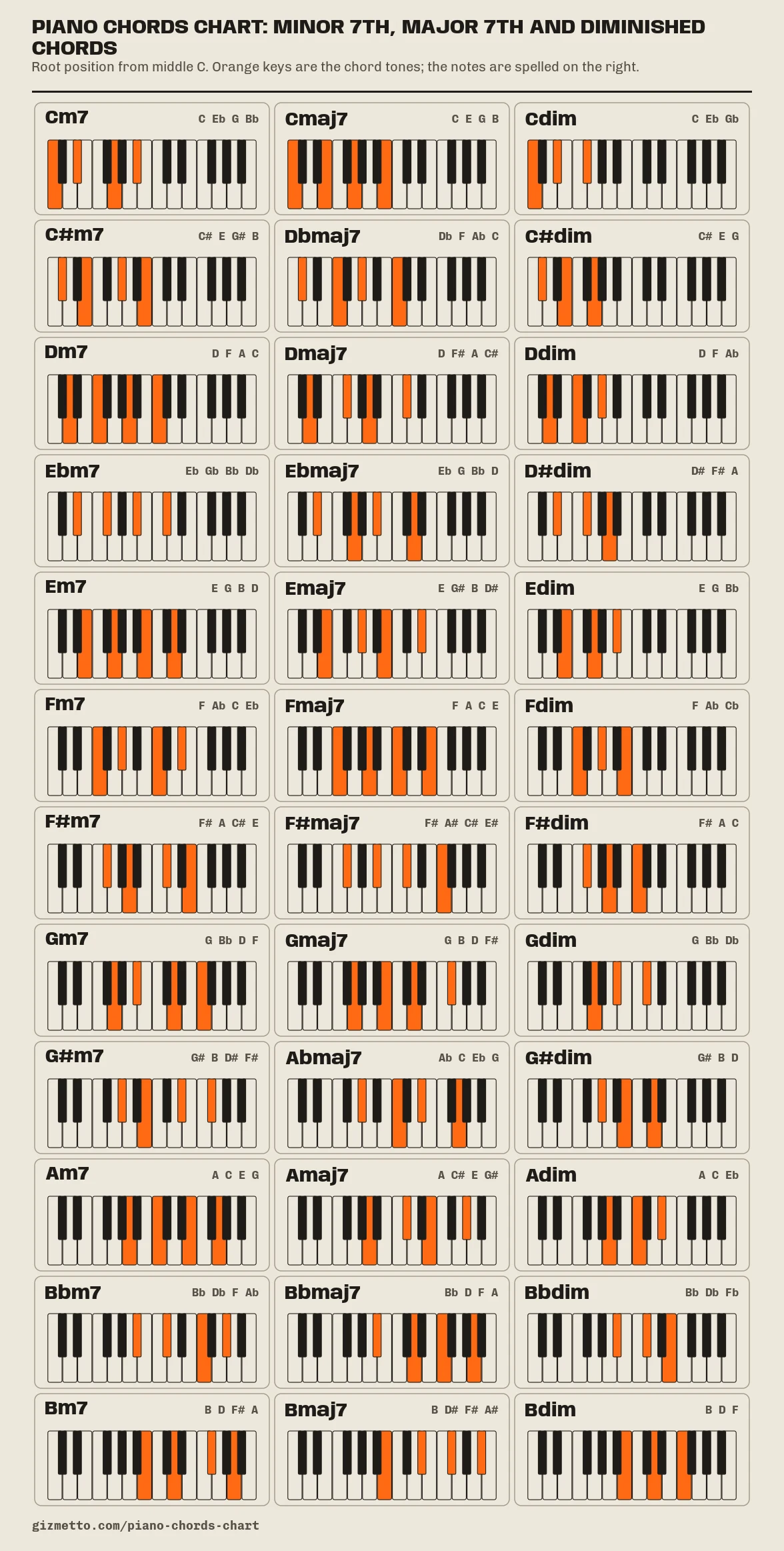
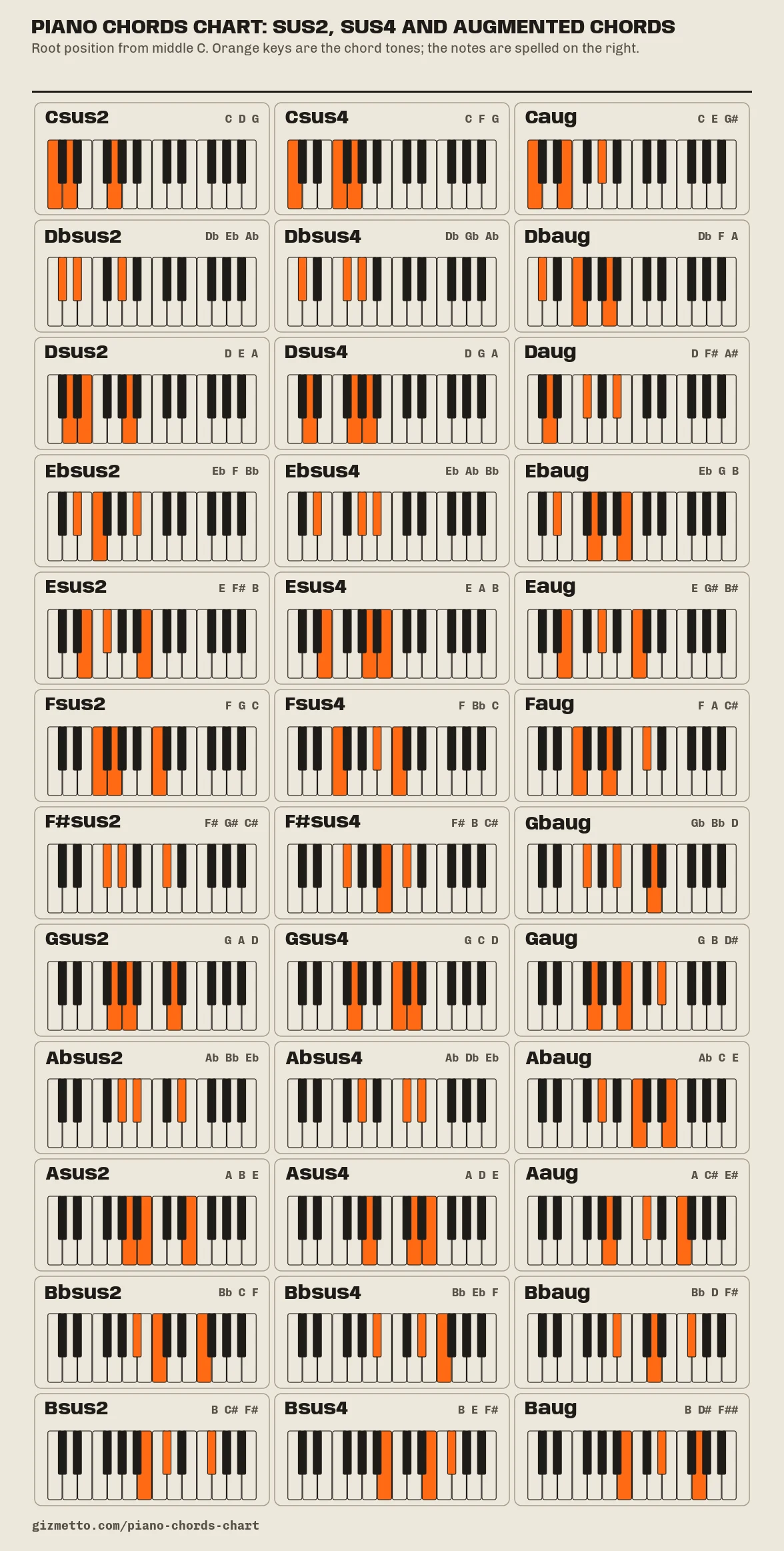
Three sheets with every root of each chord type in root position, keys lit and notes spelled. Print them (only the charts print, one per page) or download the images.
FAQ
Why is D♭ major spelled D♭ F A♭ and not C♯ F G♯?
A triad is built on every other letter: root, third and fifth. From D♭ the letters are D, F and A, so the notes are D♭, F and A♭. C♯ F G♯ uses the letters C, F and G, which are not every other letter, so it is not a correct spelling, even though it uses the same keys. The same chord can be spelled C♯ E♯ G♯ as C sharp major.
What are the first piano chords to learn?
C, G, F and A minor: all white keys, and together they play the I V vi IV progression in C. Then add D minor and E minor, the other two white-key minor chords.
What is a chord inversion?
The same notes with a different note at the bottom. Root position has the root lowest (C E G). First inversion moves the root to the top (E G C), and second inversion moves the third up too (G C E). Inversions let your hand move less between chords.
Which fingers do I use for piano chords?
For a right hand triad in root position use 1 3 5 (thumb, middle, little finger). Baylor Piano Basics teaches 1 2 5 for first inversion and 1 3 5 for second inversion, the same in every key. Seventh chords have four notes and their fingering depends on the passage, so the chart leaves them without numbers.
Why does E♭ diminished show as D♯ diminished?
Spelled from E♭, the diminished fifth would be B double flat. D♯ F♯ A is the same three keys without a double flat, so the chart uses that name. In the same way, F♯ augmented is shown as G♭ augmented (G♭ B♭ D).
Sources
Checked on 22 November 2026. A test checks the spelling and the intervals of all 108 chords: one letter per chord tone and the right number of semitones above the root.
- Open Music Theory: Triads, Seventh Chords and Triadic Inversion (Chelsey Hamm and Samuel Brady, VIVA open textbook) How to spell a chord by letter (every other letter from the root) and name its quality; the spelling rules on this page follow it.
- Baylor Piano Basics, chapter 19: Triad Inversions (Baylor University open textbook) Right hand blocked triads fingered 1 3 5 in root position, 1 2 5 in first inversion and 1 3 5 in second inversion, kept the same in every key. The chart gives fingers for major and minor triads only.
Related tools
All music chartsName every key on the piano, with octaves and the staff.
Find the chords of a song from a file or the microphone.
The same chords on the ukulele, with fingers.
Play a key and see its note and tuning.