Guitar Fretboard Notes Chart
Every note on the guitar fretboard in standard tuning, from the open strings to fret 12. Tap a fret to hear it and see it on the staff.
Tap a fret to hear it
Scientific pitch: middle C is C4. Frequencies at A4 = 440 Hz, equal temperament.
How to read a guitar fretboard chart
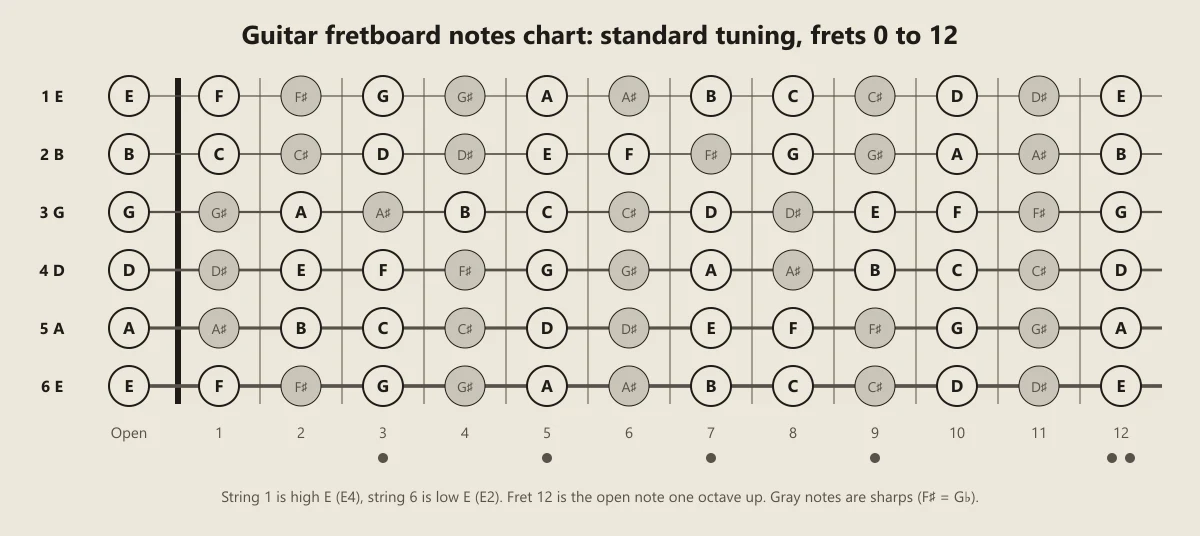
The chart is the neck of the guitar as you see it when you look down at it while you play: string 1, the thin high E, is on top, and string 6, the thick low E, is at the bottom. Fret 0 is the open string, on the left of the nut. The strings are tuned to E2, A2, D3, G3, B3 and E4, from string 6 to string 1.
Each fret raises the note by one semitone, the step from one piano key to the next. Twelve frets make an octave, so fret 12 plays the open note one octave higher and the pattern starts again.
- Step 1Tap a fretString 1, the thinnest, is on top, as in tab. Fret 0 is the open string. On a phone, swipe the fretboard sideways.
- Step 2Read the screenIt shows the note with its octave, its frequency, and how it is written on the treble staff.
- Step 3Choose sharps or flatsSwitch the names between sharps (F♯) and flats (G♭). The fret and the sound are the same.
Notes on every fret, 0 to 12
The note on each fret of each string in standard tuning, with the octave number. Notes that are black keys on a piano, such as F♯ / G♭, have two names.
| Fret | String 6, E | String 5, A | String 4, D | String 3, G | String 2, B | String 1, E |
|---|---|---|---|---|---|---|
| Open | E2 | A2 | D3 | G3 | B3 | E4 |
| 1 | F2 | A♯2 / B♭2 | D♯3 / E♭3 | G♯3 / A♭3 | C4 | F4 |
| 2 | F♯2 / G♭2 | B2 | E3 | A3 | C♯4 / D♭4 | F♯4 / G♭4 |
| 3 | G2 | C3 | F3 | A♯3 / B♭3 | D4 | G4 |
| 4 | G♯2 / A♭2 | C♯3 / D♭3 | F♯3 / G♭3 | B3 | D♯4 / E♭4 | G♯4 / A♭4 |
| 5 | A2 | D3 | G3 | C4 | E4 | A4 |
| 6 | A♯2 / B♭2 | D♯3 / E♭3 | G♯3 / A♭3 | C♯4 / D♭4 | F4 | A♯4 / B♭4 |
| 7 | B2 | E3 | A3 | D4 | F♯4 / G♭4 | B4 |
| 8 | C3 | F3 | A♯3 / B♭3 | D♯4 / E♭4 | G4 | C5 |
| 9 | C♯3 / D♭3 | F♯3 / G♭3 | B3 | E4 | G♯4 / A♭4 | C♯5 / D♭5 |
| 10 | D3 | G3 | C4 | F4 | A4 | D5 |
| 11 | D♯3 / E♭3 | G♯3 / A♭3 | C♯4 / D♭4 | F♯4 / G♭4 | A♯4 / B♭4 | D♯5 / E♭5 |
| 12 | E3 | A3 | D4 | G4 | B4 | E5 |
The lowest note is E2 on the open low E string, and fret 12 on the high E string is E5. For the exact frequency of each open string and ways to tune them, see the guitar string notes guide.
Guitar notes on the staff
Guitar music uses the treble clef, but it is written one octave higher than it sounds. The treble clef puts G4 on the second line; on guitar music that written G sounds as G3, the open G string. Some music shows this with a small 8 under the clef, as in the drawings here. There is no bass clef in guitar music.
So a note on the bottom line of the staff (written E4) can be played on the D string at fret 2, and it sounds E3. Tap any fret in the chart at the top of the page and the staff shows how it is written.
Tricks to remember the notes on the fretboard
- String order, 6 to 1: Eddie Ate Dynamite, Good Bye Eddie (E A D G B E).
- Fret 12: the same notes as the open strings, one octave up. Many guitars mark it with a double dot.
- The two E strings: strings 6 and 1 have the same names on every fret.
- Fret 5: the next open string, except fret 4 on the G string.
- Octaves: the same note is two strings up and two frets up (from strings 6 and 5), or two strings up and three frets up (from strings 4 and 3, because of the B string).
Start with the natural notes on the two lowest strings, with the fret of each in brackets:
- String 6, low E: E (0), F (1), G (3), A (5), B (7), C (8), D (10), E (12)
- String 5, A: A (0), B (2), C (3), D (5), E (7), F (8), G (10), A (12)
Printable guitar fretboard notes chart
The whole fretboard from the open strings to fret 12 on one page, laid out like the chart at the top of the page. Natural notes are in white circles and sharps in gray. Save it or print it and keep it next to your guitar.
FAQ
What are the notes of the guitar strings?
In standard tuning, from the thickest string (6) to the thinnest (1): E2, A2, D3, G3, B3, E4. The low E is 82.41 Hz and the high E is 329.63 Hz, two octaves higher.
What note is the 5th fret?
On every string but one, fret 5 plays the note of the next thinner open string: A on string 6, D on string 5, G on string 4 and E on string 2. The exception is the G string, where fret 4 gives B, the note of the open B string. Fret 5 on the G string is C.
Is F sharp the same as G flat on the guitar?
Yes. F♯ and G♭ are two names for the same fret and the same sound, for example fret 2 on the low E string. Music in sharp keys uses the sharp name and music in flat keys the flat name.
What are the notes after the 12th fret?
The same notes again, one octave higher. Fret 12 plays the open string an octave up, fret 13 is fret 1 an octave up, and so on to the last fret of your guitar.
Why is guitar music written an octave higher than it sounds?
At its real pitch the low E string would sit far below the treble staff. Guitar music is written on the treble clef one octave above the sound, often with a small 8 under the clef. A written middle C on guitar sounds as C3.
Does this chart work for bass guitar?
The note names do. A 4 string bass is tuned E A D G like the four lowest guitar strings, one octave lower, so each fret has the same name as on the guitar but sounds an octave below it.
Related tools
All music chartsTune each string with your microphone before you practice.
Play a fret and see which note it is and how far off.
Play a steady reference note to tune or play along with.
See the same notes on a piano keyboard and the grand staff.
Maintained by NabeelUpdated Nov 13, 2026.