Flute Fingering Chart
An interactive flute fingering chart for every note from C4 to C7. Tap a note to see the keys, hear it and check your own note with the microphone.
Tap a note
D5Concert
T 2 3 | 1 2 3
Processed on your device. Nothing is recorded.
How to read the flute fingering chart
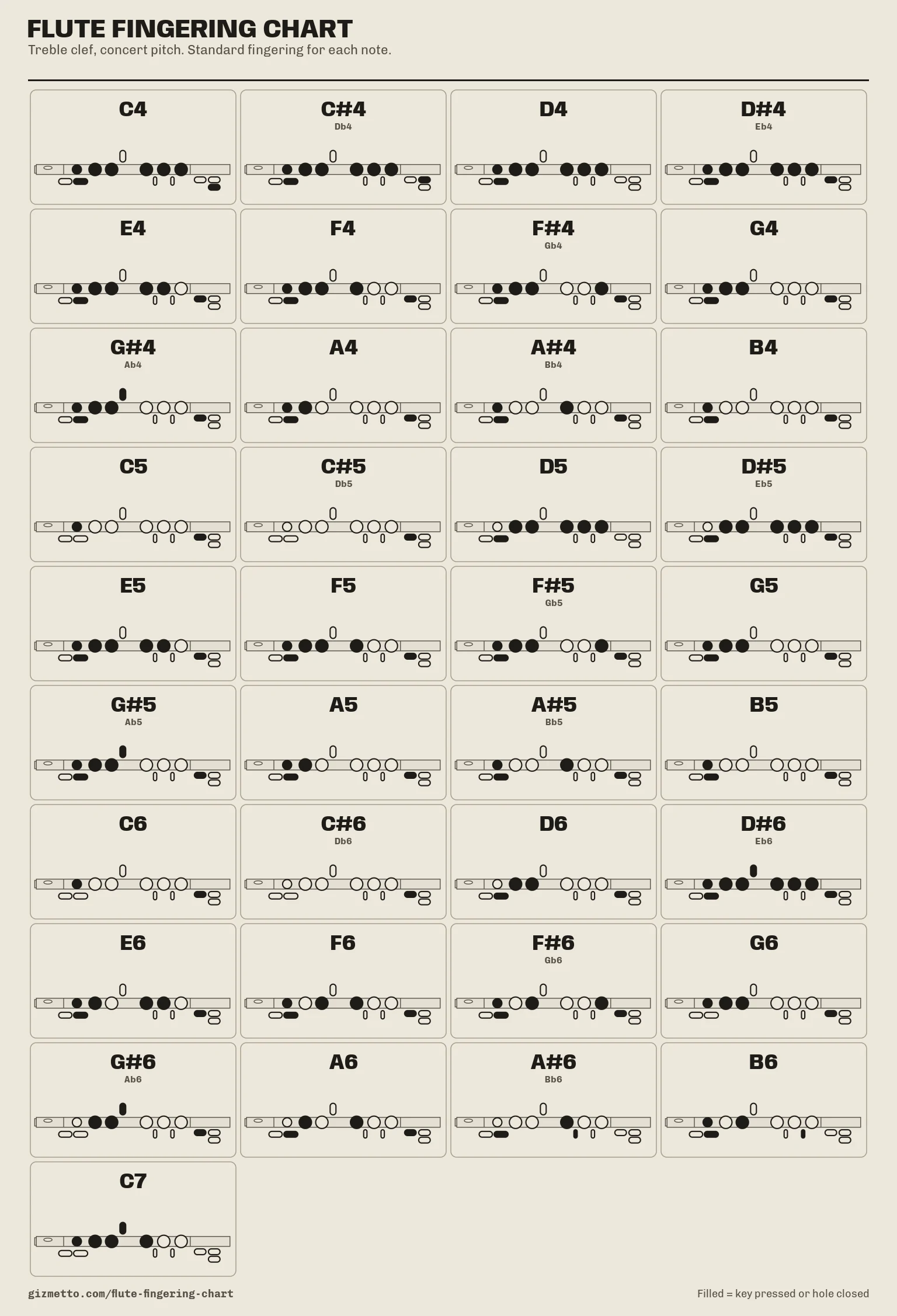
The diagram shows the flute as you see it in a printed chart: the headjoint at the left, the foot at the right. A filled key is pressed; an empty one stays up. The left thumb keys are under the body (the thumb key and, beside it, the B♭ lever). Then come the three left hand fingers, the G♯ key for the left little finger, the three right hand fingers with the two small trill keys between them, and the foot keys for the right little finger: E♭, then the C♯ and C rollers.
Under the diagram the fingering is also written out. "T 1 2 3 | 1 2 3 + E♭" means thumb and the first three fingers of the left hand, then the first three fingers of the right hand, plus the E♭ key. A 0 means no fingers of that hand. Every note is in the table below: the standard fingering first, then any alternates in brackets.
| Note | Fingering |
|---|---|
| C4 | T 1 2 3 | 1 2 3 + C |
| C♯4 / D♭4 | T 1 2 3 | 1 2 3 + C♯ |
| D4 | T 1 2 3 | 1 2 3 |
| D♯4 / E♭4 | T 1 2 3 | 1 2 3 + E♭ |
| E4 | T 1 2 3 | 1 2 + E♭ |
| F4 | T 1 2 3 | 1 + E♭ |
| F♯4 / G♭4 | T 1 2 3 | 3 + E♭ (or T 1 2 3 | 2 + E♭) |
| G4 | T 1 2 3 | 0 + E♭ |
| G♯4 / A♭4 | T 1 2 3 | 0 + G♯ + E♭ |
| A4 | T 1 2 | 0 + E♭ |
| A♯4 / B♭4 | T 1 | 1 + E♭ (or 1 | 0 + B♭ thumb + E♭) |
| B4 | T 1 | 0 + E♭ |
| C5 | 1 | 0 + E♭ (or 1 2 3 | 1 2 3 + C) |
| C♯5 / D♭5 | E♭ (or 2 3 | 1 2 3 + C) |
| D5 | T 2 3 | 1 2 3 |
| D♯5 / E♭5 | T 2 3 | 1 2 3 + E♭ |
| E5 | T 1 2 3 | 1 2 + E♭ |
| F5 | T 1 2 3 | 1 + E♭ |
| F♯5 / G♭5 | T 1 2 3 | 3 + E♭ (or T 1 2 3 | 2 + E♭) |
| G5 | T 1 2 3 | 0 + E♭ |
| G♯5 / A♭5 | T 1 2 3 | 0 + G♯ + E♭ |
| A5 | T 1 2 | 0 + E♭ |
| A♯5 / B♭5 | T 1 | 1 + E♭ (or 1 | 0 + B♭ thumb + E♭) |
| B5 | T 1 | 0 + E♭ |
| C6 | 1 | 0 + E♭ (or 1 2 3 | 1 2 3 + C) |
| C♯6 / D♭6 | E♭ |
| D6 | T 2 3 | 0 + E♭ |
| D♯6 / E♭6 | T 1 2 3 | 1 2 3 + G♯ + E♭ |
| E6 | T 1 2 | 1 2 + E♭ |
| F6 | T 1 3 | 1 + E♭ |
| F♯6 / G♭6 | T 1 3 | 3 + E♭ |
| G6 | 1 2 3 | 0 + E♭ |
| G♯6 / A♭6 | 2 3 | 0 + G♯ + E♭ (or 2 3 | 2 3 + G♯ + E♭) |
| A6 | T 2 | 1 + E♭ |
| A♯6 / B♭6 | T | 1 + D trill |
| B6 | T 1 3 | 0 + D♯ trill |
| C7 | 1 2 3 | 1 + G♯ |
The three octaves of the flute
The first octave runs from C4 up to C♯5. Each note adds or lifts one finger: close everything for D4, lift the right hand fingers from the bottom up for E4, F4 and G4, then the left hand fingers for A4, B4 and C5. C♯5 is almost open, with only the E♭ key down.
The second octave, D5 to C♯6, uses the same fingerings as the first, played with faster, more focused air. Two notes change: D5 and D♯5 lift the left first finger so the octave speaks.
The third octave, D6 to C7, has its own fingerings. They are cross fingerings that pick out higher harmonics, so they need to be learned one by one: E6 is thumb, 1 2 | 1 2 and E♭, and F♯6 is thumb, 1 3 | 3 and E♭. G6, G♯6 and C7 take the thumb off.
Alternate and trill fingerings
Both charts we checked give an alternate F♯ with the right middle finger in place of the ring finger. It is the trill fingering for trills between E and F♯. For B♭ there are two standard choices: the left first finger with the right first finger, or the thumb on the B♭ lever. C5, C♯5 and C6 also have long alternates with the thumb off and the right hand down, and G♯6 has one with the right middle and ring fingers down. Tap Fingerings in the chart to see each one.
The two charts do not agree on every alternate. Yamaha's alternate A adds the right ring finger where the Woodwind Fingering Guide uses only the right first finger, and they differ on the alternates for F♯6, A6, B♭6, B6 and C7. We left those out and kept only the alternates both charts give.
Concert pitch: no transposing
The flute is a concert pitch instrument, so the written note is the note you hear and you can read piano, violin and voice parts as they are. The Play key sounds each note, and Check my note listens for the same note, so the chart works side by side with a piano or a tuner.
Printable flute fingering chart
The chart below has every note from C4 to C7 with its standard fingering on the key diagram. Print it (only the chart prints) or download the image for a practice folder or a music stand.
Other charts: Piano notes chart, Guitar notes chart, Violin notes chart, Ukulele chords chart, Piano chords chart, Trumpet fingering chart, Tuba fingering chart, Euphonium fingering chart, Baritone fingering chart, Mellophone fingering chart, French horn fingering chart, Trombone slide position chart, Clarinet fingering chart, Recorder fingering chart, Bass clarinet fingering chart, Alto sax fingering chart. All of them are on the music charts page.
FAQ
Why do D5 and D4 have different fingerings?
Low D4 closes every finger hole. For D5 and D♯5 you lift the left first finger, which vents the tube and makes the octave speak cleanly. Both published charts we checked give these fingerings.
When does the right little finger stay on the E♭ key?
For almost every note. In this chart only C4, C♯4, D4, D5, B♭6, B6 and C7 leave the E♭ key up: C4 and C♯4 use the foot rollers instead, and D5 and the top three notes are fingered without it.
Which B♭ fingering should I use?
The standard B♭ is the B fingering plus the right first finger. The thumb B♭ lever (thumb on the lever, left first finger only) is easier in keys with many flats; the Woodwind Fingering Guide advises it for passages with no B natural.
Is the flute a transposing instrument?
No. The concert flute is in C: a written C sounds as a C, so the notes in this chart are the notes you hear. The piccolo uses the same fingerings and sounds an octave higher than written.
Does an open-hole flute use different fingerings?
No, the standard fingerings are the same. On an open-hole flute your fingers also cover the holes in the middle of the ring keys. The open holes allow some extra alternate and special fingerings.
How does Check my note work?
Tap Check my note and allow the microphone, then play the note shown. The chart compares the pitch you play with the note you chose and says in tune (within 10 cents), sharp, flat, or which note you played instead. Nothing is recorded.
Sources
Every fingering on this page was checked note by note against these published charts on 13 November 2026. Where they differ, the page says so.
- Yamaha, Flute fingering chart (Musical instrument guide) Every note from C4 to C7 on a full key diagram, with alternates.
- The Woodwind Fingering Guide, basic fingering chart for flute (first to third octave) and alternate fingerings Every note from B3 to C7 in written notation, with trill and alternate fingerings.
Related tools
All music chartsUse it as a flute tuner: play any note and see how many cents off you are.
Hold a steady reference note while you practise long tones and harmonics.
Tap a tempo or play a click track to practise with.