Noise Generator
White, pink and brown noise made in your browser, with a volume, a sleep timer and gentle fades.
Ready
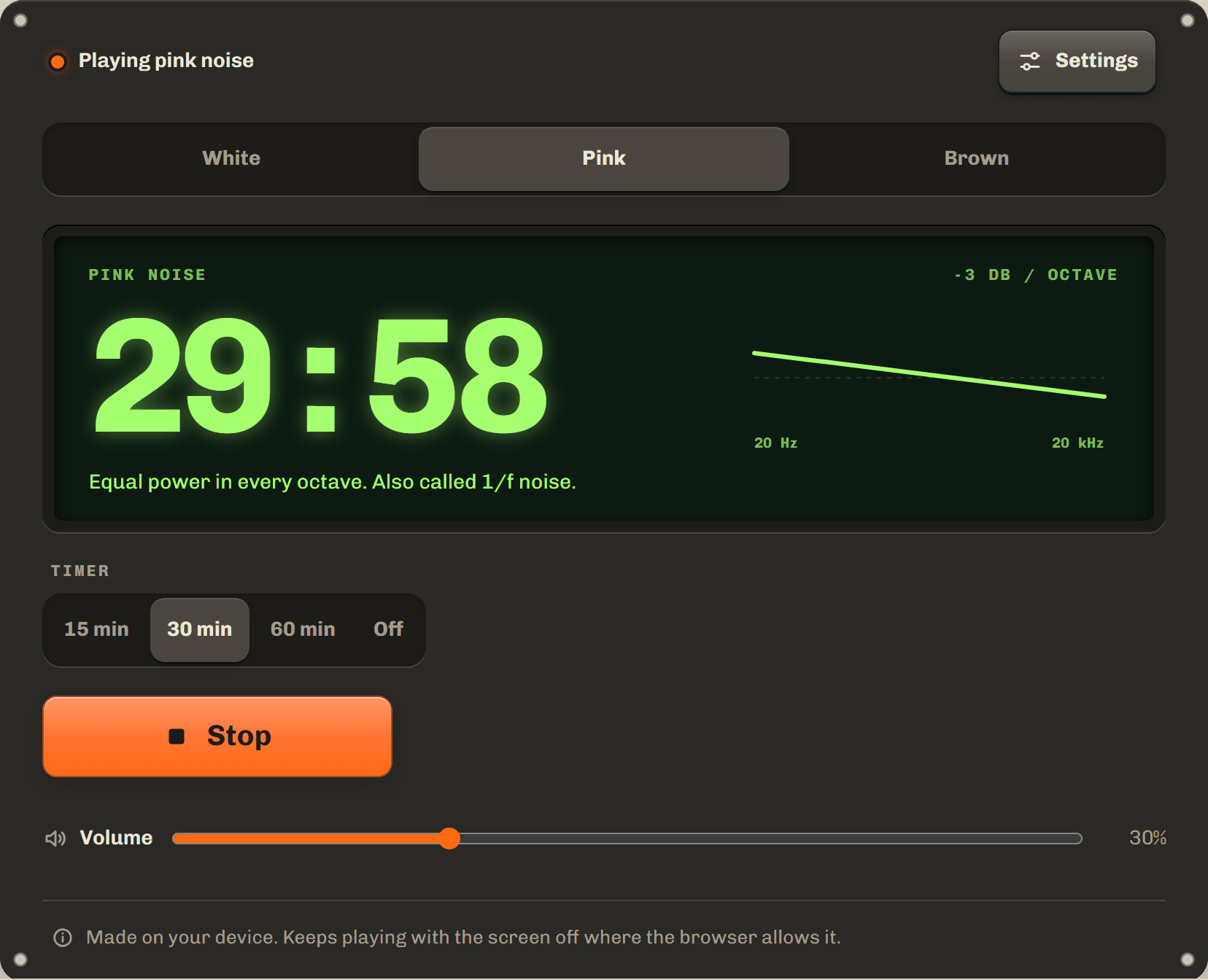
Equal power in every octave. Also called 1/f noise.
Settings
On: the noise fades in over 5 seconds and fades out over the last 30 seconds of the timer.
Made on your device. Keeps playing with the screen off where the browser allows it.
How to use the noise generator
- Step 1Pick a colorChoose White, Pink or Brown. The screen shows the shape of its spectrum, from 20 Hz to 20 kHz.
- Step 2Set the timerChoose 15, 30 or 60 minutes, or Off to play until you stop it.
- Step 3PlayTap Play. The noise fades in over 5 seconds and, with a timer, fades out over its last 30 seconds. Settings can turn the fades off.
- Step 4Set the volumeIt starts at 30%. Keep it as low as still works for you. You can switch colors while it plays.
The noise keeps playing while you use other tabs. With the screen off, it keeps playing where the browser allows it; on some phones a web page is paused when the screen locks. Headset and lock screen keys can stop it in browsers that support media controls.
White, pink and brown noise: what the colors mean
All three are random signals. What differs is how their power is spread over frequency, the spectrum. The names and slopes below follow the usual definitions, as on the colors of noise page.
| Color | Power per hertz | Law | Power per octave | How this tool makes it |
|---|---|---|---|---|
| White | Flat (0 dB per octave) | Same at every frequency | Doubles with each octave up | Random samples, each one independent |
| Pink | Falls 3 dB per octave | 1/f | Same in every octave | White noise through a pink filter |
| Brown | Falls 6 dB per octave | 1/f² | Halves with each octave up | White noise, integrated |
White noise has the same power at every frequency. Since each octave up spans twice as many hertz, most of its energy sits in the treble, and it sounds like a bright hiss.
Pink noise falls 3 dB per octave, which leaves the same power in every octave: as much between 100 and 200 Hz as between 5 and 10 kHz. It sounds fuller and less sharp than white noise. Audio engineers use it to test speakers and rooms for this reason.
Brown noise falls 6 dB per octave, so the low end dominates and it sounds like a deep rumble. It is named after Brownian motion, not the color, and is also called red noise.
How the noise is made
Nothing is streamed or recorded. When you first play a color, the page computes 12 seconds of it for each ear, with a different random seed per ear, and the Web Audio API loops it with no gap or click.
- White: independent random samples with a normal (bell curve) distribution.
- Pink: white noise through Paul Kellet's refined pink filter, a sum of first-order filters thatstays within ±0.05 dB of the ideal slope above 9.2 Hz at a 44.1 kHz sample rate.
- Brown: white noise integrated, each sample adding to the last, which is how a random walk works. A small leak stops the sum drifting away, so below about 15 Hz the slope flattens, far under what speakers play.
Our unit tests measure the result in octave bands from 100 Hz to 12.8 kHz: white rises about 3 dB per octave band, pink stays flat, and brown falls about 3 dB per octave band, matching the 0, −3 and −6 dB per octave per hertz in the table.
Sleep and focus: what the evidence says
Many people play noise to fall asleep or to mask sounds while they work. The research is less clear than the claims you may see online. A 2021 systematic review in Sleep Medicine Reviews (Riedy, Smith, Rocha and Basner) looked at 38 studies of continuous noise as a sleep aid. It found results that ranged from better sleep to more disturbed sleep, rated the evidence that noise improves sleep as very low quality, and called for more research before noise is promoted as a sleep aid. It also warned that noise may harm sleep and hearing.
So this page makes no health claim for any color. If you like a steady sound in the background, pick the color you find least annoying, keep the volume low, and use the timer so it does not play all night.
Volume
The noise starts at 30% and the control turns amber above 70%. The same slider setting sounds different on every device, so start low and raise it slowly. On headphones, keep it lower than on speakers. Brown noise can seem quiet on a phone or laptop speaker because those speakers play little bass; turning it up to make up for that mostly makes the speaker buzz.
FAQ
Which noise is best for sleep or focus?
Nobody knows for sure. A 2021 systematic review of 38 studies (Riedy and colleagues, Sleep Medicine Reviews) rated the evidence that continuous noise improves sleep as very low quality, found results that ranged from better sleep to more disturbed sleep, and asked for more research before noise is promoted as a sleep aid. Many people simply like one color more than another. Try each one at a low volume and see what you prefer.
Does it keep playing when my screen locks?
Where the browser allows it, yes: the sound is made on your device and the timer's end is scheduled in the audio itself, so it does not depend on the page staying awake. Some phones and browsers pause sound from a web page when the screen locks or the tab is in the background. If that happens, the page tells you when you come back.
Why does white noise sound so hissy?
Because it has the same power at every frequency, and each octave up covers twice as many frequencies as the one below. The octave from 10 to 20 kHz holds half of all its power above 20 Hz. Pink noise gives each octave the same power, and brown noise even less to the higher ones, so they sound deeper.
Is brown noise really brown?
No. It is named after Brownian motion, the random movement Robert Brown saw in particles, because a random walk has the same spectrum. It is also called red noise. White and pink are named by analogy with light.
Is it a recording, and is anything stored?
No recording. Your browser makes 12 seconds of noise per ear when you first play a color and repeats it with no gap. Nothing is uploaded or saved.
Related tools
All audio toolsPlay a single frequency, a sweep or a note.
Check left, right and balance before a long listen.
See how loud your room is in dB.
Maintained by NabeelUpdated Nov 22, 2026.