Tuba Fingering Chart
Pick 3 or 4 valves, tap a note to see the fingering, hear it and check your own note with the microphone.
Tap a note
F2Concert
Open · 3rd partial
Processed on your device. Nothing is recorded.
How to read the tuba fingering chart
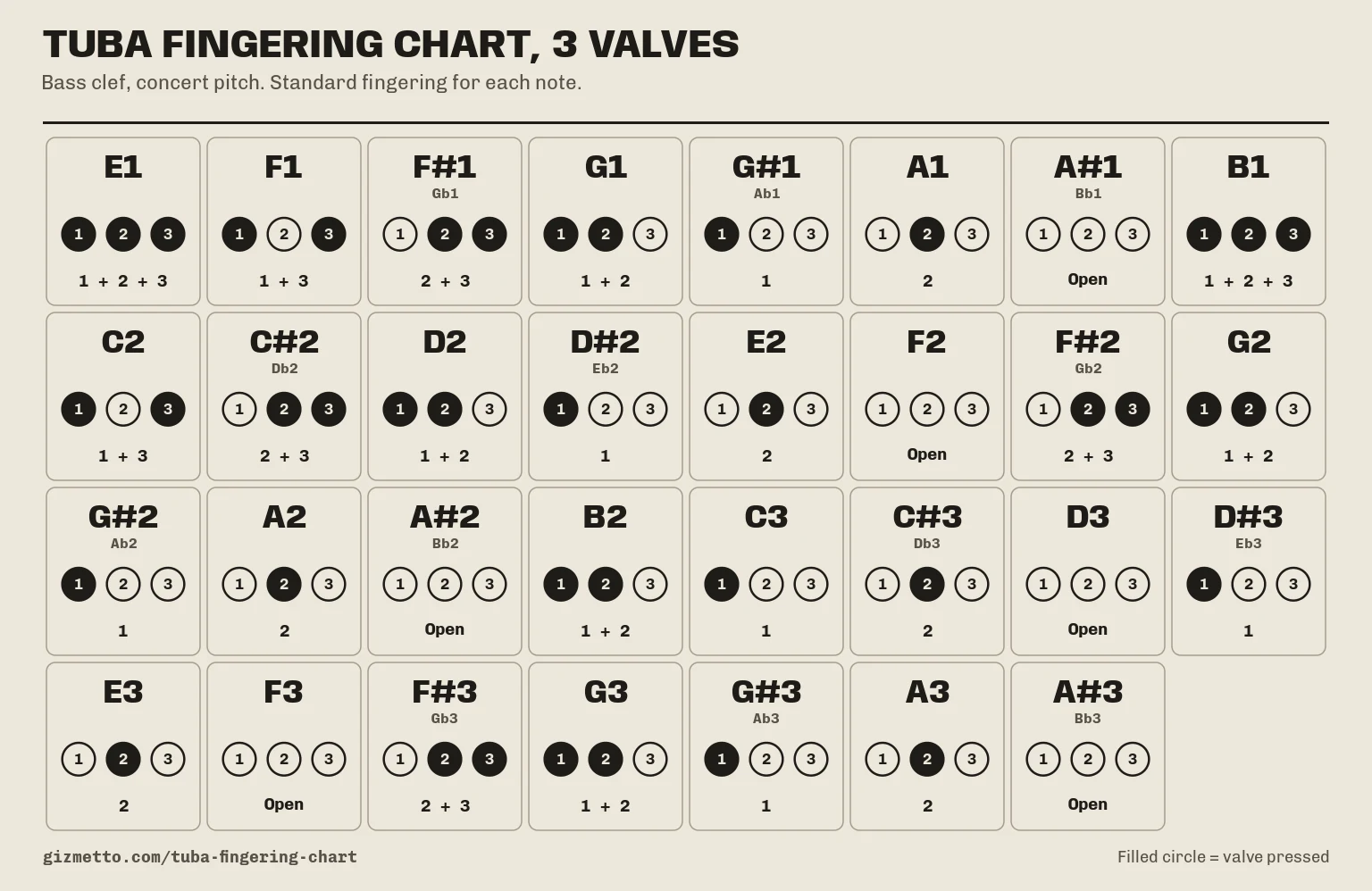
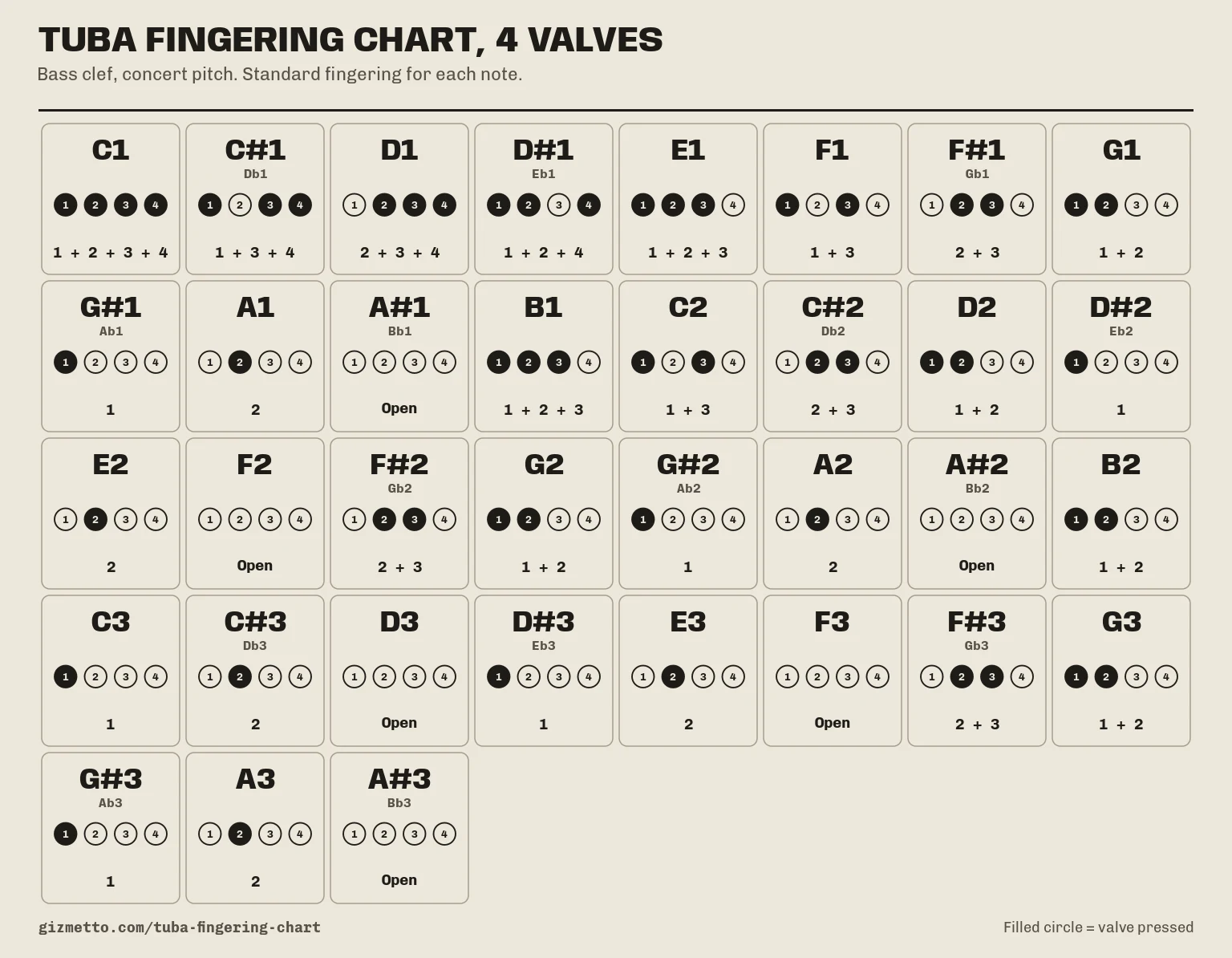
The circles are the valves, 1 to 3 (and 4 on a 4-valve tuba). A filled circle means press that valve; an empty one means leave it up. "Open" means no valves. Choose 3 valves or 4 valves at the top of the chart, then tap a note on the strip or step with the arrows.
This chart is for the BB♭ tuba. The table has every note from C1 to B♭3: the standard fingering first, then alternates in brackets. The 4 valves column shows where a 4th valve gives you another option.
| Note | 3 valves | 4 valves |
|---|---|---|
| C1 | not on this model | 1 + 2 + 3 + 4 |
| C♯1 / D♭1 | not on this model | 1 + 3 + 4 |
| D1 | not on this model | 2 + 3 + 4 |
| D♯1 / E♭1 | not on this model | 1 + 2 + 4 |
| E1 | 1 + 2 + 3 | 1 + 2 + 3 (or 2 + 4) |
| F1 | 1 + 3 | 1 + 3 (or 4) |
| F♯1 / G♭1 | 2 + 3 | 2 + 3 |
| G1 | 1 + 2 (or 3) | 1 + 2 (or 3) |
| G♯1 / A♭1 | 1 | 1 |
| A1 | 2 | 2 |
| A♯1 / B♭1 | Open | Open |
| B1 | 1 + 2 + 3 | 1 + 2 + 3 (or 2 + 4) |
| C2 | 1 + 3 | 1 + 3 (or 4) |
| C♯2 / D♭2 | 2 + 3 | 2 + 3 |
| D2 | 1 + 2 (or 3) | 1 + 2 (or 3) |
| D♯2 / E♭2 | 1 | 1 |
| E2 | 2 (or 1 + 2 + 3) | 2 (or 2 + 4, or 1 + 2 + 3) |
| F2 | Open (or 1 + 3) | Open (or 4, or 1 + 3) |
| F♯2 / G♭2 | 2 + 3 | 2 + 3 |
| G2 | 1 + 2 (or 3) | 1 + 2 (or 3) |
| G♯2 / A♭2 | 1 | 1 |
| A2 | 2 | 2 |
| A♯2 / B♭2 | Open (or 2 + 3) | Open (or 2 + 3) |
| B2 | 1 + 2 (or 3, or 1 + 2 + 3) | 1 + 2 (or 3, or 2 + 4, or 1 + 2 + 3) |
| C3 | 1 (or 1 + 3) | 1 (or 4, or 1 + 3) |
| C♯3 / D♭3 | 2 (or 2 + 3) | 2 (or 2 + 3) |
| D3 | Open (or 1 + 2, or 3) | Open (or 1 + 2, or 3) |
| D♯3 / E♭3 | 1 | 1 |
| E3 | 2 | 2 |
| F3 | Open | Open |
| F♯3 / G♭3 | 2 + 3 | 2 + 3 |
| G3 | 1 + 2 (or 3) | 1 + 2 (or 3) |
| G♯3 / A♭3 | 1 | 1 |
| A3 | 2 | 2 |
| A♯3 / B♭3 | Open (or 1) | Open (or 1) |
Tuba registers and partials
With no valves, a BB♭ tuba plays the partials of one harmonic series: B♭1 (the 2nd partial), F2 (3rd), B♭2 (4th), D3 (5th), F3 (6th) and B♭3 (8th). The 7th partial, near A♭3, is flat, so A♭3 is normally played with valve 1. The 1st partial, the pedal B♭0, is below this chart.
Each valve lowers every partial: valve 2 by a half step, valve 1 by a whole step, valve 3 (or 1 and 2) by a step and a half and valve 4 by a perfect fourth. In the low register, E1 to B♭1, all seven 3-valve combinations go down from the 2nd partial. From F2 upward the partials are closer, so fewer valves are needed between them.
Alternate fingerings and the harmonic series
Each fingering has its own harmonic series, so one fingering plays several notes. Valves 1 and 3 give F1, C2, F2 and C3, each on another partial. And many notes have more than one fingering: 3 instead of 1 and 2 for G1, D2, G2, B2 and G3, or 2 and 3 for B♭2 and C♯3. Tap Fingerings in the chart to see each one.
On a 4-valve tuba, 2 and 4 is an alternate for E1, B1, E2 and B2, and 4 alone for F1, C2, F2 and C3. Everett's chart lists 2 and 4 first for E1 and 4 first for F1; the Yamaha chart lists 1, 2 and 3 and 1 and 3 first. This chart keeps the 3-valve fingering as the standard, which both charts list.
Written vs concert pitch
Tuba parts in concert bands and orchestras are written in bass clef at concert pitch: the written note is the note that sounds. So this chart has no Concert pitch switch, and a tuba B♭ matches a piano B♭.
British-style brass bands are the exception: they write the bass parts in treble clef as transposing parts. This chart is for bass clef parts. The Play key always plays the note that sounds, and Check my note listens for it.
Printable tuba fingering chart
There is one chart for a 3-valve tuba and one for a 4-valve tuba. Print them (only the charts print, one per page) or download the image you need.
Other charts: Piano notes chart, Guitar notes chart, Violin notes chart, Ukulele chords chart, Piano chords chart, Trumpet fingering chart, Euphonium fingering chart, Baritone fingering chart, Mellophone fingering chart, French horn fingering chart, Trombone slide position chart, Flute fingering chart, Clarinet fingering chart, Recorder fingering chart, Bass clarinet fingering chart, Alto sax fingering chart. All of them are on the music charts page.
FAQ
What does the 4th valve do on a tuba?
It lowers the pitch by a perfect fourth, five half steps. That adds the notes below E1 (down to C1 on this chart) and gives easier fingerings for some low notes: 2 and 4 for E1 and B1, and 4 alone for F1 and C2.
Does this chart work for a CC, E♭ or F tuba?
No. This chart is for a BB♭ tuba. On a CC, E♭ or F tuba the open notes are different, so the same written note takes a different fingering. Use a chart made for that tuba.
What is a compensating tuba?
A tuba with extra tubing that corrects the long valve combinations, so the lowest notes need other fingerings. For C1 to E♭1 both charts we checked give 1 + 3 + 4, 2 + 3 + 4, 1 + 2 + 4 and 1 + 4 on a compensating tuba.
Why do B♭1, F2 and B♭2 all use no valves?
They are the 2nd, 3rd and 4th partials of the open tube. With no valves pressed the tuba plays one harmonic series, and your lips choose the partial.
Can the microphone hear low tuba notes?
Usually, yes. The pitch detector reads notes down to about 27 Hz, and E1 is 41 Hz. Play close to the microphone. Some phone and laptop microphones pick up very low notes weakly; a headset or USB microphone helps.
Sources
Every fingering on this page was checked note by note against these published charts on 13 November 2026. Where they differ, the page says so.
- Micah Everett, Chromatic Fingering Chart for BB♭ Tuba (University of Mississippi) 3 and 4 valves, compensating and non-compensating, with alternates in order of preference.
- Yamaha, Alto (Tenor) Horn, Baritone, Euphonium, Tuba and Sousaphone Owner's Manual, chart "B♭ Tuba in C" 3 and 4 valves, B♭0 to B♭3, with alternates.
- Brian N. Weidner, Brass Techniques and Pedagogy, tuba fingering chart (PALNI Pressbooks) A third check of the 3-valve fingerings.
Related tools
All music chartsUse it as a tuba tuner: play any note and see how many cents off you are.
Hold a steady reference note for long tones and tuning.
Tap a tempo or play a click track to practise with.