Hieroglyphics Translator
Write a name or word in Egyptian hieroglyphs, letter by sound, with the alphabet signs Egyptologists use. Add a cartouche for names.
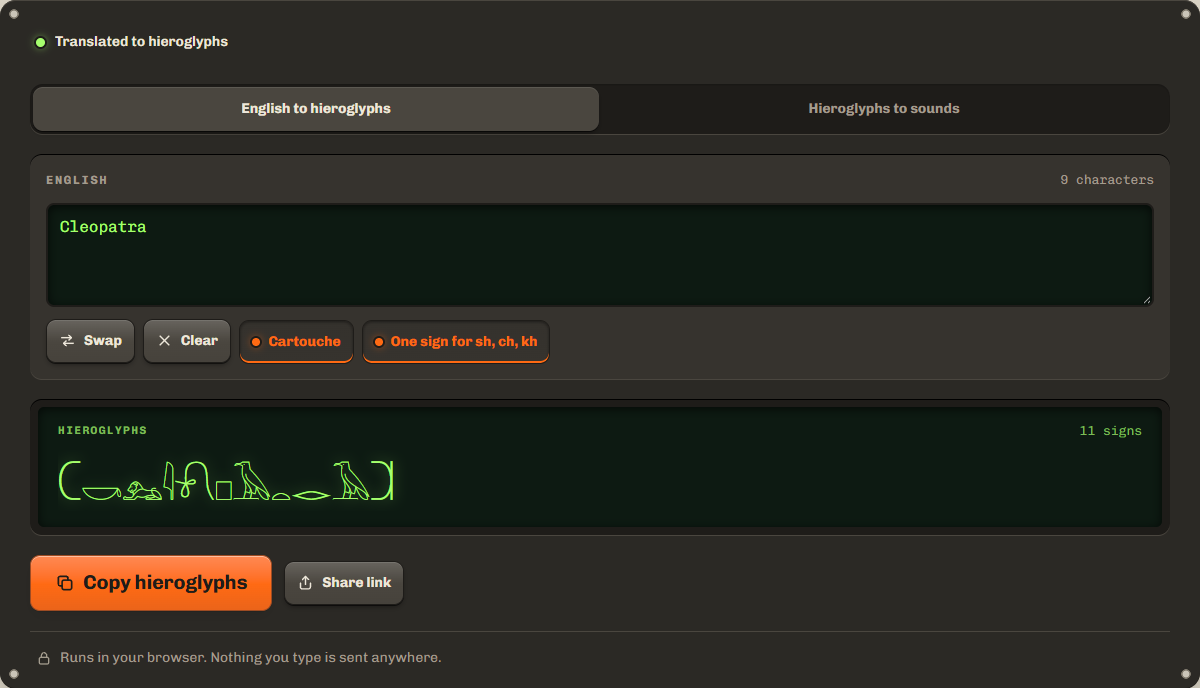
Translated to hieroglyphs
Hieroglyphs
9 signsRuns in your browser. Nothing you type is sent anywhere.
Spelling by sound, not translation
Hieroglyphs were a full writing system with hundreds of signs. Some stood for whole words, some for groups of two or three consonants, and about two dozen stood for one consonant each. Those single sound signs, called uniliterals, are what people call the hieroglyphic alphabet, and they are what this tool uses. It changes the letters of your text into signs, the way you might spell your name in Greek letters. It does not know the Egyptian words, so the result is a spelling of English, not ancient Egyptian.
- Step 1Type a name or wordEach letter becomes the Egyptian sign for the closest sound, so the result spells your word, it does not translate it.
- Step 2Add a cartoucheTurn on Cartouche to ring each word in the oval that Egyptians used for royal names.
- Step 3Copy or read backCopy the signs as text, or paste hieroglyphs in Hieroglyphs to sounds to see the letters they stand for.
The signs are named by their number in Gardiner's sign list, from Alan Gardiner's Egyptian Grammar (1927), the standard way to refer to a hieroglyph. G1 is the first bird sign, D58 a body part, and so on. The output is real text from the Unicode Egyptian Hieroglyphs block, which Unicode 5.2 added in 2009 with the Gardiner set of signs.
Hieroglyphic alphabet chart
The English letters, the sign the translator writes for each, its Gardiner number and Unicode code point, and the Egyptian sound it stood for. Letters that share a sign are on one row.
| Letter | Sign | Gardiner | Unicode | Picture | Egyptian sound |
|---|---|---|---|---|---|
| A | 𓄿 | G1 | U+1313F | Egyptian vulture | ꜣ (a glottal sound) |
| B | 𓃀 | D58 | U+130C0 | Foot and lower leg | b |
| C, K | 𓎡 | V31 | U+133A1 | Basket with handle | k |
| D | 𓂧 | D46 | U+130A7 | Hand | d |
| E, I | 𓇋 | M17 | U+131CB | Flowering reed | i (a short vowel or y sound) |
| F, V | 𓆑 | I9 | U+13191 | Horned viper | f |
| G | 𓎼 | W11 | U+133BC | Jar stand | g |
| H | 𓉔 | O4 | U+13254 | Reed shelter | h |
| J | 𓆓 | I10 | U+13193 | Cobra | ḏ (dj) |
| L | 𓃭 | E23 | U+130ED | Recumbent lion | rw, used for l |
| M | 𓅓 | G17 | U+13153 | Owl | m |
| N | 𓈖 | N35 | U+13216 | Ripple of water | n |
| O | 𓍯 | V4 | U+1336F | Lasso | wꜣ |
| P | 𓊪 | Q3 | U+132AA | Stool | p |
| Q | 𓈎 | N29 | U+1320E | Sandy hill slope | q (a k far back in the throat) |
| R | 𓂋 | D21 | U+1308B | Mouth | r |
| S | 𓋴 | S29 | U+132F4 | Folded cloth | s |
| T | 𓏏 | X1 | U+133CF | Bread loaf | t |
| U, W | 𓅱 | G43 | U+13171 | Quail chick | w (or u) |
| Y | 𓇌 | M17a | U+131CC | Two flowering reeds | y |
| Z | 𓊃 | O34 | U+13283 | Door bolt | z (later s) |
| SH | 𓈙 | N37 | U+13219 | Pool of water | š (sh) |
| CH | 𓍿 | V13 | U+1337F | Tethering rope | ṯ (tj, close to ch) |
| KH | 𓐍 | Aa1 | U+1340D | Placenta (or sieve) | ḫ (kh, as in Scottish loch) |
| X | 𓎡𓋴 | V31 + S29 | U+133A1, U+132F4 | Basket and folded cloth | k + s |
The signs were not an alphabet to the Egyptians. Scribes mixed them with word signs and with determinatives, silent signs at the end of a word that show what kind of thing it is. A name written only with sound signs is how later scribes wrote foreign names, such as Ptolemy and Cleopatra, and it is how Jean-François Champollion began to read hieroglyphs in 1822.
Letters Egyptian did not have
Egyptian writing showed consonants only, and its sounds were not the same as English ones. Charts fill the gaps in the same few ways, and this tool follows the common choices:
- Vowels. A uses the vulture 𓄿, a throat sound that Egyptologists say as a. E and I use the reed 𓇋, U uses the quail chick 𓅱, and O uses the lasso 𓍯, which charts borrow for its wꜣ sound.
- L. Egyptian had no l. Late scribes wrote it with the lion 𓃭, so Cleopatra's name has a lion in it, and so does the chart.
- V and C. V uses the horned viper 𓆑 of f, the nearest sound. C is written as the k sound with the basket 𓎡; for a soft c, as in Cecil, type s instead.
- X. There is no x, so it becomes its two sounds, k and s: 𓎡𓋴.
- Sh, ch and kh. Egyptian had single signs for these sounds: the pool 𓈙, the tethering rope 𓍿 and the placenta 𓐍. The tool uses them by default; turn off One sign for sh, ch, kh to spell the letters one by one.
Digits and punctuation stay as you typed them, because the Egyptian number signs work differently from ours. Accented letters are read without the accent, and letters from other alphabets are kept and listed under the result.
Names in a cartouche
A cartouche is the oval ring that Egyptians drew around the names of kings and queens. With Cartouche on, the translator puts each word between the two ends of a cartouche (Unicode signs V11a and V11b). How well the ends join around the signs depends on the font.
| Name | In hieroglyphs | Reads back as |
|---|---|---|
| Cleopatra | 𓍹𓎡𓃭𓇋𓍯𓊪𓄿𓏏𓂋𓄿𓍺 | kliopatra |
| Alexander | 𓍹𓄿𓃭𓇋𓎡𓋴𓄿𓈖𓂧𓇋𓂋𓍺 | aliksandir |
| Sophia | 𓍹𓋴𓍯𓊪𓉔𓇋𓄿𓍺 | sophia |
| Muhammad | 𓍹𓅓𓅱𓉔𓄿𓅓𓅓𓄿𓂧𓍺 | mwhammad |
| Olivia | 𓍹𓍯𓃭𓇋𓆑𓇋𓄿𓍺 | olifia |
The last column shows what a reader of the signs gets back: sounds without the English spelling, such as k for the C of Cleopatra. That is what Hieroglyphs to sounds in the tool gives you too.
Fonts for hieroglyphs
The hieroglyphs are Unicode characters, so they copy and paste like letters, but they only show where a font has them. This page uses no special font and relies on the one your device has. Windows 10 and 11 include the block in Segoe UI Historic, and Apple and Android systems ship Noto fonts that cover it. If you see empty boxes, install the free Noto Sans Egyptian Hieroglyphs font, or check the signs against the Unicode chart.
FAQ
Does this translate English into ancient Egyptian?
No. It spells English words with the Egyptian sound signs, the way you might write your name in another alphabet. A real translation would need Egyptian words and grammar, which this tool does not have. Cat comes out as the signs for k, a and t, not the Egyptian word for cat.
Why are some letters the same sign?
Egyptian had fewer sounds than English spelling has letters, and it did not write vowels. E and I share the reed, U and W the quail chick, F and V the horned viper, and C and K the basket. That is also why reading the signs back gives sounds, not your original spelling.
How do I write my name in hieroglyphs?
Type it in the translator and turn on Cartouche. Egyptians wrote royal names inside a cartouche, an oval ring, and it is the usual way to show a name today. Spell it as it sounds if you like: Kate and Cate give the same signs.
Why do I see boxes instead of hieroglyphs?
Your device has no font with the Egyptian Hieroglyphs block. Windows 10 and 11 include them in Segoe UI Historic, and Apple and Android systems ship Noto fonts that cover them, but some older devices and apps do not. Installing the free Noto Sans Egyptian Hieroglyphs font fixes it on a computer.
Which direction do hieroglyphs read?
Egyptians wrote right to left, left to right or in columns, and the signs that show people and animals face the start of the line. This tool writes left to right, the way most modern books print them.
Are these the same signs as on a hieroglyph alphabet chart from a museum?
Mostly yes. The charts agree on most letters and differ on a few choices, such as the shelter or the twisted flax for H and the lasso or the quail chick for O. The chart on this page shows which sign the tool uses and why.
Sources: Unicode, Egyptian Hieroglyphs chart (U+13000); Unicode 5.2.0; Alan Gardiner, Egyptian Grammar, sign list.
Related tools
All creator toolsTurn text into Wingdings symbols that paste anywhere.
Turn English into Unified English Braille, cell by cell.
Turn text into binary, with UTF-8 for any character.
Maintained by NabeelUpdated Nov 22, 2026.