Trombone Slide Position Chart
Tap a note to see its slide position, hear how it sounds and check your own note with the microphone.
Tap a note
F3Concert
Position 1 · 3rd partial
Processed on your device. Nothing is recorded.
How to read the trombone slide position chart
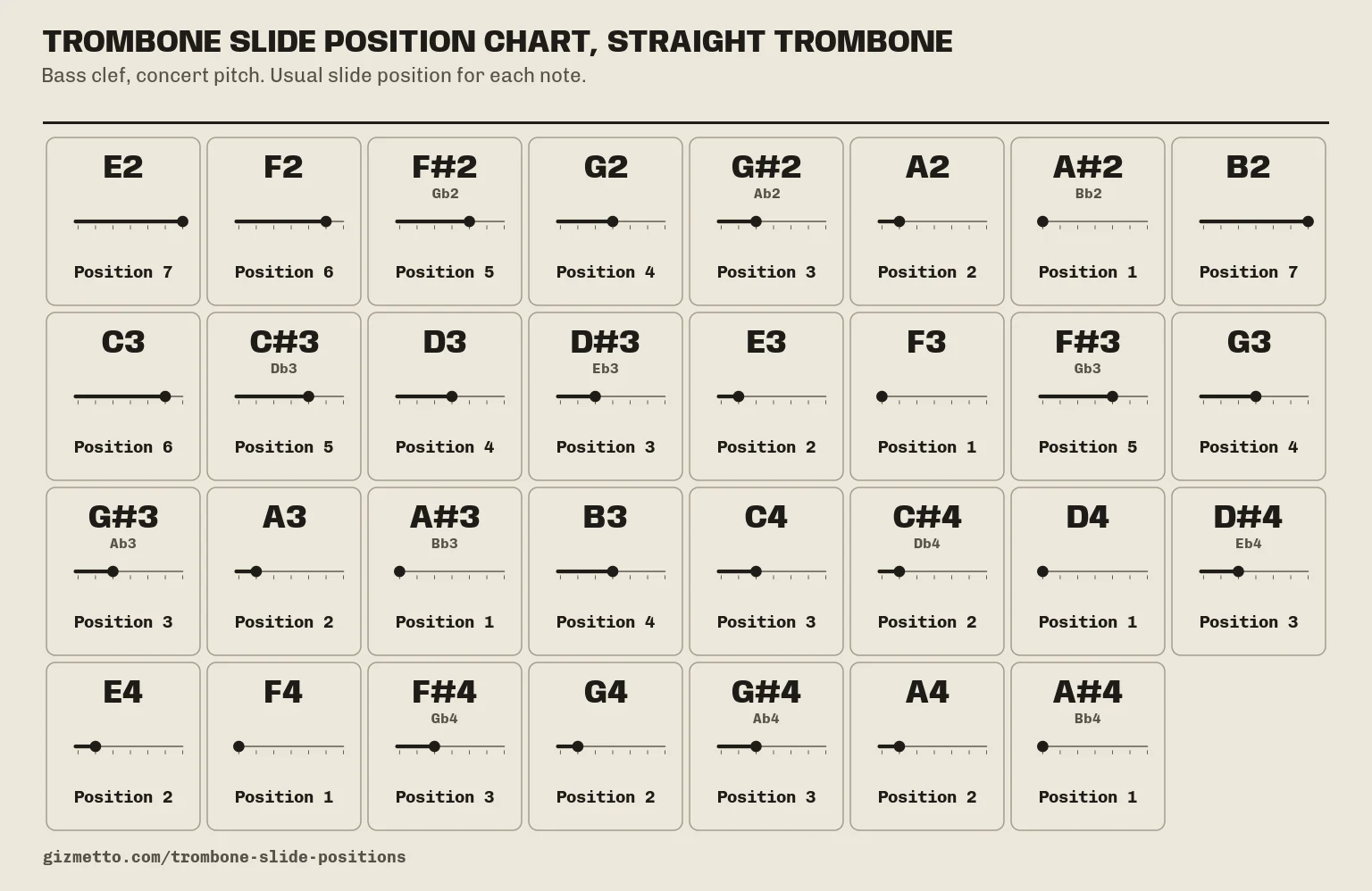
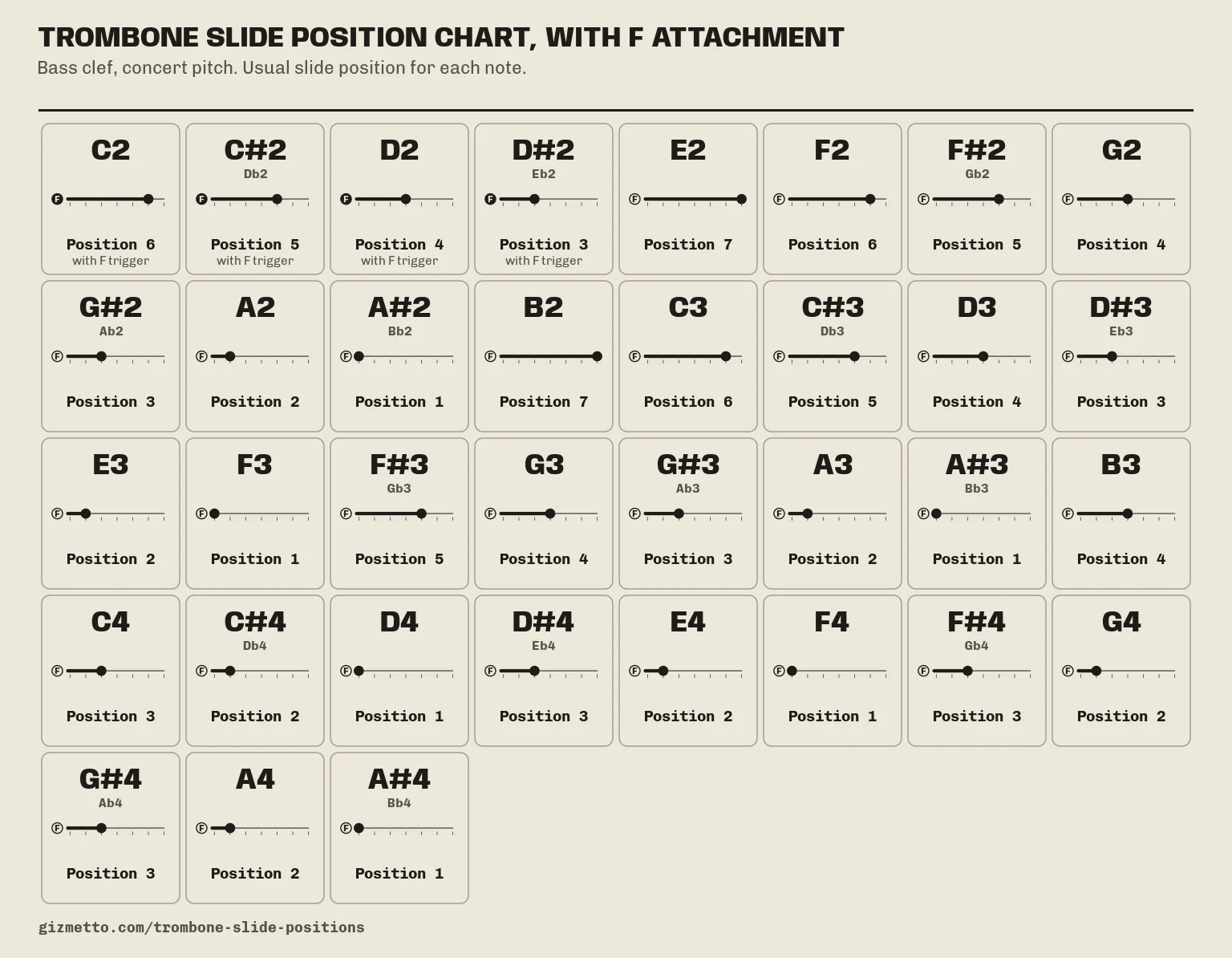
The scale from 1 to 7 is the slide. The dark bar shows how far out the slide goes, and the dot marks the position: 1st with the slide all the way in, 7th with it nearly all the way out. Choose Straight trombone or With F attachment at the top of the chart; on a trombone with an F attachment, the F lamp shows when to press the trigger.
The table lists every note from C2 to B♭4: the usual position first, then alternates in brackets. Notes below E2 need the F attachment.
| Note | Straight trombone | With F attachment |
|---|---|---|
| C2 | not on this model | Position 6 with trigger |
| C♯2 / D♭2 | not on this model | Position 5 with trigger |
| D2 | not on this model | Position 4 with trigger |
| D♯2 / E♭2 | not on this model | Position 3 with trigger |
| E2 | Position 7 | Position 7 (or Position 2 with trigger) |
| F2 | Position 6 | Position 6 (or Position 1 with trigger) |
| F♯2 / G♭2 | Position 5 | Position 5 |
| G2 | Position 4 | Position 4 (or Position 6 with trigger) |
| G♯2 / A♭2 | Position 3 | Position 3 (or Position 5 with trigger) |
| A2 | Position 2 | Position 2 (or Position 4 with trigger) |
| A♯2 / B♭2 | Position 1 | Position 1 (or Position 3 with trigger) |
| B2 | Position 7 | Position 7 (or Position 2 with trigger) |
| C3 | Position 6 | Position 6 (or Position 1 with trigger) |
| C♯3 / D♭3 | Position 5 | Position 5 |
| D3 | Position 4 | Position 4 |
| D♯3 / E♭3 | Position 3 | Position 3 |
| E3 | Position 2 (or Position 7) | Position 2 (or Position 7) |
| F3 | Position 1 (or Position 6) | Position 1 (or Position 6) |
| F♯3 / G♭3 | Position 5 | Position 5 |
| G3 | Position 4 | Position 4 |
| G♯3 / A♭3 | Position 3 (or Position 7) | Position 3 (or Position 7) |
| A3 | Position 2 (or Position 6) | Position 2 (or Position 6) |
| A♯3 / B♭3 | Position 1 (or Position 5) | Position 1 (or Position 5) |
| B3 | Position 4 (or Position 7) | Position 4 (or Position 7) |
| C4 | Position 3 (or Position 6) | Position 3 (or Position 6) |
| C♯4 / D♭4 | Position 2 (or Position 5) | Position 2 (or Position 5) |
| D4 | Position 1 (or Position 4) | Position 1 (or Position 4) |
| D♯4 / E♭4 | Position 3 (or Position 6) | Position 3 (or Position 6) |
| E4 | Position 2 (or Position 5) | Position 2 (or Position 5) |
| F4 | Position 1 (or Position 4, or Position 6) | Position 1 (or Position 4, or Position 6) |
| F♯4 / G♭4 | Position 3 (or Position 5) | Position 3 (or Position 5) |
| G4 | Position 2 (or Position 4) | Position 2 (or Position 4) |
| G♯4 / A♭4 | Position 3 (or Position 5) | Position 3 (or Position 5) |
| A4 | Position 2 (or Position 4) | Position 2 (or Position 4) |
| A♯4 / B♭4 | Position 1 (or Position 3) | Position 1 (or Position 3) |
Trombone registers and partials
In 1st position the trombone plays the partials of one harmonic series: B♭2 (the 2nd partial), F3 (3rd), B♭3 (4th), D4 (5th), F4 (6th) and B♭4 (8th). The pedal B♭1 is the 1st partial. Each position further out lowers every partial by a half step.
Between B♭2 and the next partial, F3, there are seven half steps, so in the low register every position is needed: E2 in 7th up to B♭2 in 1st, then B2 in 7th up to F3 in 1st. Higher up the partials are closer together, so fewer positions are used, and the same notes can be found in more than one place.
Alternate positions and the harmonic series
Each position has its own harmonic series, so one position plays several notes, and from F3 up most notes have a second position on another partial: F3 in 1st or 6th, B♭3 in 1st or 5th, D4 in 1st or 4th, F4 in 1st or a short 4th. Alternates save long slide moves in fast passages: D4 in 4th, for example, sits next to C4 in 3rd.
Both charts we checked agree on every usual position. The Yamaha chart lists only three alternates (F3 in 6th, D4 and F4 in 4th); the others here come from Everett's chart, which also marks some positions short (slightly in). Tap the positions under Fingerings in the chart to see each one.
Written vs concert pitch
Trombone parts in bass clef are written at concert pitch: the written note sounds, and a trombone B♭ matches a piano B♭. That is why this chart has no Concert pitch switch.
British-style brass bands are the exception: tenor trombone parts there are written in treble clef for a B♭ instrument, a major 9th above the sound, like treble clef baritone. This chart is for bass clef parts. Play always plays the note that sounds, and Check my note listens for it.
Printable trombone slide position chart
There is a chart for the straight trombone and one with the F attachment. Print them (only the charts print, one per page) or download the one for your trombone.
Other charts: Piano notes chart, Guitar notes chart, Violin notes chart, Ukulele chords chart, Piano chords chart, Trumpet fingering chart, Tuba fingering chart, Euphonium fingering chart, Baritone fingering chart, Mellophone fingering chart, French horn fingering chart, Flute fingering chart, Clarinet fingering chart, Recorder fingering chart, Bass clarinet fingering chart, Alto sax fingering chart. All of them are on the music charts page.
FAQ
How many slide positions does a trombone have?
Seven. 1st position is the slide all the way in; each position further out lowers the pitch by a half step, so 7th position is three whole steps below 1st. Every note on a straight tenor trombone from E2 up is played in one of them.
How do I find each position?
The positions are not marked on the slide, so players learn them by ear. Pick a note, tap Play to hear it, then move the slide until Check my note says in tune. The positions get a little further apart as you go out.
What does the F attachment trigger do?
It adds tubing that lowers the trombone a perfect 4th, from B♭ to F. That fills the gap between pedal B♭1 and E2 (C2 to E♭2 with the trigger in 6th to 3rd position) and gives short-position alternates for notes such as E2, F2, B2 and C3.
Is the trombone a transposing instrument?
Not in bass clef. Trombone parts in bands and orchestras are written in bass clef (and tenor clef for high parts) at concert pitch, so the written note sounds. British-style brass bands write tenor trombone parts in treble clef as B♭ transposing parts.
Why are some positions marked short?
Some notes sit on a partial that is naturally a little flat or sharp. Everett's chart marks those positions "short": pull the slide in a little from the usual spot. In this chart, F♯4 and G4 in 3rd and 2nd position are examples. Check my note shows how far off you are.
Sources
Every fingering on this page was checked note by note against these published charts on 13 November 2026. Where they differ, the page says so.
- Micah Everett, Chromatic Slide Position Chart for Tenor and Bass Trombones (University of Mississippi) Positions in order of preference, F attachment positions and "short" tuning marks, F1 to F5.
- Yamaha, Trombone Owner's Manual, Position Chart (tenor trombone) Positions with alternates and F attachment (lever) positions, B♭1 to B♭4.
Related tools
All music chartsUse it as a trombone tuner: play any note and see how many cents off you are.
Hold a steady reference note while you find a position by ear.
Tap a tempo or play a click track to practise with.