Recorder Fingering Chart
An interactive soprano recorder fingering chart for every note from C4 to D6, Baroque or German. Tap a note to see the holes and hear it.
Tap a note
A♯4Written
Concert A♯5T 1 3 | 4
Processed on your device. Nothing is recorded.
How to read the recorder fingering chart
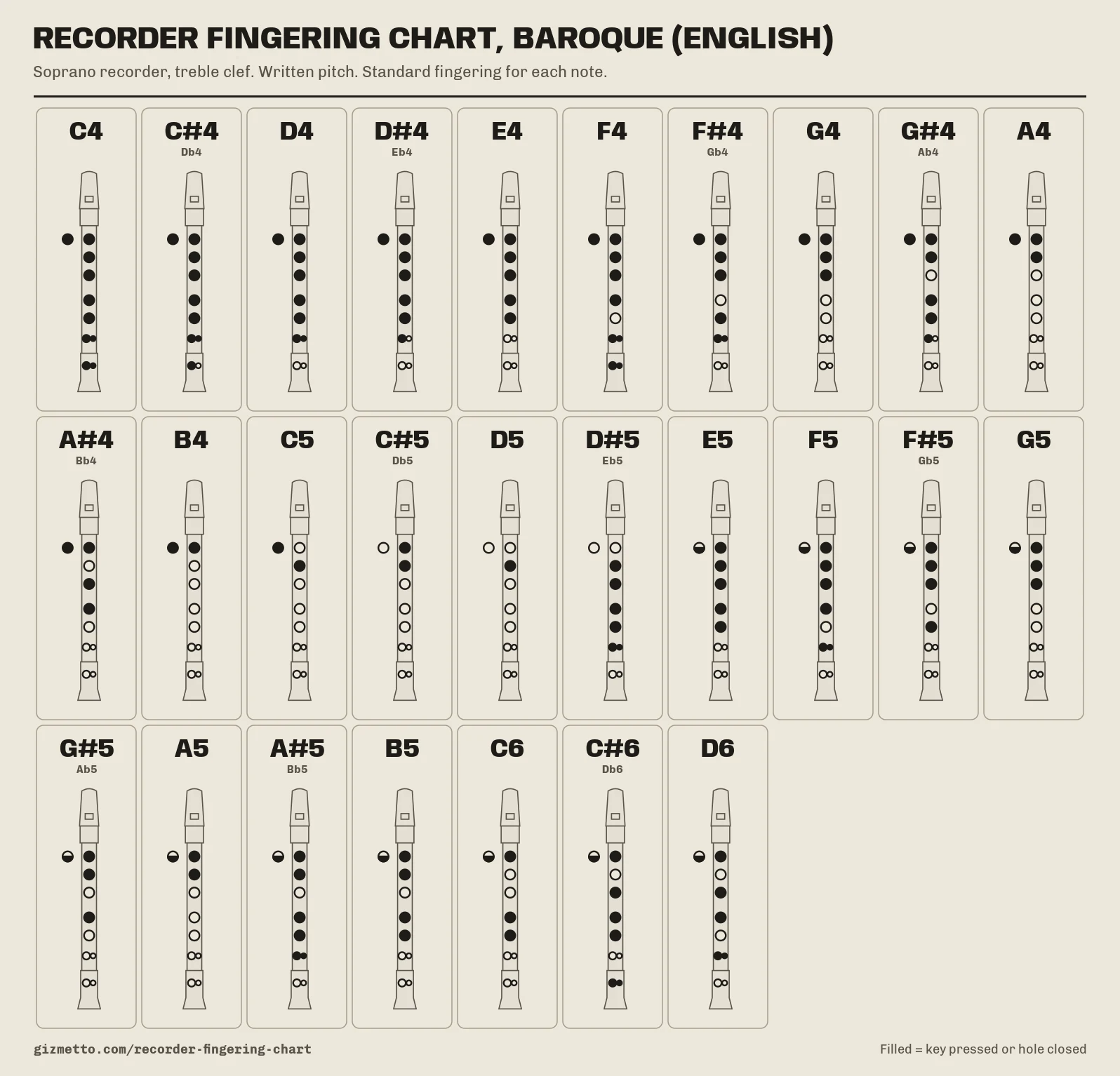
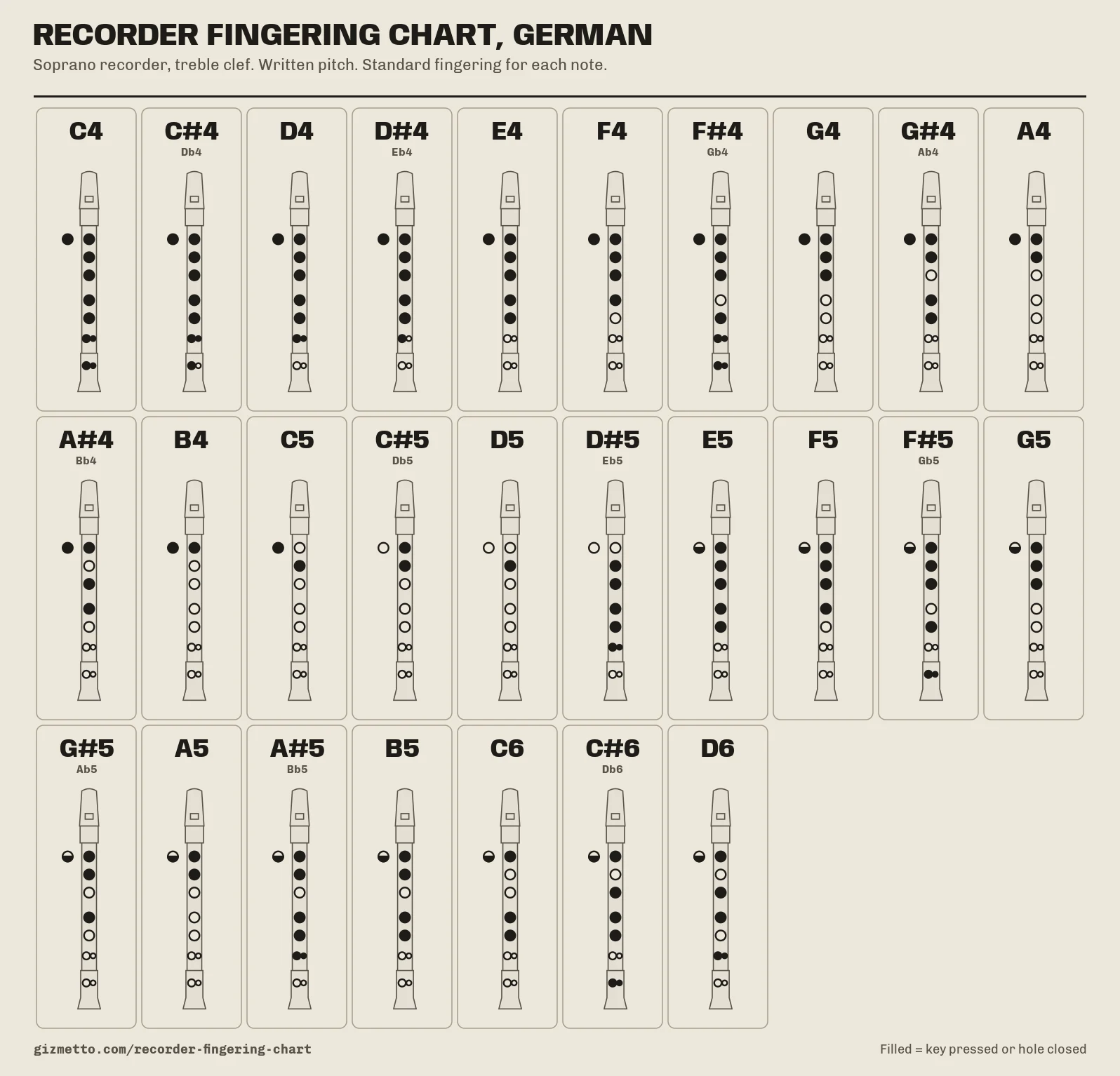
The diagram shows the recorder from the front, mouthpiece at the top. The thumb hole, which is on the back, is drawn at the left. A filled hole is covered; an empty one stays open; a half filled thumb hole is pinched (half open). Holes 1 to 3 are the left hand, holes 4 to 7 the right hand, and 6 and 7 are the double holes.
Under the diagram the fingering is written out the way recorder charts number the holes: "T 1 2 3 | 4 5 6" means thumb and left hand 1, 2 and 3, then right hand 4, 5 and 6. ½T is a half-open thumb, ½6 means only the larger of the two small holes of 6, and 0 means no fingers of that hand. Choose Baroque or German at the top of the chart. The table lists both.
| Written note | Concert pitch | Baroque (English) | German |
|---|---|---|---|
| C4 | C5 | T 1 2 3 | 4 5 6 7 | T 1 2 3 | 4 5 6 7 |
| C♯4 / D♭4 | C♯5 / D♭5 | T 1 2 3 | 4 5 6 ½7 | T 1 2 3 | 4 5 6 ½7 |
| D4 | D5 | T 1 2 3 | 4 5 6 | T 1 2 3 | 4 5 6 |
| D♯4 / E♭4 | D♯5 / E♭5 | T 1 2 3 | 4 5 ½6 | T 1 2 3 | 4 5 ½6 |
| E4 | E5 | T 1 2 3 | 4 5 | T 1 2 3 | 4 5 |
| F4 | F5 | T 1 2 3 | 4 6 7 | T 1 2 3 | 4 |
| F♯4 / G♭4 | F♯5 / G♭5 | T 1 2 3 | 5 6 | T 1 2 3 | 5 6 7 |
| G4 | G5 | T 1 2 3 | 0 | T 1 2 3 | 0 |
| G♯4 / A♭4 | G♯5 / A♭5 | T 1 2 | 4 5 ½6 | T 1 2 | 4 5 (or T 1 2 | 4 5 ½6) |
| A4 | A5 | T 1 2 | 0 | T 1 2 | 0 |
| A♯4 / B♭4 | A♯5 / B♭5 | T 1 3 | 4 | T 1 3 | 4 |
| B4 | B5 | T 1 | 0 (or T 2 3 | 0) | T 1 | 0 (or T 2 3 | 0) |
| C5 | C6 | T 2 | 0 | T 2 | 0 |
| C♯5 / D♭5 | C♯6 / D♭6 | 1 2 | 0 (or T | 0) | 1 2 | 0 (or T | 0) |
| D5 | D6 | 2 | 0 | 2 | 0 |
| D♯5 / E♭5 | D♯6 / E♭6 | 2 3 | 4 5 6 | 2 3 | 4 5 6 |
| E5 | E6 | ½T 1 2 3 | 4 5 | ½T 1 2 3 | 4 5 |
| F5 | F6 | ½T 1 2 3 | 4 6 | ½T 1 2 3 | 4 |
| F♯5 / G♭5 | F♯6 / G♭6 | ½T 1 2 3 | 5 | ½T 1 2 3 | 5 7 |
| G5 | G6 | ½T 1 2 3 | 0 | ½T 1 2 3 | 0 |
| G♯5 / A♭5 | G♯6 / A♭6 | ½T 1 2 | 4 | ½T 1 2 | 4 (or ½T 1 2 3 | 5 6 7) |
| A5 | A6 | ½T 1 2 | 0 | ½T 1 2 | 0 |
| A♯5 / B♭5 | A♯6 / B♭6 | ½T 1 2 | 4 5 6 | ½T 1 2 | 4 5 6 |
| B5 | B6 | ½T 1 2 | 4 5 | ½T 1 2 | 4 5 |
| C6 | C7 | ½T 1 | 4 5 | ½T 1 | 4 5 |
| C♯6 / D♭6 | C♯7 / D♭7 | ½T 1 3 | 4 5 7 (or ½T 1 3 | 4 6) | ½T 1 3 | 4 5 7 (or ½T 1 3 | 4 6) |
| D6 | D7 | ½T 1 3 | 4 6 | ½T 1 3 | 4 6 |
First and second octave
In the first octave you lift fingers from the bottom: every hole for C4, then lift 7 for D4, 6 for E4, and so on up to the left hand notes G4, A4 and B4, C5 with only the thumb and 2, and D5 with only 2. C♯4 and D♯4 use one hole of the double pair.
The second octave, from E5 up, uses the same fingers as the first with the thumb hole half open. Opening a small gap at the thumb makes the recorder jump to its second register. The top notes, C♯6 and D6, use cross fingerings of their own.
Baroque (English) vs German fingering
Most notes are fingered the same way on both systems. Both the Yamaha charts and the Woodwind Fingering Guide give these differences:
- F4: Baroque T 1 2 3 | 4 6 7 (a fork fingering), German T 1 2 3 | 4.
- F♯4: Baroque T 1 2 3 | 5 6, German T 1 2 3 | 5 6 7.
- F5: Baroque ½T 1 2 3 | 4 6, German ½T 1 2 3 | 4.
- F♯5: Baroque ½T 1 2 3 | 5, German ½T 1 2 3 | 5 7.
For G♯4 and G♯5 the two sources differ on German models. The Woodwind Fingering Guide gives T 1 2 | 4 5 for German G♯4 and the same G♯5 as Baroque; Yamaha's German chart adds holes to both. The chart shows the Woodwind Fingering Guide's as standard and Yamaha's as alternates. Use the variant that matches your recorder.
Alternate fingerings
Both sources give two alternates for notes next to C5: B4 as T 2 3 and C♯5 as the thumb alone. The Woodwind Fingering Guide lists them for use next to C5.
For C♯6 the sources disagree. Yamaha uses ½T 1 3 | 4 5 7; the Woodwind Fingering Guide uses ½T 1 3 | 4 6 with the end of the recorder closed, for example against your knee. The chart shows Yamaha's first and the other as an alternate.
Written vs sounding pitch: an octave higher
The soprano recorder is a C instrument, so it reads the same note names as the piano, but it sounds an octave higher than written: written C4, the lowest note, sounds C5. Turn on Concert pitch to see the sounding note. Play and Check my note use the sounding note, so a tuner or a piano agrees with them.
Printable recorder fingering chart
There is one chart for Baroque and one for German fingering, each with every written note from C4 to D6. Print them (only the charts print) or download the one for your recorder.
Other charts: Piano notes chart, Guitar notes chart, Violin notes chart, Ukulele chords chart, Piano chords chart, Trumpet fingering chart, Tuba fingering chart, Euphonium fingering chart, Baritone fingering chart, Mellophone fingering chart, French horn fingering chart, Trombone slide position chart, Flute fingering chart, Clarinet fingering chart, Bass clarinet fingering chart, Alto sax fingering chart. All of them are on the music charts page.
FAQ
Is my recorder Baroque or German?
Compare the fourth and fifth holes from the top (the first two right hand holes). Yamaha explains that on a Baroque recorder the fourth hole is smaller than the fifth, and on a German recorder the fourth hole is larger than the fifth. If you are not sure which system your class uses, ask your teacher.
Which is better, Baroque or German fingering?
German fingering makes a few notes easier for beginners, F in particular, but Yamaha notes that some notes then become harder to play in tune. Most schools teach Baroque fingering, and Yamaha recommends it for players who want to keep going, because its tuning is better.
What does ½T mean?
It means a half-open (pinched) thumb hole. For the second octave, from E5 up, bend the thumb so the nail opens a small gap at the top of the thumb hole. The Woodwind Fingering Guide advises a smaller gap from A5 up.
Why are there two small holes at the bottom?
Holes 6 and 7 are double holes on most recorders. Covering both plays the normal note; covering only the larger one raises it a half step, which is how C♯4 and D♯4 are played. In the chart, ½6 means cover only the larger hole of 6.
Why does the recorder sound higher than the note on the chart?
The soprano recorder sounds an octave higher than written. Music for it is written an octave low so it fits on the staff. Turn on Concert pitch in the chart to see the sounding note; Play and Check my note use the sounding note.
How does Check my note work?
Tap Check my note and allow the microphone, then play the note shown. The chart compares the pitch you play with the note you chose and says in tune (within 10 cents), sharp, flat, or which note you played instead. Nothing is recorded.
Sources
Every fingering on this page was checked note by note against these published charts on 13 November 2026. Where they differ, the page says so.
- Yamaha, Recorder fingering chart, Baroque (Musical instrument guide) Soprano recorder, every note from C4 to D6 with alternates. The German chart is at fingering_german.pdf on the same site.
- The Woodwind Fingering Guide, basic fingering chart for recorder Every note in written notation, with the Baroque (English) and German fingerings marked.
- Yamaha, Recorders: Baroque vs German How to tell the two systems apart, and why most schools teach Baroque.
Related tools
All music chartsUse it as a recorder tuner: play any note and see how many cents off you are.
Hold a steady reference note to match while you practise.
Tap a tempo or play a click track to practise with.