Pickleball Round Robin Generator
Doubles rounds for 4 to 24 players: new partners each round, fair opponents, even sit-outs and court numbers, with scores and standings.
Enter 4 to 24 players
4 to 24 players.
--
Enter 4 to 24 players
Saved schedules
Schedules you save appear here. They stay on this device.
Made on your device. Schedules you save stay in this browser; a share link carries the names and scores.
How the round robin generator works
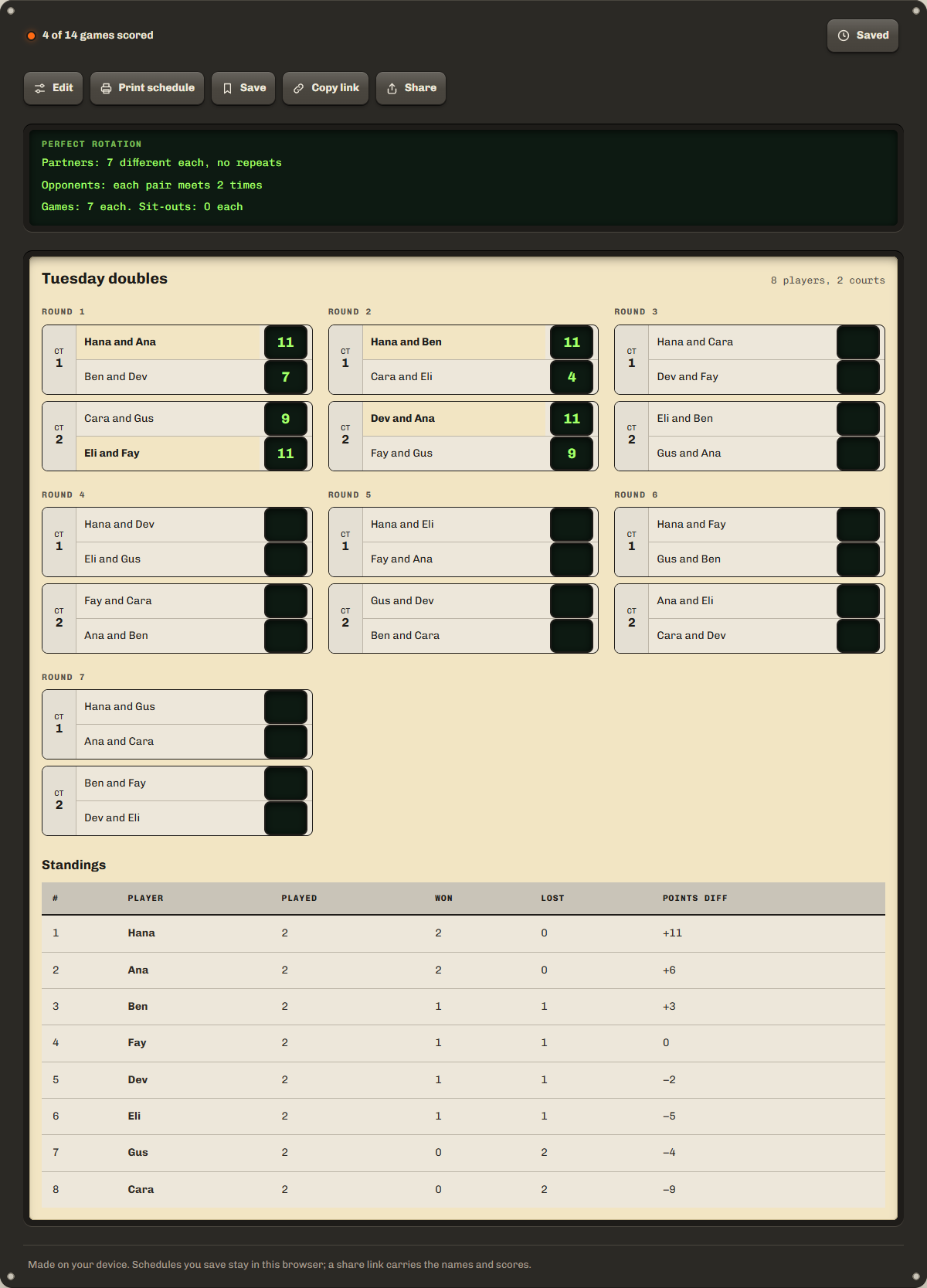
List the players, choose rotating or fixed partners, set the courts and press Make schedule. Every round shows each court with its two teams and who sits out. Type the scores as games end; the standings under the rounds update at once. Print schedule prints the rounds and the table only, so you can pin a sheet up at the courts.
- Step 1List the playersOne name per line, 4 to 24 players. For fixed partners, put partners on lines next to each other.
- Step 2Set courts and roundsPick how many courts you have and, for rotating partners, how many rounds you have time for.
- Step 3Play and scoreEach round lists the court numbers and who sits out. Type the scores and the standings update.
The schedule, scores and settings stay in this browser, and Save keeps a copy in your saved list. Share makes a link with the names and scores in it, so another organizer can open the same schedule on their phone. Nothing is uploaded.
The rotation explained
In a rotating partners round robin, the aim is that each player partners as many different players as possible and meets the others as opponents about equally often. The ideal is a schedule where every two players are partners exactly once and opponents exactly twice. Mathematicians call this a whist tournament, and it exists only when the number of players is a multiple of 4 (n − 1 rounds, nobody sits out) or one more than a multiple of 4 (n rounds, one player sits out each round).
For those counts, when you have a court for every four players, the generator uses a perfect whist schedule that is checked by its tests: one base round, shifted one place each round. Stop early and nobody has partnered anyone twice yet.
For every other count (6, 7, 10, 11, 14 players and so on), or with fewer courts, no perfect schedule exists. The generator then builds the rounds one at a time with a search that starts from a fixed seed: it sits out the players who have sat out least, then tries many groupings of the others and keeps the one with the fewest repeat partners, then the fewest repeat opponents. The result is near balanced, not perfect, and it is the same every time for the same input. The numbers above the schedule say exactly how even it came out: different partners per player, how often pairs meet as opponents, and games and sit-outs per player.
Fixed partners is a plain round robin of teams by the circle method: every team plays every other team once. When there are more games than courts, a round is split over more rounds.
Recommended formats by player count
With a court for every four players. The last column is from the schedule the generator makes for that count, not an estimate.
| Players | Courts | Sit out each round | Recommended | Partners each |
|---|---|---|---|---|
| 4 | 1 | 0 | 3 rounds, every partner once | 3 |
| 5 | 1 | 1 | 5 rounds, every partner once | 4 |
| 6 | 1 | 2 | 5 rounds, near balanced | 3 to 4 |
| 7 | 1 | 3 | 6 rounds, near balanced | 3 to 4 |
| 8 | 2 | 0 | 7 rounds, every partner once | 7 |
| 9 | 2 | 1 | 9 rounds, every partner once | 8 |
| 10 | 2 | 2 | 9 rounds, near balanced | 7 to 8 |
| 11 | 2 | 3 | 9 rounds, near balanced | 6 to 7 |
| 12 | 3 | 0 | 11 rounds, every partner once | 11 |
| 13 | 3 | 1 | 13 rounds, every partner once | 12 |
| 14 | 3 | 2 | 9 rounds, near balanced | 7 to 8 |
| 16 | 4 | 0 | 15 rounds, every partner once | 15 |
| 17 | 4 | 1 | 17 rounds, every partner once | 16 |
| 20 | 5 | 0 | 19 rounds, every partner once | 19 |
| 21 | 5 | 1 | 21 rounds, every partner once | 20 |
| 24 | 6 | 0 | 23 rounds, every partner once | 23 |
A full rotation for 20 or more players is long (19 to 23 rounds), so most groups play 8 to 10 rounds. With an even number of players and set pairs (a league night, a club ladder), use fixed partners instead. For a knockout with the winners of a round robin, the bracket maker draws single and double elimination brackets.
Scoring a round robin
Round robin socials usually play one game to 11, win by 2, with rally or side-out scoring as your club prefers. To keep rounds in step on several courts, many groups play to 11 with a time cap of about 12 to 15 minutes, or one game to 15 with no win by 2.
The standings rank players (or teams) by games won, then point differential, then points scored. Point differential rewards close losses, so it is a fair tie-break when partners change every round. If players sit out a different number of times, compare games played too: the table shows it.
FAQ
Does everyone get to partner everyone?
With 4, 5, 8, 9, 12, 13, 16, 17, 20, 21 or 24 players and a court for every four players, yes: the full rotation gives every player every other player as a partner exactly once, and every two players face each other exactly twice. With other counts, or fewer courts, it is not possible to make it perfect, so the generator makes it as even as it can and shows the real numbers above the schedule.
How are sit-outs chosen?
When the players are not a multiple of 4, or there are more players than the courts hold, the players who have sat out the least sit out next. So nobody sits out twice before everyone has sat out once, and the sit-out counts never differ by more than one.
What if a player leaves or arrives late?
Press Edit, change the list and make a new schedule. The new schedule starts over, so note the scores of the rounds already played first, or keep them on a printed sheet. For a long event with many changes, fixed partners are simpler.
How is the winner decided?
By games won. When two players have won the same number of games, the one with the better point differential (points scored minus points let in) is higher. In rotating mode each player gets their own result from every game they played, so the winner is a player, not a team.
Is the schedule random?
No. The same names count, courts and rounds always give the same schedule, so a share link or a saved schedule always shows the same games. To change who plays with whom, change the order of the names.
Can I use it for tennis, padel or badminton doubles?
Yes. The rotation works for any doubles game. Only the scoring note on this page is pickleball specific.
Related tools
All game toolsSingle and double elimination brackets and round robins.
Plan pixel circles, ovals and spheres block by block.
Find the best moves for your three blocks.
Maintained by NabeelUpdated Nov 22, 2026.