Pips Solver
A free Pips puzzle solver and hint tool. Draw the board, add the dominoes, and get one hint at a time or the full answer.
Ready to solve
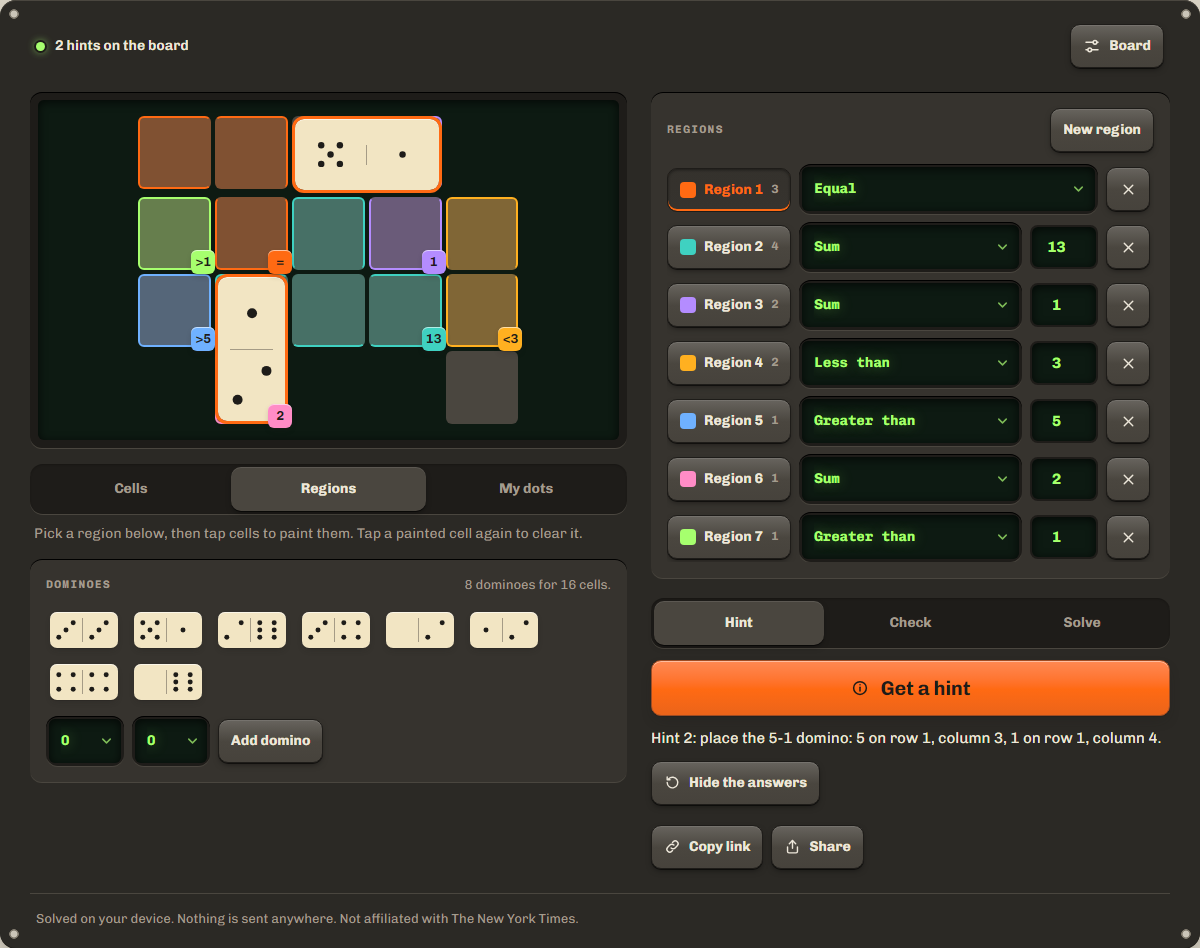
Pick a region below, then tap cells to paint them. Tap a painted cell again to clear it.
Board
Solved on your device. Nothing is sent anywhere. Not affiliated with The New York Times.
How to use the Pips solver
Copy the board from the game into the tool, then ask for as much help as you want. The tool opens with an example board made for this site, so you can try every mode first. Not affiliated with The New York Times.
- Step 1Draw the boardOpen Board to set the rows and columns, up to 10 by 10. Choose Cells and tap squares to add or remove them until the shape matches the game.
- Step 2Paint the regionsChoose Regions and tap New region. Pick its condition and number, then tap its cells. A cell with no color has no condition.
- Step 3Add the dominoesPick the dots on each half and tap Add domino, once for each domino in the game's tray. The count line turns plain when they cover every cell.
- Step 4Hint, Check or SolveHint places one domino. Check marks the dots you got wrong. Solve fills the whole board.
The board goes into the address bar as you edit, so a reload keeps it, and Copy link gives you a link that opens the same board on another device. We do not copy boards from the game: you enter the puzzle, and the solver works it out on your device.
Pips hint for today's puzzle: one domino at a time
This page has no daily answers. Enter today's board, choose Hint, and tap Get a hint: one domino appears on the board, with an orange outline, and the text under the key says where it goes. Tap again for the next one.
The game itself has no small hints. Its Reveal shows the whole puzzle and asks first, because "Showing the answer will end the game." Here you take only the next step. Each hint starts where the board is tightest, such as a small Sum region, and when a board has more than one answer, the hint is a domino that every answer agrees on, when there is one.
Already placed some dominoes in the game? Choose My dots, tap each cell and enter the dots you placed. Hints then skip what you have right, and Check marks every dot that does not match, so you know what to move.
Pips rules explained
In Pips you fill the board with all the dominoes, so that every colored region meets its condition. Each domino covers two cells next to each other, across or up and down; in the game you tap a domino to rotate it. Each half has 0 to 6 dots. The condition sits on the bottom right corner of its region. Halves that touch do not have to match, as they do in a game of dominoes.
Sum (a number)
The dots in the region add up to the number. A region marked 8 with two cells can hold 5 and 3, 6 and 2, or 4 and 4.
Equal (=)
Every half in the region has the same number of dots. Three cells marked = can be 4, 4 and 4, but not 4, 4 and 3.
Not equal (≠)
Every half in the region has a different number of dots. No number may repeat, so 1, 3 and 6 fit, and 1, 3 and 3 do not.
Less than (<)
The dots in the region add up to less than the number. A region marked <4 with two cells can hold 1 and 2 (3), but not 2 and 2 (4).
Greater than (>)
The dots in the region add up to more than the number. A region marked >9 with two cells needs at least 10, such as 6 and 5.
Empty regions
Cells with no color have no condition. Any number of dots can go there, so they are often the last cells you fill.
Rules as the game's own How to Play describes them. The pictures are drawn for this page.
Easy, medium and hard Pips: what changes
The game has three levels, Easy, Medium and Hard, and the rules are the same at every level. What grows is the board. In the daily puzzles of 1, 8 and 15 October 2026, Easy had 5 dominoes each day, Medium had 7 or 8, and Hard had 11 to 16.
Hard boards also use their conditions differently. One of them put its own Sum region on every one of its 32 cells, so the work was in fitting the dominoes, not in reading the regions. The solver treats all levels the same way. On a laptop, it solved each of these Hard boards in a few milliseconds.
Strategy tips
- Start with the tightest regions: a one-cell Sum region tells you that half exactly, and a Sum of 0 needs blank halves only.
- Look for cells with only one free neighbour. A domino must cover that cell and its neighbour together.
- For an Equal region, count the halves in the tray with each number. Doubles such as 4 and 4 often belong there.
- A Not equal region with 7 cells uses every number from 0 to 6 once.
- Push Greater than and Less than to the limit. Two cells marked >10 need 5 and 6 or 6 and 6; two cells marked <2 need 0 and 0 or 0 and 1.
- Fill the empty regions last: they accept any dots, so they take whatever dominoes are left.
Stuck on one domino? Use a single hint, then go back to the game and work out the rest from there.
FAQ
Is this the official answer?
No. The solver works out an answer from the board you enter, and that answer meets every condition on it. When a board has only one such answer, it is the game's answer too, as long as you copied the board exactly. When it has more than one, the tool says so.
Why does it say no solution?
Almost always because one detail differs from the game: a missing or extra cell, a region with the wrong condition or number, or a domino with the wrong dots. Check the count line first: the dominoes must cover exactly the cells on the board. Then compare each region's badge with the game.
Does it work on my phone?
Yes. Every cell is a tap target, the domino dots are picked from a list, and a board that is wider than your screen scrolls sideways. The solver runs in your browser, so it works without an account and without an app.
Is the Pips solver free?
Yes. It is free, with no sign-up and nothing to install. The board you enter stays on your device; only a link you choose to share carries it.
Related tools
All puzzle solversFind the spangram and theme words in a Strands grid.
See the best order and place for your three blocks.
Maintained by NabeelUpdated Oct 23, 2026.