Hearing Age Test
High tones step up one at a time. Say when you stop hearing them, and see which age group heard the same in a clinic study.
Ready
- Use headphones, in a quiet room.
- Turn your device volume down before the first tone. It starts at 10%.
- Tones step up from 9 kHz to 20 kHz. Say whether you hear each one.
- 9k
- 10k
- 11.5k
- 12.5k
- 14k
- 16k
- 18k
- 20k
Not a medical hearing test. Results depend on your headphones, volume and device.
Not a medical hearing test. It shows the highest tone you heard on this device and compares it with a published study. It cannot find hearing loss. If you are worried about your hearing, see a doctor or an audiologist.
How to take the hearing age test
- Step 1Put on headphonesUse wired headphones if you have them, in a quiet room. Turn your device volume down first.
- Step 2Set a soft levelTap Play start tone. A 8 kHz tone plays at 10% volume. Raise it slowly until the tone is soft but clear, never loud.
- Step 3Answer each toneTones step up from 9 kHz to 20 kHz. Tap I hear it or I can't hear it for each one.
- Step 4Read your resultThe highest tone you heard shows with the age group in which that result was most common in the study.
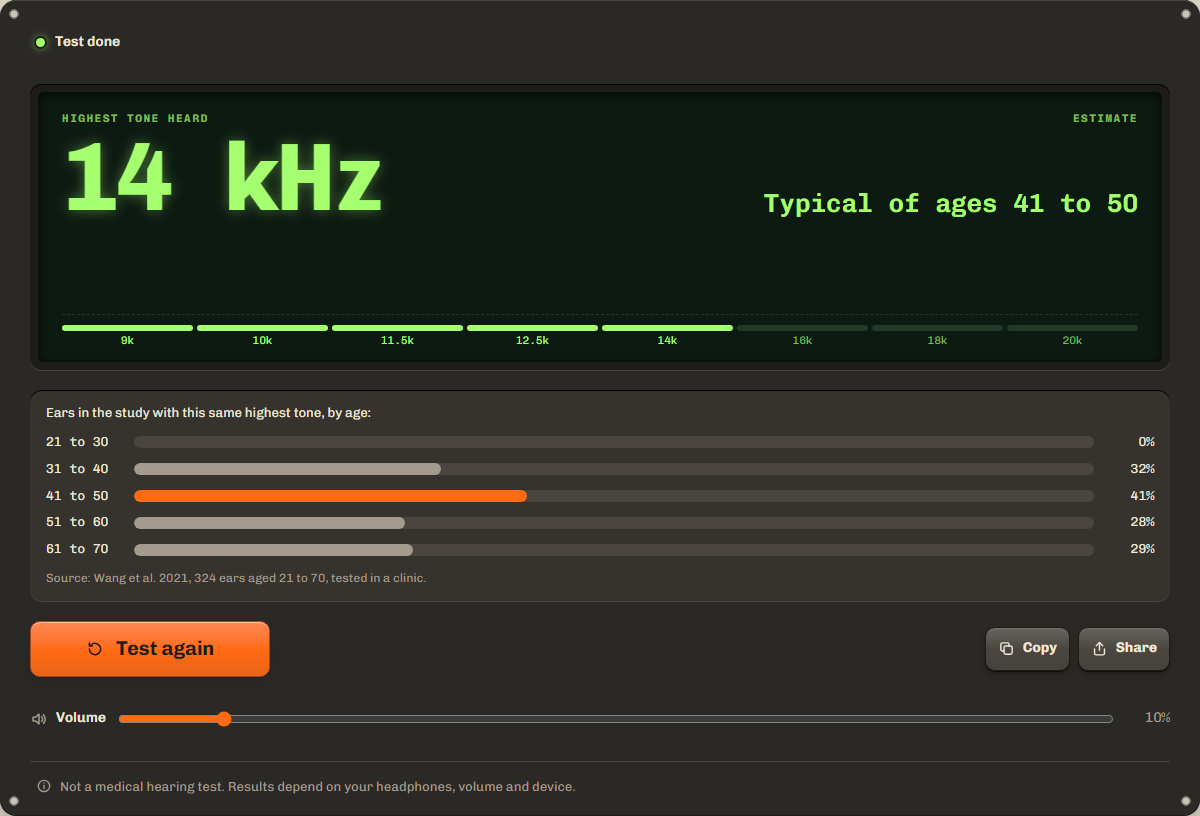
The tones are 9, 10, 11.5, 12.5, 14, 16, 18, 20 kHz, the frequencies the study tested. Each one starts after a short silence, so you hear it begin. Listen for a few seconds before you answer: very high tones are easy to miss at first.
Hearing range by age
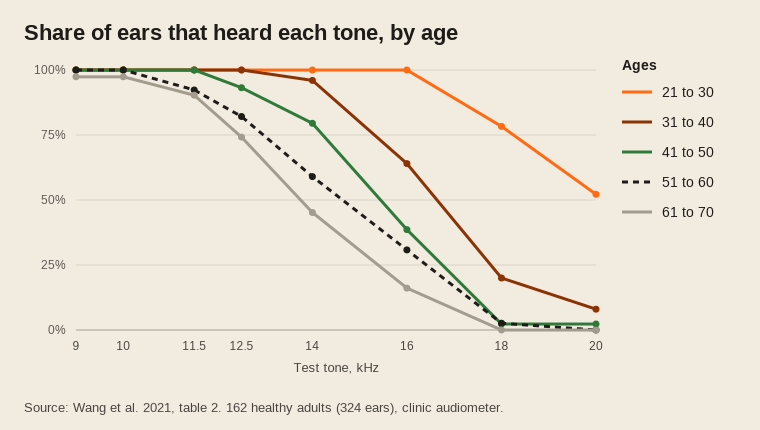
The commonly stated range of human hearing is 20 Hz to 20 kHz, and the top falls with age. The age groups here come from Wang and colleagues (2021), who tested 162 healthy adults (324 ears) aged 21 to 70 with an audiometer up to 20 kHz. Table 2 of the paper gives the share of ears in each age group that responded to each tone.
| Ages | 12.5 kHz | 14 kHz | 16 kHz | 18 kHz | 20 kHz |
|---|---|---|---|---|---|
| 21 to 30 | 100% | 100% | 100% | 78.3% | 52.2% |
| 31 to 40 | 100% | 96% | 64% | 20% | 8% |
| 41 to 50 | 93.2% | 79.5% | 38.6% | 2.3% | 2.3% |
| 51 to 60 | 82.1% | 59% | 30.8% | 2.6% | 0% |
| 61 to 70 | 74.2% | 45.2% | 16.1% | 0% | 0% |
Your result is the group in which your top tone was most common. For a top tone of 16 kHz (you heard 16 but not 18), that was true of 44% of ears aged 31 to 40, more than in any other group, so the result is 31 to 40. Each group is wide, and many people hear better or worse than their age group, so treat the band as a comparison, not a measure of your age.
The study used a clinic audiometer, which plays each tone at known levels to find the softest one a person hears. This page plays each tone at one level that you set, through headphones it knows nothing about. A tone too soft for you here might be heard at a clinic level, so a result here can read lower than a clinic test would.
Device limits: what your phone can play
A browser plays sound at a fixed sample rate, usually 44.1 or 48 kHz. Digital audio can only hold tones below half the sample rate (the Nyquist frequency), so 22 kHz is the top for 44.1 kHz audio. This test reads your device's rate and leaves out any tone it cannot play, and says so.
The speaker matters too. Phone and laptop speakers, earbuds and wireless links can play the highest tones much more quietly, or not at all, and the test cannot tell. If you hear nothing above some tone, try other headphones: a result that rises with better headphones was the device, not your ears.
Use it safely
Start quiet. The level tone plays at 10% volume, and the volume key turns amber above 40%. Set your device volume low before you put the headphones on, and never raise the volume to chase a tone you cannot hear: the sound still reaches your ears.
Long or repeated exposure to sounds at or above 85 dBA can cause hearing loss, and the hair cells that noise damages do not grow back. Stop if a tone hurts, sounds harsh or leaves your ears ringing.
FAQ
Is this a real hearing test?
No. It is not a medical test and cannot find hearing loss. Your headphones, the volume and your device all change the result. If you notice a change in your hearing, ringing in your ears, or trouble following speech, see a doctor or an audiologist.
What is the highest frequency humans can hear?
The commonly stated range of human hearing is 20 Hz to 20 kHz. The top falls with age. In the study this test uses, about half of the ears aged 21 to 30 heard 20 kHz, and almost no ears over 40 did.
Why can I not hear anything above a certain tone?
It may be your ears, or it may be your device. Small speakers and some earbuds can play very high tones weakly or not at all. Try again with other headphones; if the result goes up, the first pair was the limit.
Is it safe?
Keep it soft. The test starts at a low volume and warns you above 40%. A high tone can be loud even when it sounds faint, and a tone you cannot hear still reaches your ears and your tweeters, so never turn the volume up to find a tone.
Why does my result say 21 to 30, or younger?
The study tested adults from 21 to 70 only. If you heard 18 or 20 kHz, your result matches its youngest group best, and it says nothing about younger ages.
Related tools
All audio toolsPlay any frequency, or sweep up to find your top note.
Check left, right and bass before you start.
See how loud it is where you are.
Maintained by NabeelUpdated Oct 23, 2026.