Bass Clarinet Fingering Chart
An interactive bass clarinet fingering chart for low C and low E♭ models, from low C to C6. Tap a note to see the keys and hear it.
Tap a note
D4Written
Concert C3T 1 2 | 0
Processed on your device. Nothing is recorded.
How to read the bass clarinet fingering chart
The diagram shows the bass clarinet from the front, neck and mouthpiece at the top and the upturned bell at the bottom, with the keys drawn like the clarinet chart. A filled key or hole is closed. The register key and the thumb hole are at the top left. The right thumb keys of a low C model (E♭, C♯ and C) are at the left of the lower body, the left little finger keys at the right of the joint, and the right little finger keys, with low E♭ and D, at the bottom left.
The fingering is written out under the diagram. "T 1 2 3 | 1 2 3 + thumb C" means the thumb hole and all six finger holes, plus the low C key under the right thumb. The table lists every note for both models and both clefs.
| Treble clef | Bass clef | Concert pitch | Low C model | Low E♭ model |
|---|---|---|---|---|
| C3 | C2 | A♯1 / B♭1 | T 1 2 3 | 1 2 3 + thumb C | not on this model |
| C♯3 / D♭3 | C♯2 / D♭2 | B1 | T 1 2 3 | 1 2 3 + thumb C♯ | not on this model |
| D3 | D2 | C2 | T 1 2 3 | 1 2 3 + LH D (or T 1 2 3 | 1 2 3 + RH D) | not on this model |
| D♯3 / E♭3 | D♯2 / E♭2 | C♯2 / D♭2 | T 1 2 3 | 1 2 3 + RH E♭ (or T 1 2 3 | 1 2 3 + thumb E♭) | T 1 2 3 | 1 2 3 + RH E♭ |
| E3 | E2 | D2 | T 1 2 3 | 1 2 3 + LH E/B (or T 1 2 3 | 1 2 3 + RH E/B, or T 1 2 3 | 1 2 3 + LH E/B + RH F/C) | T 1 2 3 | 1 2 3 + LH E/B (or T 1 2 3 | 1 2 3 + RH E/B, or T 1 2 3 | 1 2 3 + LH E/B + RH F/C) |
| F3 | F2 | D♯2 / E♭2 | T 1 2 3 | 1 2 3 + RH F/C (or T 1 2 3 | 1 2 3 + LH F/C) | T 1 2 3 | 1 2 3 + RH F/C (or T 1 2 3 | 1 2 3 + LH F/C) |
| F♯3 / G♭3 | F♯2 / G♭2 | E2 | T 1 2 3 | 1 2 3 + LH F♯/C♯ (or T 1 2 3 | 1 2 3 + RH F♯/C♯, or T 1 2 3 | 1 2 3 + LH F♯/C♯ + RH F/C) | T 1 2 3 | 1 2 3 + LH F♯/C♯ (or T 1 2 3 | 1 2 3 + RH F♯/C♯, or T 1 2 3 | 1 2 3 + LH F♯/C♯ + RH F/C) |
| G3 | G2 | F2 | T 1 2 3 | 1 2 3 | T 1 2 3 | 1 2 3 |
| G♯3 / A♭3 | G♯2 / A♭2 | F♯2 / G♭2 | T 1 2 3 | 1 2 3 + RH G♯/D♯ | T 1 2 3 | 1 2 3 + RH G♯/D♯ |
| A3 | A2 | G2 | T 1 2 3 | 1 2 | T 1 2 3 | 1 2 |
| A♯3 / B♭3 | A♯2 / B♭2 | G♯2 / A♭2 | T 1 2 3 | 1 | T 1 2 3 | 1 |
| B3 | B2 | A2 | T 1 2 3 | 2 (or T 1 2 3 | 1 + B/F♯ lever) | T 1 2 3 | 2 (or T 1 2 3 | 1 + B/F♯ lever) |
| C4 | C3 | A♯2 / B♭2 | T 1 2 3 | 0 | T 1 2 3 | 0 |
| C♯4 / D♭4 | C♯3 / D♭3 | B2 | T 1 2 3 | 0 + C♯/G♯ | T 1 2 3 | 0 + C♯/G♯ |
| D4 | D3 | C3 | T 1 2 | 0 | T 1 2 | 0 |
| D♯4 / E♭4 | D♯3 / E♭3 | C♯3 / D♭3 | T 1 2 | 0 + side 4 (or T 1 2 | 0 + E♭/B♭ lever) | T 1 2 | 0 + side 4 (or T 1 2 | 0 + E♭/B♭ lever) |
| E4 | E3 | D3 | T 1 | 0 | T 1 | 0 |
| F4 | F3 | D♯3 / E♭3 | T | 0 | T | 0 |
| F♯4 / G♭4 | F♯3 / G♭3 | E3 | 1 | 0 | 1 | 0 |
| G4 | G3 | F3 | Open | Open |
| G♯4 / A♭4 | G♯3 / A♭3 | F♯3 / G♭3 | G♯ key | G♯ key |
| A4 | A3 | G3 | A key | A key |
| A♯4 / B♭4 | A♯3 / B♭3 | G♯3 / A♭3 | R | 0 + A key | R | 0 + A key |
| B4 | B3 | A3 | R T 1 2 3 | 1 2 3 + LH E/B (or R T 1 2 3 | 1 2 3 + RH E/B) | R T 1 2 3 | 1 2 3 + LH E/B (or R T 1 2 3 | 1 2 3 + RH E/B) |
| C5 | C4 | A♯3 / B♭3 | R T 1 2 3 | 1 2 3 + RH F/C (or R T 1 2 3 | 1 2 3 + LH F/C) | R T 1 2 3 | 1 2 3 + RH F/C (or R T 1 2 3 | 1 2 3 + LH F/C) |
| C♯5 / D♭5 | C♯4 / D♭4 | B3 | R T 1 2 3 | 1 2 3 + LH F♯/C♯ (or R T 1 2 3 | 1 2 3 + RH F♯/C♯) | R T 1 2 3 | 1 2 3 + LH F♯/C♯ (or R T 1 2 3 | 1 2 3 + RH F♯/C♯) |
| D5 | D4 | C4 | R T 1 2 3 | 1 2 3 | R T 1 2 3 | 1 2 3 |
| D♯5 / E♭5 | D♯4 / E♭4 | C♯4 / D♭4 | R T 1 2 3 | 1 2 3 + RH G♯/D♯ | R T 1 2 3 | 1 2 3 + RH G♯/D♯ |
| E5 | E4 | D4 | R T 1 2 3 | 1 2 | R T 1 2 3 | 1 2 |
| F5 | F4 | D♯4 / E♭4 | R T 1 2 3 | 1 | R T 1 2 3 | 1 |
| F♯5 / G♭5 | F♯4 / G♭4 | E4 | R T 1 2 3 | 2 | R T 1 2 3 | 2 |
| G5 | G4 | F4 | R T 1 2 3 | 0 | R T 1 2 3 | 0 |
| G♯5 / A♭5 | G♯4 / A♭4 | F♯4 / G♭4 | R T 1 2 3 | 0 + C♯/G♯ | R T 1 2 3 | 0 + C♯/G♯ |
| A5 | A4 | G4 | R T 1 2 | 0 | R T 1 2 | 0 |
| A♯5 / B♭5 | A♯4 / B♭4 | G♯4 / A♭4 | R T 1 2 | 0 + side 4 | R T 1 2 | 0 + side 4 |
| B5 | B4 | A4 | R T 1 | 0 | R T 1 | 0 |
| C6 | C5 | A♯4 / B♭4 | R T | 0 | R T | 0 |
Low E♭ and low C: the extension keys
Below the clarinet's low E, every bass clarinet has a low E♭, played with all holes closed and the right little finger on the E♭ key. A low C model goes on to D, C♯ and C. Low D has a key for either little finger; C♯ and C are right thumb keys. Backun's low C models also have a right thumb E♭ key, shown as an alternate.
Chalumeau, throat tones and clarion
From low E up, the fingerings are the B♭ clarinet's. The chalumeau register runs to F♯4 by lifting fingers, the throat tones G4 to B♭4 use the G♯ and A keys at the top, and the clarion, B4 to C6, repeats the chalumeau fingerings with the register key, a twelfth higher.
This chart stops at C6. Above it, low clarinets use a half hole for the left first finger, and the altissimo fingerings differ from model to model, so check them with your teacher or your maker's chart.
Alternate fingerings
Low E, F and F♯, and B4, C5 and C♯5 above them, have a key for each little finger, like the clarinet. Use the one that saves sliding the same finger from key to key. B3 also has the chromatic fingering with the B/F♯ lever, and D♯4 the E♭/B♭ lever version. Tap Fingerings in the chart to see each one.
Written vs concert pitch
In treble clef the bass clarinet sounds a major ninth lower than written: written C4 sounds B♭2. In bass clef it sounds a whole step lower. Turn on Concert pitch to see the sounding note. Play and Check my note always use the sounding note.
Printable bass clarinet fingering chart
There is a chart for each model and clef, with every written note and its standard fingering on the key diagram. Print them (only the charts print) or download the one you need.
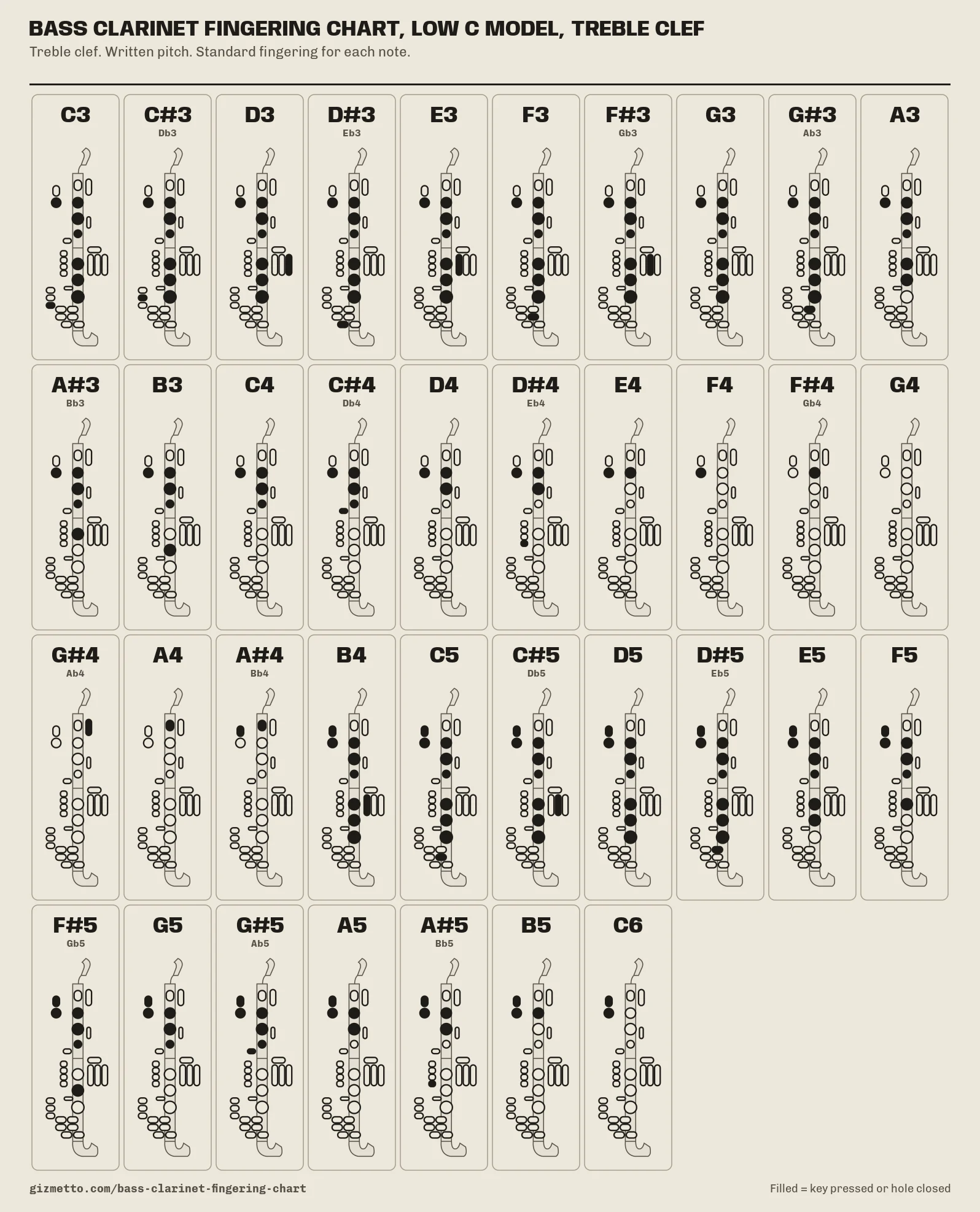
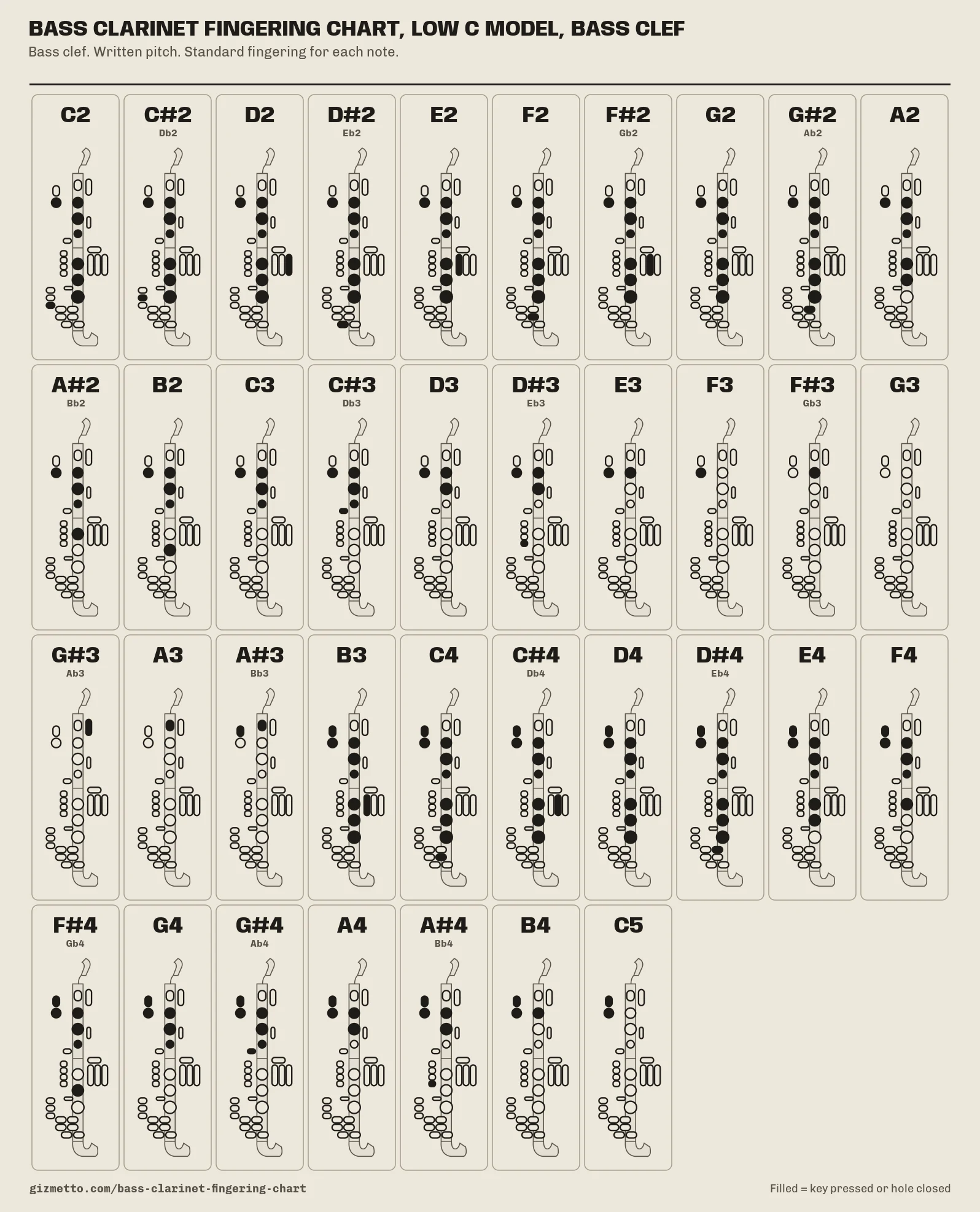
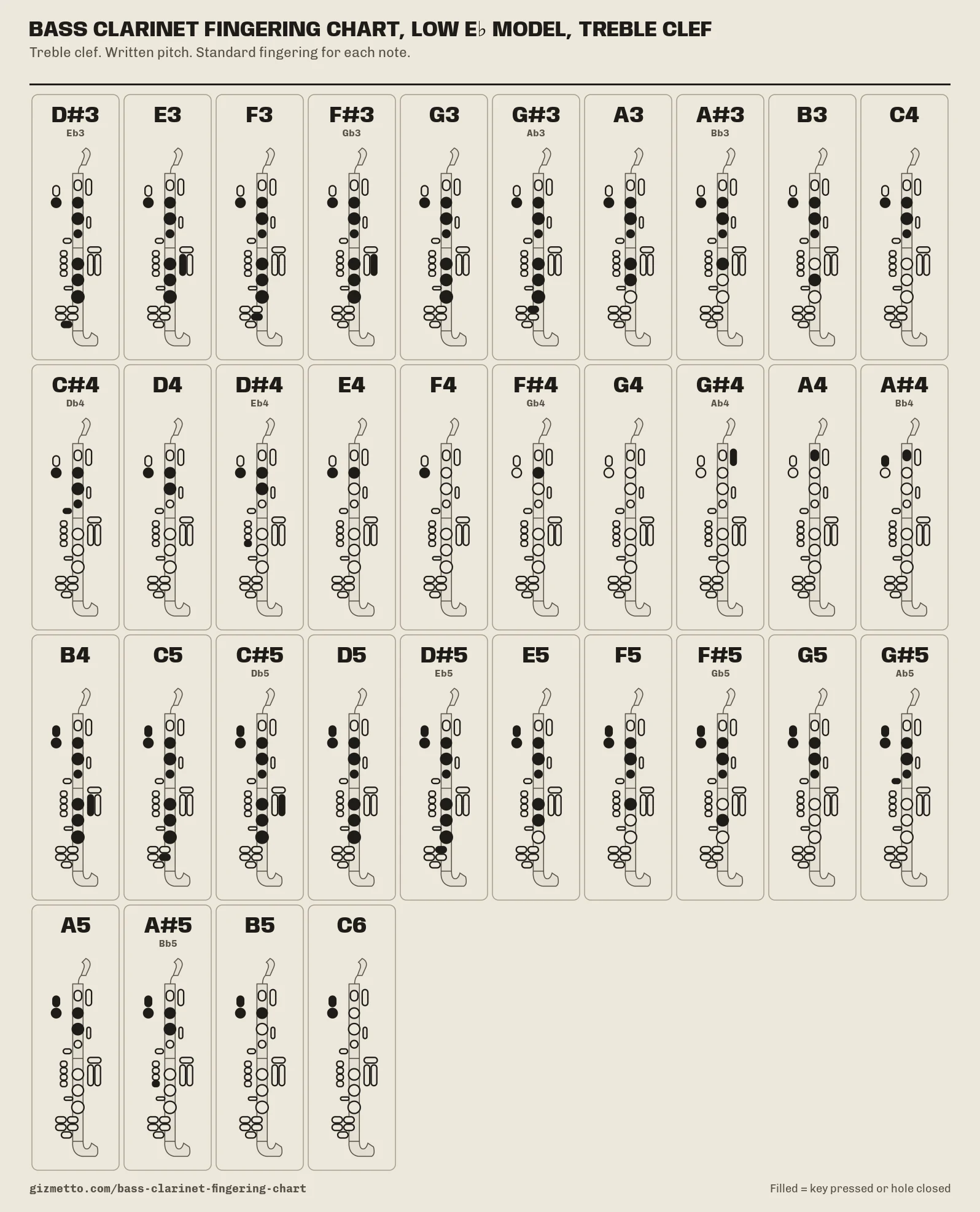
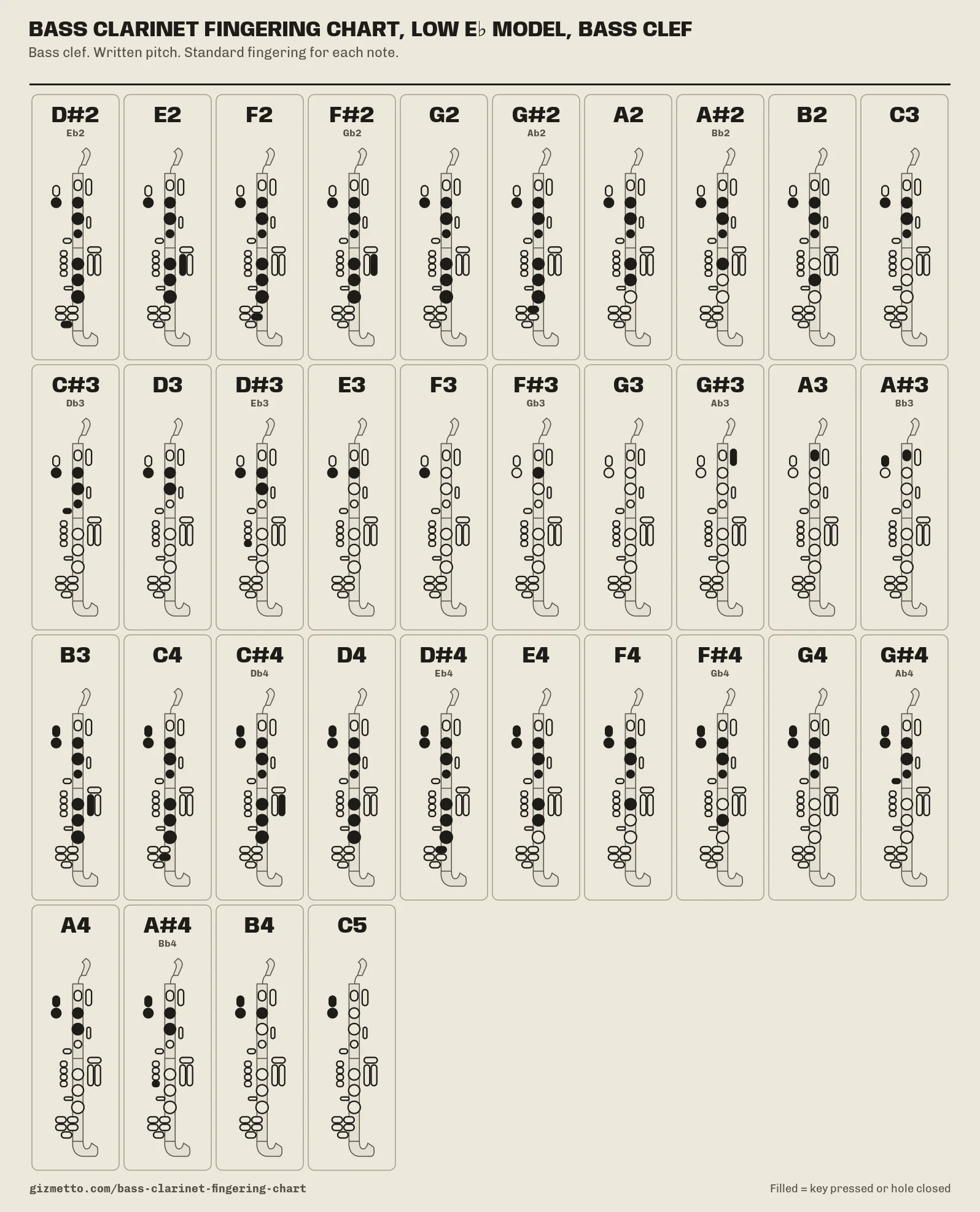
Other charts: Piano notes chart, Guitar notes chart, Violin notes chart, Ukulele chords chart, Piano chords chart, Trumpet fingering chart, Tuba fingering chart, Euphonium fingering chart, Baritone fingering chart, Mellophone fingering chart, French horn fingering chart, Trombone slide position chart, Flute fingering chart, Clarinet fingering chart, Recorder fingering chart, Alto sax fingering chart. All of them are on the music charts page.
FAQ
Is bass clarinet fingering the same as clarinet fingering?
Yes, for almost every note. The bass clarinet uses the same Boehm fingerings as the B♭ clarinet from low E to C6; the Woodwind Fingering Guide states that its soprano clarinet fingerings apply to the low clarinets too. What the bass adds is extra keys for the notes below low E, and a half hole for the left first finger in the altissimo.
Do I have a low E♭ or a low C bass clarinet?
Look at the keys for the right thumb on the back of the lower part of the instrument. A low C model has thumb keys for C♯ and C, and a D key for each little finger, as in Backun's key chart. A low E♭ model stops at written E♭, played with the right little finger. Choose your model at the top of the chart.
Which clef does bass clarinet music use?
Most parts are written in treble clef and sound a major ninth (an octave and a whole step) lower. Some parts are written in bass clef and sound a whole step lower. The chart reads both: pick Treble clef or Bass clef at the top.
Why are the low notes hard to start?
The extension notes close every hole and add a long key, so any small leak stops the note. Check that the pads of the low keys close fully and that the fingers cover the rings well.
How does Check my note work?
Tap Check my note and allow the microphone, then play the note shown. The chart listens for the sounding (concert) note and says in tune (within 10 cents), sharp, flat, or which written note you played instead. Nothing is recorded.
Sources
Every fingering on this page was checked note by note against these published charts on 13 November 2026. Where they differ, the page says so.
- The Woodwind Fingering Guide, chalumeau register fingering chart for Boehm-system alto, bass and contrabass clarinet Written C3 to F4 with the low extension keys. The throat and clarion fingerings are the ones in its basic clarinet chart.
- Backun Musical Services, Low C bass clarinet fingerings The left little finger, right little finger and right thumb keys of a low C bass clarinet and the notes they play.
- Yamaha, Clarinet fingering chart (Musical instrument guide) Soprano clarinet chart, used to check the shared fingerings from E3 to C6.
Related tools
All music chartsUse it as a bass clarinet tuner: play any note and see how many cents off you are.
Hold a steady low reference note while you practise long tones.
Tap a tempo or play a click track to practise with.