Violin Notes Chart
Every note in first position on the G, D, A and E strings, with the finger that plays it. Tap a note to hear it and see it on the staff.
Tap a note to hear it
Scientific pitch: middle C is C4. Frequencies at A4 = 440 Hz, equal temperament.
How to read a violin notes chart
A violin is tuned in fifths: G3, D4, A4 and E5, from the thickest string to the thinnest. The chart shows each string as a column and each finger as a row, from the open string at the nut down to finger 4. Fingers are numbered 1 (index) to 4 (little finger).
Each row is one half step higher than the row above it. Fingers 1, 2 and 3 each have a low and a high place, named as violin teachers name them: low 1 and 1, low 2 and high 2, 3 and high 3 (first position finger chart). All of them are in first position, the hand position nearest the scroll.
- Step 1Tap a noteThe strings run G D A E from left to right, as you see them when you hold the violin. The nut is at the top.
- Step 2Read the screenIt shows the note with its octave, its frequency, the string and finger, and the note on the treble staff.
- Step 3Choose sharps or flatsSwitch the names between sharps (C♯) and flats (D♭). The finger and the sound stay the same.
All violin notes in first position
The note under each finger on each string, with its frequency at A4 = 440 Hz. First position runs from the open G, G3, to B5, finger 4 on the E string.
| Finger | G string | D string | A string | E string |
|---|---|---|---|---|
| Open | G3196.00 Hz | D4293.66 Hz | A4440.00 Hz | E5659.26 Hz |
| Low 1 | G♯3 / A♭3207.65 Hz | D♯4 / E♭4311.13 Hz | A♯4 / B♭4466.16 Hz | F5698.46 Hz |
| 1 | A3220.00 Hz | E4329.63 Hz | B4493.88 Hz | F♯5 / G♭5739.99 Hz |
| Low 2 | A♯3 / B♭3233.08 Hz | F4349.23 Hz | C5523.25 Hz | G5783.99 Hz |
| High 2 | B3246.94 Hz | F♯4 / G♭4369.99 Hz | C♯5 / D♭5554.37 Hz | G♯5 / A♭5830.61 Hz |
| 3 | C4261.63 Hz | G4392.00 Hz | D5587.33 Hz | A5880.00 Hz |
| High 3 | C♯4 / D♭4277.18 Hz | G♯4 / A♭4415.30 Hz | D♯5 / E♭5622.25 Hz | A♯5 / B♭5932.33 Hz |
| 4 | D4293.66 Hz | A4440.00 Hz | E5659.26 Hz | B5987.77 Hz |
Violin notes on the staff
Violin music is written in the treble clef, which puts G4 on the second line, and it sounds as written. The open G string, G3, hangs below two ledger lines under the staff. The D is just below the staff, the A in the second space and the E in the top space.
Tricks to remember the violin notes
- Open strings, low to high: Good Dogs Always Eat (G D A E).
- Finger 4: the same note as the next open string up. Finger 4 on the A string is E.
- Finger 3: C on G, G on D, D on A and A on E. On the first three strings it is the letter just before the next open string.
- Finger 1: A on G, E on D, B on A and F♯ on E. Low 1 on the E string is F.
- The staff: the A string is the second space and the E string the top space, the same spaces as in FACE.
Printable violin notes chart
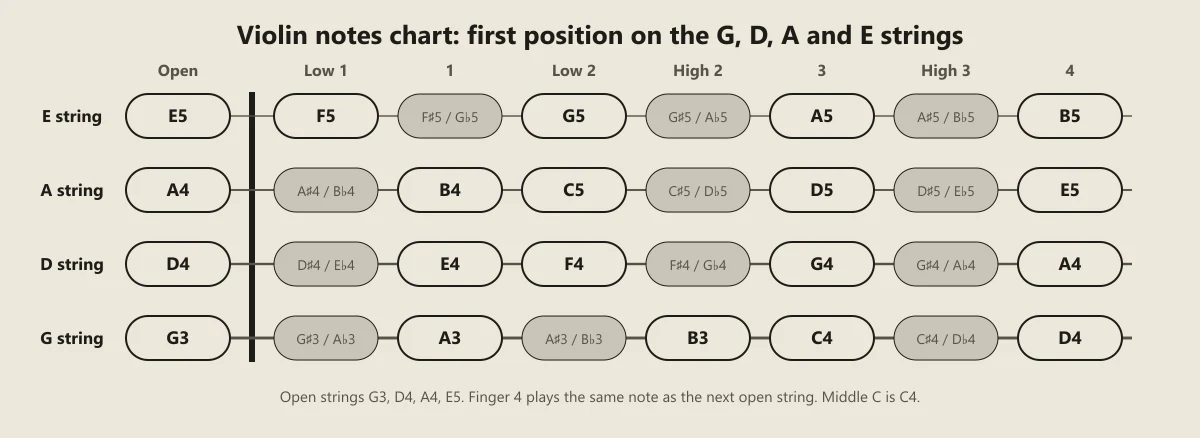
All the first position notes on one page, with the finger names on top. Here the strings run across, with the E string on top, so the whole chart fits a page in landscape. Natural notes are in white and the notes with two names in gray.
FAQ
What are the notes of the violin strings?
G3, D4, A4 and E5, from the lowest string to the highest. At A = 440 Hz they are 196.00 Hz, 293.66 Hz, 440.00 Hz, 659.26 Hz. Players number them from the top: E is string 1 and G is string 4.
What is first position on the violin?
The hand position closest to the scroll, where finger 1 plays one step above each open string and finger 4 reaches the note of the next open string. It covers every note from the open G (G3) to B5, finger 4 on the E string.
What do low 2 and high 2 mean?
Finger 2 has two places in first position. Low 2 sits close to finger 1, a half step above it, such as C on the A string. High 2 sits close to finger 3, a whole step above finger 1, such as C♯ on the A string. Low 1 and high 3 work the same way.
Is finger 4 the same note as the next open string?
Yes. Finger 4 in first position plays a fifth above the open string, which is the note of the next string up: finger 4 on G is D, on D is A and on A is E. On the E string it is B5.
What clef is violin music written in?
The treble clef, and it sounds as written. The open G string hangs below two ledger lines under the staff, the D is just below the staff, the A is in the second space and the E in the top space.
Related tools
All music chartsTune G D A E with your microphone before you play.
Play a note and see if your finger is in tune, in cents.
Play a steady A 440 or any note to tune or practice by ear.
See the same notes on a piano keyboard and the grand staff.
Maintained by NabeelUpdated Nov 13, 2026.