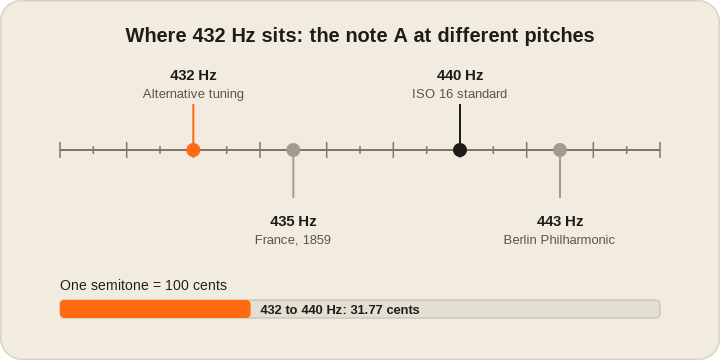
432 Hz and 440 Hz are two tuning pitches for the note A. 440 Hz is the international standard, set in ISO 16. 432 Hz is 31.77 cents lower, about a third of a semitone, so music tuned to it sounds slightly lower and a little darker. Neither is better in an objective sense: it is a matter of taste and of who you play with. The claims that 432 Hz heals, calms or is “in tune with nature” are not supported by good evidence. A few small studies found small differences, and their own authors say larger trials are needed.
Listen to 432 Hz and 440 Hz
Play A (432 Hz) or B (440 Hz), then press the A/B switch to jump between them while the tone keeps playing. 432 Hz is about 31.8 cents below 440 Hz.
Tap A or B to listen
432Hz
432 Hz is about 31.8 cents below 440 Hz.
A pure sine tone from the tone generator. Start with the volume low, then switch back and forth.
The step is just over the 25 cents that, as the section below explains, normal adults can reliably hear, so listen closely as you switch.
How different are 432 Hz and 440 Hz?
The size of a pitch difference is measured in cents. A semitone, the step from one piano key to the next, is 100 cents, and the number of cents between two frequencies is 1200 × log2(f2 / f1) (Cent). For 440 and 432:
1200 × log2(440 / 432) = 31.77 cents.
That is less than a third of the way to the next note down. Middle C moves from 261.63 Hz to 256.87 Hz, and every other note moves by the same ratio.
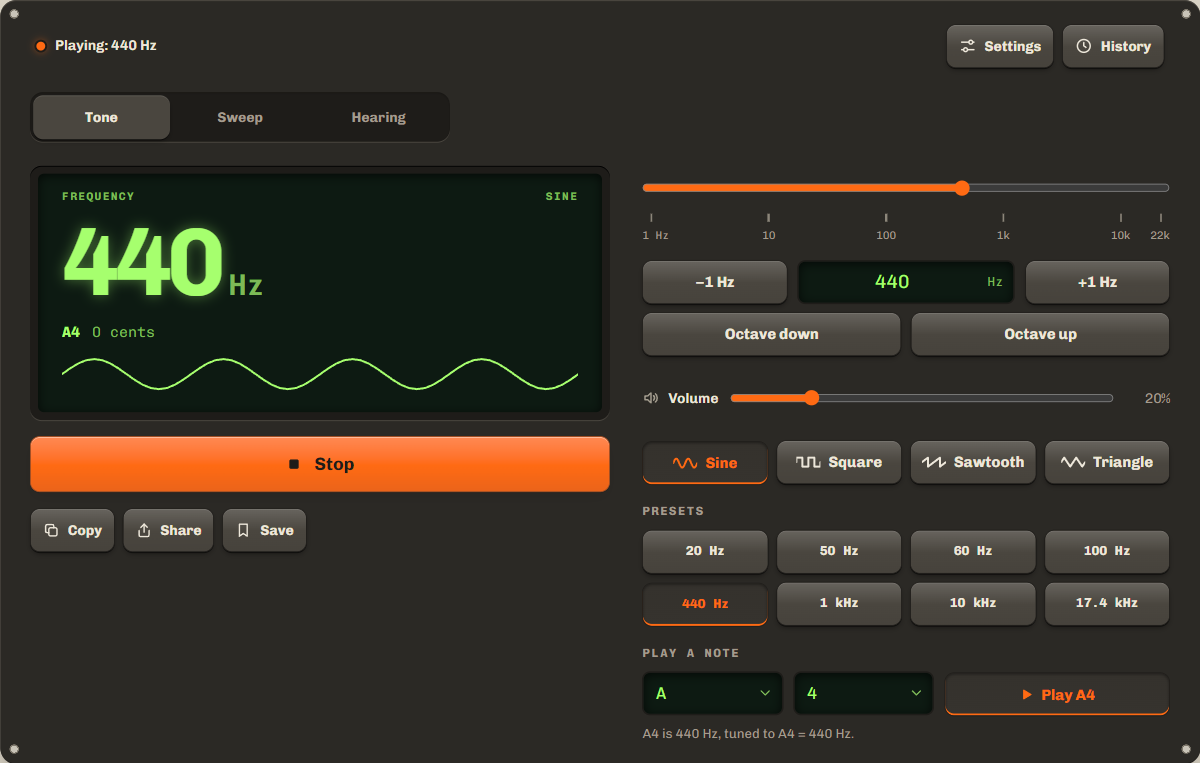
Can you hear it? Side by side, most people can. The same Cent article says normal adults can reliably recognize pitch differences as small as 25 cents. Played alone, without a reference, a song at 432 Hz just sounds like the same song a little lower. Try it with the tone generator: play 440 Hz, then type 432.
Where 440 Hz comes from
Pitch was not always the same. A French law of 16 February 1859 set A at 435 Hz, after singers complained that pitch kept rising (Concert pitch). 440 Hz has a long history too: Johann Heinrich Scheibler recommended it in 1834, and the American music industry used it informally from 1926 (A440).
In May 1939, delegates from France, Germany, the Netherlands, Italy and England met at the BBC in London and agreed on A = 440 Hz. ISO adopted it as Recommendation R 16 in 1955 and made it the standard ISO 16 in 1975.
Even now, not every orchestra uses exactly 440. The Berlin Philharmonic uses 443 Hz, and a 1987 New York Times survey found most symphony and opera orchestras between 440 and 444 Hz (Concert pitch). So “440 Hz” is the reference, not a rule every musician follows.
Where 432 Hz comes from
The Concert pitch article says that since the early 2000s, many websites and videos have argued for 432 Hz, often under the name “Verdi pitch”. It describes the arguments as including conspiracy theories, “specious claims of healing properties”, and the claim that the Nazis favored 440 Hz.
The history above answers the last claim: 440 Hz was recommended in 1834, used in the USA from 1926, and agreed by delegates from several countries, including England and France, in 1939. ISO made it a standard in 1975.
The name “Verdi pitch” also has a twist. The Schiller Institute promoted it, citing Verdi’s proposal to lower the French standard slightly. Its A = 432 Hz is based on a C of 256 Hz with a Pythagorean ratio, not on equal temperament. The same article says this promotion was unsuccessful.
Does 432 Hz music have health benefits?
There is no good evidence that it does. Here is what the studies we found say:
- A 2019 pilot study. Calamassi and Pomponi played the same film music at 440 Hz and at 432 Hz to 33 healthy volunteers, on different days, without them knowing which was which. At 432 Hz, mean heart rate was 4.79 beats a minute lower, with p = 0.05, right at the usual limit of statistical significance. The small drop in blood pressure was not statistically significant. The authors call for larger samples and randomized controlled trials (Explore, 2019).
- A 2025 randomized cross-over trial. Hohneck and colleagues gave 43 cancer patients a 15 minute sound session at 432 Hz and one at 443 Hz. Heart rate fell with both, a little more at 432 Hz (a median of 3 beats a minute against 1). Mood improved with both, with no significant difference between them. Their conclusion: a greater influence on heart rate and blood pressure “was observed with 432 Hz, but not significantly different compared to 443 Hz” (BMC Complementary Medicine and Therapies, 2025).
The same 2025 paper says the claimed natural effects of 432 Hz are based on “historical and philosophical interpretations and not on empirical data”, and that more extensive randomized controlled trials are needed.
What this means in practice: listening to calm music you like can feel relaxing at either pitch. The studies so far are small, and a difference of a few heartbeats a minute in a small group is not evidence that 432 Hz heals anything. If you have a health problem, see a doctor; do not rely on the tuning of a song.
Should you tune to 432 Hz?
It depends on what you play and who you play with.
- Alone, for your own taste: go ahead. Some musicians prefer the slightly lower sound.
- With others or with recordings: use the pitch the others use, usually 440 Hz, the standard. At 432 Hz you will be 31.77 cents flat against anyone at 440 Hz, more than the 25 cents most adults can hear.
- To change a tuner: set the A4 reference to 432 Hz, then tune as normal. The guitar tuner and ukulele tuner offer 432, 440 and 442 Hz in their settings.
You can compare the two any time with the tone generator. Keep the volume low.