A dollar bill’s serial number can make it interesting to collectors when its 8 digits form a pattern that is rare or easy to remember: a solid such as 77777777, a ladder such as 12345678, a radar that reads the same backwards, a repeater, a very low number such as 00000042, or a star in place of the last letter. Most serial numbers have no such pattern. Even for a fancy one, the price is set by collectors and dealers, and the bill’s condition matters as much as the number. This guide explains the patterns and how to check what similar notes really sold for. It does not give prices, because nobody can price a bill fairly without seeing it.
How to read the serial number
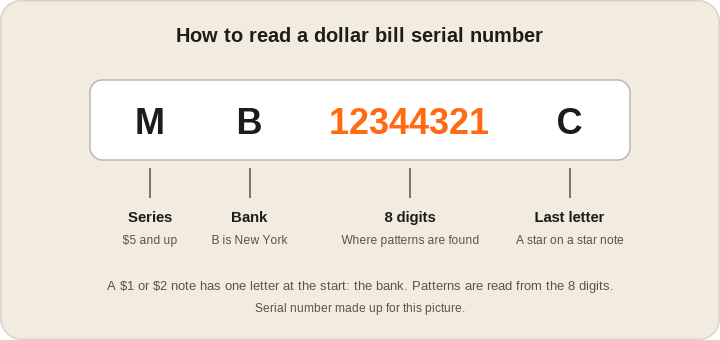
Every US banknote has its own serial number, printed twice on the front. The Bureau of Engraving and Printing describes the format:
- $1 and $2 notes, and notes before Series 1996: one letter, 8 digits and one letter, such as A12345678B. The first letter is the Federal Reserve Bank, A to L.
- $5 and higher, from Series 1996: two letters, 8 digits and one letter. The first letter is the series and the second is the bank.
- The last letter can be any letter except O and Z. The Bureau keeps Z for test printings.
- A star note has a star in place of the last letter.
The patterns collectors look for
Collectors call bills with a pattern in the serial number “fancy serial numbers”. These are the common names. A number can match more than one.
- Solid: all 8 digits the same, such as 33333333. A solid is one of the hardest patterns to find, because only 10 of the 100 million possible 8 digit numbers are solids.
- Near solid: 7 of the 8 digits the same, such as 55555255.
- Ladder: the digits count up or down by one all the way, such as 12345678 or 87654321. Only a handful of true ladders exist in 8 digits.
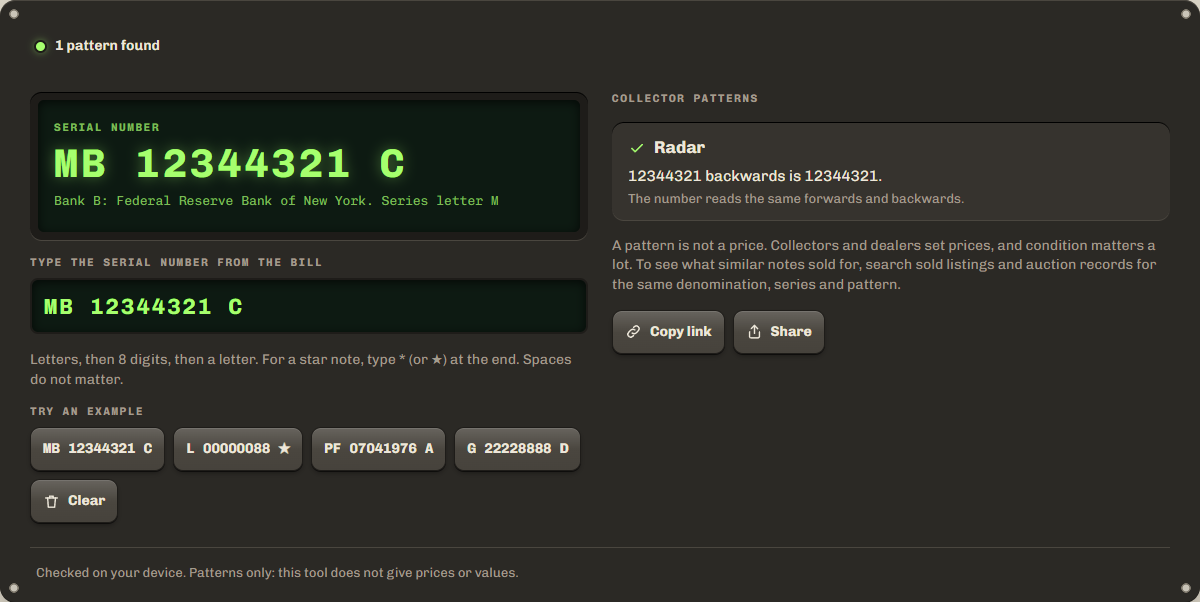
- Radar: the number reads the same forwards and backwards, such as 12344321. A super radar has the same digit in all 6 middle places, such as 90000009.
- Repeater: the first 4 digits repeat as the last 4, such as 12341234. A super repeater repeats 2 digits 4 times, such as 35353535.
- Double quads: four of one digit then four of another, such as 22228888.
- Binary: only the digits 0 and 1, such as 10110001.
- Rotator: reads the same when you turn the bill upside down, using only 0, 1, 6, 8 and 9, such as 16988691.
- Low serial: a number with many leading zeros, such as 00000042. The lower, the fewer exist.
- High serial: a number near the top of the range, such as 99997310.
- Date or birthday note: the digits read as a date, such as 07041976 for July 4, 1976. These matter mostly to the person whose date it is.
- Star note: a replacement note with a star at the end of the serial number.
The fancy serial number checker tests a serial number for all of these at once and explains each match.
Why rarity is a matter of counting
The reason a solid is rarer than a radar is simple arithmetic, not opinion. In 8 digits there are 100 million possible numbers. Only 10 are solids (00000000 to 99999999 with one digit). Radars are any number whose last 4 digits mirror the first 4, so there are 10,000 of them. Repeaters, where the last 4 digits copy the first 4, also number 10,000. So among all 8 digit numbers, a radar or a repeater is about a thousand times more common than a solid. That is why collectors treat these patterns differently.
Low numbers work the same way. Only 99 of the 100 million possible numbers run from 00000001 to 00000099.
Star notes
When a printed sheet has a flaw, it is replaced. The Bureau explains that printing the same serial numbers again would be costly and time consuming, so the replacement sheet gets its own serial numbers with a star in place of the suffix letter (BEP). A star note is a normal bill you can spend.
There are fewer star notes than regular notes, but how few depends on the print run. Some runs of star notes are small and some are large. A star alone does not make a bill special. Collectors care most about star notes from small runs, star notes in top condition, and star notes that also have a fancy pattern.
Condition matters as much as the number
Two bills with the same fancy number can be worth very different amounts to a collector. A crisp bill that was never folded or handled is a different item from one that was folded in a wallet for years. Folds, stains, tears, writing and fading all count against a bill.
If you find a bill you might want to sell:
- Do not fold it again, and do not try to clean, iron or flatten it.
- Keep it flat in a paper sleeve or a currency holder, away from light and damp.
- Handle it by the edges with clean, dry hands.
For notes that may be worth having checked, currency dealers offer professional grading, which records the condition and seals the bill in a holder.
How to check what similar notes sold for
We do not give values, and be careful with any site that prices a bill from a serial number alone. Instead, look at what real buyers paid for notes like yours:
- Note the details: denomination, series year (printed on the front), the full serial number, whether it is a star note, and the pattern.
- Search sold listings, not asking prices. On auction and marketplace sites, filter to sold or completed listings. An asking price is only a wish; a sale is evidence.
- Search auction archives. Large currency auction houses keep records of past sales that you can search by pattern and series.
- Compare like with like: the same denomination, a close series and a similar condition. A sale of a crisp bill tells you little about a worn one.
- Ask a dealer if you believe you have something special. They can see the bill itself, which no website can.
Quick answers
Is my bill worth more than face value? Most bills, fancy or not, are worth their face value in a shop. A collector may pay more for a rare pattern in good condition. Check sold listings to see.
Are old bills always valuable? No. Age alone does not make a bill rare. Condition, series and the serial number all play a part.
Can I still spend a fancy bill? Yes. Every Federal Reserve note is legal tender, whatever its serial number.