Normal conversation is about 60 decibels (dB), a hair dryer 100 dB, standing near a siren 120 dB, a jackhammer 130 dB and an airplane taking off 140 dB, according to the World Health Organization. Sound becomes a risk to your hearing well before it hurts: NIOSH sets its limit at 85 dBA averaged over an 8 hour day, and for each 3 dB more, the safe time halves. The chart and the table below list common sounds, with the source of every number.
Each level page lists real sounds at that level, the sounds just above and below it, and how long it is safe.
Decibel chart of common sounds
Embed this chart on your site
Copy this code. The chart links back here, so your readers can try the tool.
Every level in the chart comes from one of three public health sources: the WHO guide to safe listening, the NIDCD page on noise-induced hearing loss (part of the U.S. National Institutes of Health) and the NIOSH page on noise-induced hearing loss (part of the CDC). Where a source gives a range, such as 74 to 104 dBA for a movie theater, the chart shows the whole range.
| Sound | Level | Source |
|---|---|---|
| Normal breathing | 10 dB | WHO |
| Soft whispering | 30 dB | WHO |
| Library | 40 dB | WHO |
| Normal conversation | 60 dB | WHO |
| Movie theater | 74 to 104 dBA | NIDCD |
| Doorbell | 80 dB | WHO |
| Heavy traffic, inside a car | 85 dB | WHO |
| Lawn mower, vacuum, power tools | 85 to 90 dBA | NIOSH |
| Shouted conversation | 90 dB | WHO |
| Max-volume headphones, concerts | 94 to 110 dBA | NIDCD |
| Motorcycle | 95 dB | WHO |
| Chain saw, bulldozer, nightclub | 95 dBA or more | NIOSH |
| Hair dryer | 100 dB | WHO |
| Car horn at 5 meters | 105 dB | WHO |
| Shouting in the ear | 110 dB | WHO |
| Sirens | 110 to 129 dBA | NIDCD |
| Standing near a siren | 120 dB | WHO |
| Jackhammer | 130 dB | WHO |
| Airplane taking off | 140 dB | WHO |
| Fireworks show | 140 to 160 dBA | NIDCD |
| Firecrackers | 150 dB | WHO |
Two notes on the units. WHO gives plain dB, while NIDCD and NIOSH give dBA. The “A” means A-weighting: the measurement counts low and very high frequencies less, the way the ear hears them. Hearing limits use dBA. For most everyday sounds the two numbers are close, but sounds with a lot of bass read lower in dBA.
Second, a sound’s level depends on how far away you are. WHO’s car horn is measured at 5 meters. Closer, it is louder.
How the decibel scale works
Decibels are not a straight scale. NIOSH explains that decibels are logarithmic: “a sound that is 10 dB louder than another is ten times more intense”. So 70 dB is ten times the intensity of 60 dB, and 80 dB is a hundred times the intensity of 60 dB. This is why a few decibels matter so much at the loud end of the chart.
How loud is 60 decibels?
60 dB is the level of normal conversation on the WHO list. NIDCD gives a range of 60 to 70 dBA for normal conversation. It is a comfortable, everyday level.
60 dB is safe for your hearing. NIDCD says sounds at or below 70 dBA are unlikely to cause hearing loss, even after long exposure. WHO says sound levels below 80 dB are unlikely to cause hearing damage. For more sounds at this level, see how loud is 60 dB.
How loud is 50 decibels?
WHO’s list has no sound at exactly 50 dB. It sits between a library (40 dB) and normal conversation (60 dB). Because each 10 dB is ten times the intensity, 50 dB has one tenth of the sound intensity of a 60 dB conversation. It is far below any level that harms hearing.
How loud is 120 decibels?
120 dB is standing near a siren on the WHO list. NIDCD gives sirens a range of 110 to 129 dBA. At this level, the time to harm is very short. On the NIOSH scale, 120 dBA is safe for only 9 seconds a day.
How loud is 130 decibels?
130 dB is a jackhammer on the WHO list. On the NIOSH scale, the safe time from 130 dBA up is less than 1 second a day.
How loud is a jet engine?
WHO lists an airplane taking off at 140 dB. That is the level NIOSH says no exposure should ever exceed: in its criteria for occupational noise exposure, NIOSH sets a ceiling of 140 dBA for continuous, varying, intermittent or impulsive noise. The level you hear depends on how far you are from the plane, so treat 140 dB as the level close to it.
Fireworks are in the same range. NIDCD gives 140 to 160 dBA for a fireworks show, and WHO lists firecrackers at 150 dB.
Safe exposure times: the NIOSH 85 dBA rule
NIOSH sets a recommended exposure limit (REL) of 85 dBA, averaged over an 8 hour workday. For each 3 dBA increase in noise level, NIOSH recommends cutting the time in half. This is the 3 dB exchange rate. NIOSH also gives a simple check without a meter: at 85 dBA you often have to raise your voice to be heard by someone 3 feet (1 meter) away, and at 95 dBA you likely have to shout.
The table gives the NIOSH time limit per day at each level. It uses the formula from Table 1-1 of the NIOSH criteria document: 480 minutes divided by 2 to the power of (level minus 85) divided by 3.
| Average level | Time limit per day |
|---|---|
| 85 dBA | 8 hours |
| 88 dBA | 4 hours |
| 91 dBA | 2 hours |
| 94 dBA | 1 hour |
| 97 dBA | 30 minutes |
| 100 dBA | 15 minutes |
| 103 dBA | 7 minutes 30 seconds |
| 106 dBA | 3 minutes 45 seconds |
| 109 dBA | 1 minute 53 seconds |
| 112 dBA | 56 seconds |
| 115 dBA | 28 seconds |
The limit counts all noise in the day together. One hour at 94 dBA uses the whole day’s allowance, the same as 8 hours at 85 dBA.
NIOSH chose these numbers on evidence. In the same document, NIOSH puts the excess risk of work-related hearing loss after 40 years at 85 dBA at 8%, against 25% at 90 dBA. It also notes that OSHA, the U.S. workplace regulator, used a 90 dBA limit with a 5 dB exchange rate, and that NIOSH recommends the 3 dB rate because the science supports it more firmly. The NIOSH limit is the safer of the two.
Safe listening for music and headphones
WHO gives a weekly guide for listening. You can safely listen at 80 dB for up to 40 hours a week. At 90 dB, the safe time drops to 4 hours a week. NIDCD puts music through headphones at maximum volume, sporting events and concerts at 94 to 110 dBA.
What this means in practice:
- Turning the volume down by 10 dB, from 90 to 80 dB, takes the WHO safe time from 4 hours to 40 hours a week.
- The louder the sound, the shorter the time it takes to harm hearing, as NIDCD puts it. A short time at a very loud level can use up a whole day’s limit.
- NIOSH lists lawn mowers, vacuums and power tools at around 85 to 90 dBA. For workers at 85 dBA or more, NIOSH recommends a hearing loss prevention program that includes the proper use of hearing protectors.
How to measure the sound around you
Fans and other appliances are often rated in sones instead of decibels. The sones to dB converter turns a sone rating into an approximate level in dB.
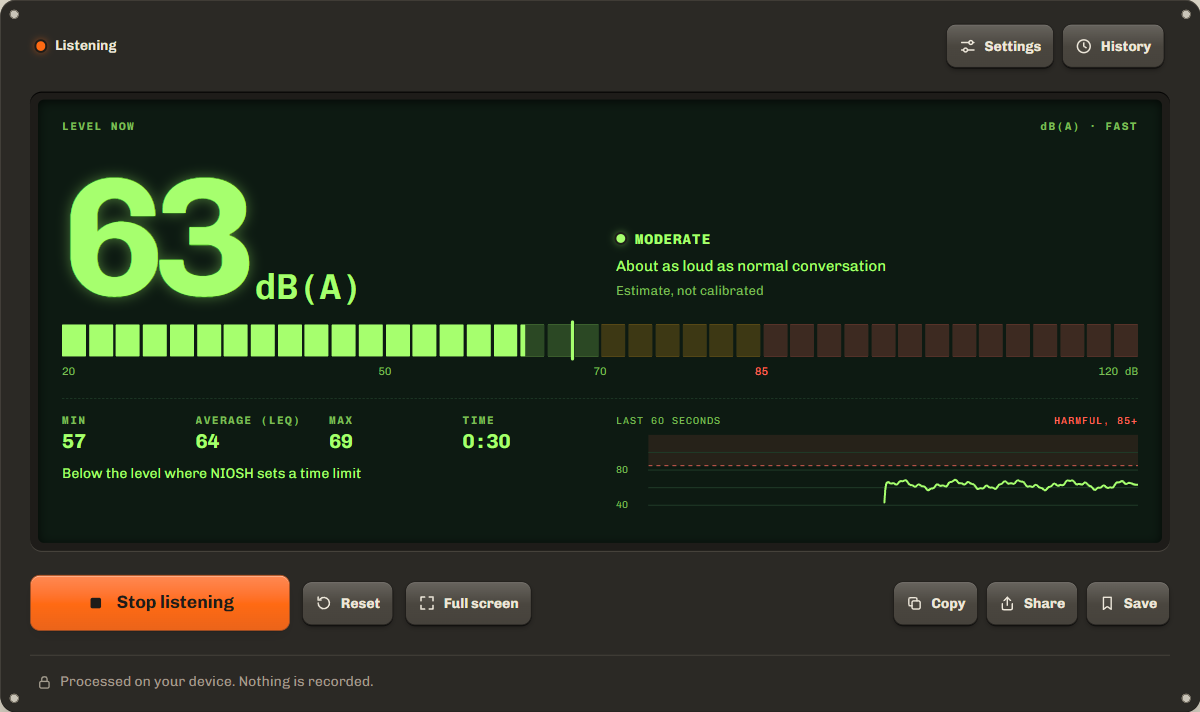
You can check a level yourself with the online decibel meter. It uses your phone or laptop microphone, shows dB(A), and gives the NIOSH time limit for your average level. A phone gives an estimate, not a certified reading, because microphones differ. For workplace noise, use a sound level meter.
FAQ
Can a sound be 440 dB?
No, not in air. A sound wave is a swing of air pressure above and below normal atmospheric pressure, and the pressure cannot swing lower than a vacuum. In air at sea level, the largest undistorted sound wave swings between a vacuum and twice normal pressure, and that is about 194 dB. Guinness World Records lists 194 dB as the loudest possible sustained sound in air, and says any event louder than 194 dB is considered a shock wave.
You can check the number: decibels of sound pressure compare a pressure with 20 micropascals, so one atmosphere (101,325 pascals) is 20 × log10(101,325 ÷ 0.00002), or about 194 dB. A 440 dB sound would need a pressure swing of about 2 × 10¹⁷ pascals, about two trillion times normal air pressure. Air at sea level cannot carry a sound wave anywhere near that.
What is the loudest sound on this chart?
Fireworks: NIDCD gives a fireworks show 140 to 160 dBA, and WHO lists firecrackers at 150 dB. NIOSH says no exposure should ever go above 140 dBA.